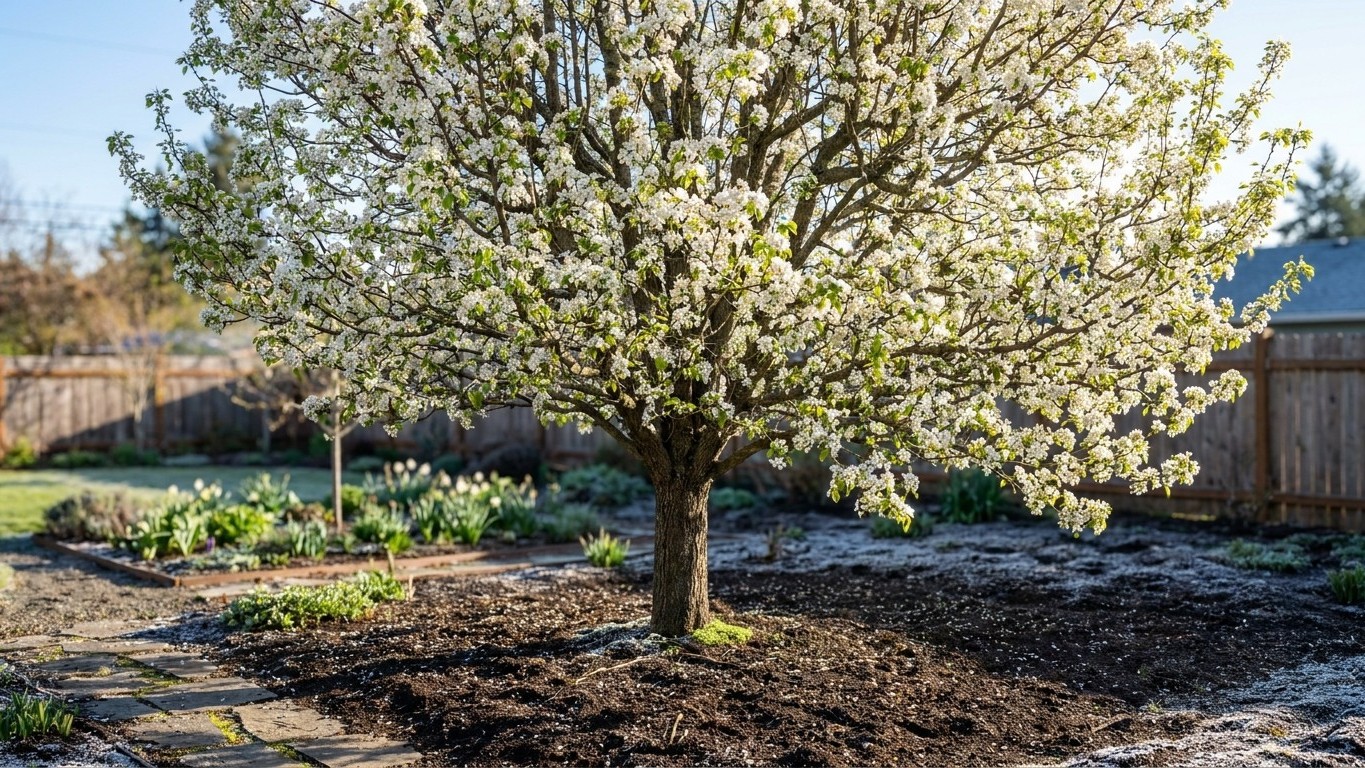

Pyrus communis, the common pear, survives across USDA hardiness zones 4a-8b, needs full sun and well-drained soil to fruit reliably, and takes up 12 to 24 feet at maturity. It blooms in spring, which puts it at frost risk in some years, and this species does not resolve the two biggest unknowns for a new grower: whether it needs a pollination partner and how many years it takes to bear.
Where it will and will not survive
USDA hardiness zones 4a-8b is the range for Pyrus communis. That is a wide band for a fruit tree, but it still has edges, and the edges matter more than the middle. Below 4a, this tree is not rated to survive winter. Above 8b, the same is true in the other direction. Neither edge is a judgment call; it is what the hardiness rating means.
A range like this describes survival, not comfort. A pear rated to the warm end of 8b will likely live there, but living and thriving are not the same claim. Winter chill, summer heat stress, and the length of the dormant season all shift how well a tree performs inside a zone where it technically survives. The zone number tells you whether the tree will make it through winter, not whether it will crop well or resist stress that shortens its life by decades instead of ending it in one hard freeze.
Matching this range to an actual planting site means knowing your own zone first, and guessing is a common way this goes wrong. Zone maps shift by elevation, proximity to water, and microclimate within a single county, so a zone number pulled from memory is not reliable enough for a tree that will occupy the same spot for decades. This site’s hardiness zone guide breaks zones down by state, and that is the better starting point than assuming your area falls somewhere inside 4a-8b because it sounds about right.
What it is called, and why that matters here
The North Carolina Extension Gardener Plant Toolbox lists three common names for this species: Common Pear, European Pear, and Pear. They are given alphabetically, and none is flagged as preferred. That is normal for these databases, but it leaves a gap a reader has to fill in, which is why this page is titled by the botanical name rather than any one of the three.
The plainest name on that list, “Pear,” is also the least useful on its own. Pyrus communis is one species inside a genus that includes other pears grown in home landscapes and orchards, some different enough that calling all of them simply “pear” invites mix-ups at a nursery. “Common Pear” and “European Pear” narrow things down, but a shopper working from a label that just says “pear” has no guarantee they are getting Pyrus communis rather than a different pear species entirely.
None of that makes any of the three names wrong. It means the common names describe a plant people already recognize, while the botanical name is the only one that reliably points to this exact species. When buying a tree, checking for Pyrus communis on the tag is the more reliable habit, since the common names in circulation are not standardized the way the botanical name is.
The site it needs to actually crop
The growing conditions the source lists are broad on soil and narrow on light, which is the pattern worth noting for a fruiting tree. A tree can survive in less light than it wants and simply produce little fruit; it rarely survives in soil far outside what it tolerates. That distinction is the one to carry into site selection.
| Condition | What the source states | Mostly about |
|---|---|---|
| Light | Full sun, 6 or more hours of direct sunlight a day | Cropping |
| Soil texture | Clay, Loam (Silt), Sand | Survival |
| Soil pH | Neutral, 6.0-8.0 | Survival |
| Drainage | Good drainage, occasionally dry | Survival |
| Space at maturity | 12 to 24 feet | Both |
Full sun is listed as a requirement, not a tolerance, and for a fruiting species that reads as a cropping condition: a tree in partial shade is more likely to persist without ever setting much fruit than to fail outright. The soil texture range, by contrast, covers clay, loam, and sand, about as wide a tolerance as a soil listing gets, pointing to survival across a range of yards rather than a preference tied to fruit output. The source does not say which soil types produce the best crop, only which ones the tree tolerates.
Space at maturity, 12 to 24 feet, is the figure most likely to get skipped when a tree looks small at a nursery. A pear reaching even the low end of that spread needs real clearance from a house wall, fence line, or neighboring tree, both for root space and for the pruning and picking access a fruiting tree demands over its life. The source also describes the habit as erect and spreading, meaning the canopy widens as it matures, and a tree planted ten feet from a structure with a mature spread of 24 feet will eventually need hard pruning or lose limbs to conflict with it, either way undercutting the harvest that was the reason for planting it.
When it crops, and whether it needs a partner
Bloom time for Pyrus communis is spring, and that single word carries more weight than it looks like. Spring bloom shifts earlier or later depending on latitude and elevation, but wherever it falls locally, an early-blooming fruit tree is the one a late frost catches. A hard freeze after the flowers open can wipe out that year’s crop even on a tree that is otherwise healthy and well sited, a separate risk from winter hardiness that spring bloom timing puts front and center for this species.
What this page cannot tell you, because the source data does not include it, is whether a given pear needs a second, compatible tree nearby to set fruit at all, or how many years after planting it typically takes to bear a first crop. Both questions matter enormously for a tree that occupies 12 to 24 feet of yard for decades. Many fruiting species, including pears in general, commonly need a compatible pollinator planted within range, while some set at least a partial crop alone; and time to first bearing can run from a few years to considerably longer depending on the selection and rootstock. Guessing at either from the fact that this is a pear, or from what a related fruit tree does, is not reliable, since self-fertility and bearing age vary by selection even within a single genus.
The practical move is to ask a nursery or supplier two direct questions before buying: does this tree need a pollination partner, and roughly how many years until it produces fruit. Getting a straight answer to both is worth more than any assumption based on the species name alone, and it avoids the scenario where a single tree goes into the ground and a grower waits years for a crop that was never going to arrive without a second tree nearby.
What the fruit is, and what it is for
The source describes the fruit of Pyrus communis as variable in size, shape, and color, with the teardrop shape being the most commonly known form. That variability is worth taking at face value: pears within this species range widely in appearance, and the familiar teardrop silhouette is a common outcome rather than a fixed rule.
On edibility, the source states plainly that the fruit is edible raw, cooked, or dried, and describes it as sweet and fragrant. That covers the range of how this fruit is typically eaten: straight off the tree once ripe, cooked down for sauces and baking, or dried for longer storage. A sweet, fragrant pear eaten raw is the classic use, with a soft, juicy texture at full ripeness suited both to eating out of hand and to slicing into a baked dish, while drying suits fruit meant to be kept rather than eaten fresh. The sweetness and fragrance are the source’s own description, not an outside claim, and nothing here extends that into a nutrition or health claim, since the source does not make one.
What it resists, and what it does not
Resistance, in a plant listing, means a tendency to shrug off a particular stress more often than not. It is not immunity, and a tree described as resistant to something can still be affected by it, particularly when young, drought-stressed, or newly transplanted. That distinction matters before reading any resistance claim as a guarantee.
The data behind this page does not carry a specific resistance list for Pyrus communis, the way it does for hardiness, light, or soil. Rather than naming pests or conditions this species is commonly said to tolerate, which would go beyond what the source states, the honest answer is that this gap is unfilled here.
What can be said plainly is a separate and often overlooked point for any fruiting tree: a general resistance rating, where one exists, typically speaks to the health of the tree itself, its leaves, bark, and structure, not to the pests and diseases that go after the fruit specifically. Codling moth, fire blight, and fruit-specific fungal issues are common concerns for pears in general orchard literature, but none of those are part of the facts behind this page, and naming them here would be reaching past what this source supports. That is a gap for a prospective grower to close with a local extension office or a nursery familiar with pear culture in their area, rather than something this page can answer.
Common questions
Does Pyrus communis need a second tree to produce fruit?
This page’s source data does not say. Pollination needs vary by specific selection even within this species, so that question needs to go to whoever is selling the tree before buying.
How many years before a pear tree bears fruit?
No figure for this is included in the data behind this page. Years to first bearing varies with the specific selection and rootstock, and that is a second question worth asking a supplier directly.
Is Pyrus communis the same as an Asian pear?
No. Asian pears belong to a different species within the same genus. The common names listed for Pyrus communis, Common Pear, European Pear, and Pear, do not distinguish it from other pear species on a plant tag, which is why checking for the botanical name is the more reliable way to confirm what is being sold.
Will a pear tree survive in zone 3 or zone 9?
Not according to the USDA range given for this species, which runs 4a-8b. A zone colder than 4a or warmer than 8b falls outside the rated range, and confirming your own zone against a state-level guide is the first step before planting.