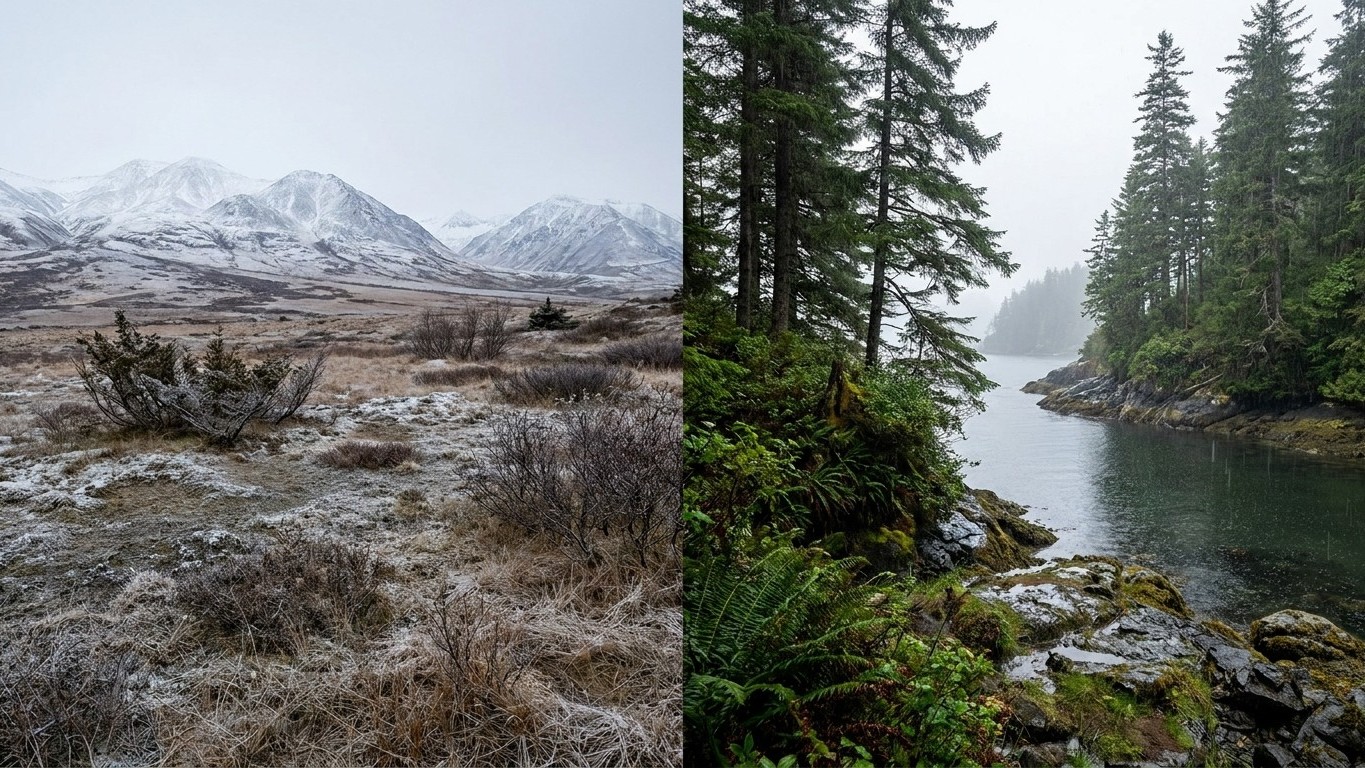

None of the trees, shrubs, and perennials tracked on this site fail to survive anywhere in Arizona, the state’s official hardiness range runs from 4b to 10b, too wide for any of the 65 species checked to be shut out completely. But every one of them is hardy in only part of that range, which means the real risk in an Arizona yard isn’t a plant that can’t grow here. It’s a plant picked for the wrong end of the state.
What Will Not Survive a winter in Arizona
Arizona’s hardiness range, 4b through 10b on the USDA Plant Hardiness Zone Map (2023 update, based on 1991-2020 minimum-temperature normals), is one of the widest of any state on this site. That width comes from elevation, not latitude: high country around Flagstaff sits near the cold end of the national scale, while the low desert around Phoenix sits near the warm end. A single state rarely spans that much ground.
To land in a genuine “won’t survive anywhere in Arizona” bucket, a species would need to fail at both extremes at once, too tender for the cold snaps that reach 4b and, separately, unable to handle whatever cuts a plant off at 10b. Crossed against the 65 landscape plants this site documents, against North Carolina Extension’s hardiness data, not one does that. Zero are excluded from the entire 4b-10b range.
That is not the same as saying all 65 thrive statewide. Zero are hardy across the whole range either. Every species checked has a home somewhere inside Arizona’s zones and a zone or two, sometimes several, where it does not belong. The next section breaks down where those lines fall.
One distinction matters before moving on: “hardy” on a USDA map means the plant will survive a typical winter minimum for that zone, not that it will look good doing it. The warm end of a species’ range, 9a through 10b here, is frequently a heat ceiling rather than a cold floor. A plant rated hardy through 10b can still sit through a Phoenix summer sulking, scorched, or dropping leaves it would keep in a milder zone. Survival and comfort are two different questions, and this crossing only answers the first one.
The plants that work in part of the state and not the rest
This is where an Arizona-specific answer actually diverges from a generic one. Among the 49 trees, shrubs, and perennials this site documents (setting aside the 16 fruiting species also in the dataset), not one fails only in Arizona’s coldest zones. The failures split into two patterns instead: plants shut out of the state’s warmest zones only, and a smaller group shut out at both ends.
Thirty-nine of the 49 fail only in the warm zones, generally 9a through 10b, the low-desert stretch. Ten fail at both the cold zones (4b, and in a few cases 5a-5b) and the warm zones, leaving them a workable middle band. No tree, shrub, or perennial in this dataset is excluded from Arizona’s cold zones alone.
Examples from each pattern
| Plant | Works in Arizona’s zones | Excluded from |
|---|---|---|
| Quercus alba (white oak) | 4b-9b | 10a, 10b |
| Acer rubrum (red maple) | 4b-9b | 10a, 10b |
| Viburnum dentatum | 4b-8b | 9a, 9b, 10a, 10b |
| Echinacea purpurea (coneflower) | 4b-8b | 9a, 9b, 10a, 10b |
| Magnolia grandiflora | 6a-9b | 4b, 5a, 5b, 10a, 10b |
| Cornus florida (flowering dogwood) | 5a-9b | 4b, 10a, 10b |
| Buxus sempervirens (boxwood) | 5a-8b | 4b, 9a, 9b, 10a, 10b |
| Lavandula angustifolia (English lavender) | 5a-9b | 4b, 10a, 10b |
Notice what that table is not saying. It is not saying white oak “grows in Arizona” or “doesn’t grow in Arizona.” It grows through 9b and stops at 10a, so the answer depends entirely on which zone a given yard sits in. A reader outside Flagstaff and a reader outside Yuma are reading two different verdicts off the same row.
Finding which zone applies to a specific address is the missing piece here, and this page can’t supply it because the range itself spans 4b to 10b. This site’s insulation page for Arizona carries the county-level zone picture, which is the fastest way to convert “somewhere in 4b-10b” into an actual number for a specific property.
The soil and the summer they will be planted into
USDA’s NRCS lists the Casa Grande series as representative of Arizona. It’s an Aridisol, the classification for dry-climate soils, and it reads exactly like what a low-desert gardener would expect: surface pH around 8.5 (distinctly alkaline), 64 percent sand, 14 percent clay, 22 percent silt, and organic matter around 0.8 percent. It’s also well drained, which is the one detail that matters most for a newly planted tree or shrub.
Winter wet, not winter cold, kills more woody perennials than anything else, because roots sitting in saturated soil suffocate and rot regardless of air temperature. A well-drained, sandy surface like Casa Grande sharply reduces that risk. The tradeoff is the alkaline pH: plants that prefer acidic conditions can struggle to pull iron and manganese out of soil sitting at 8.5, showing it as yellowed leaves with green veins rather than outright failure. Casa Grande is the soil USDA maps as representative of the state, not a guarantee about any one backyard; a home built on fill, near a wash, or on a different series entirely can behave nothing like it, and a soil test remains the only way to know an actual number.
What the summer rain adds up to
NOAA’s 1991-2020 normals for the reference station put summer rainfall (June through August) at about 1.9 inches, out of 7.2 inches for the entire year. June is nearly bone dry at 0.02 inches; July and August carry the monsoon, at 0.91 and 0.93 inches respectively.
That figure only means something once it’s read against the soil. On the sandy Casa Grande surface, a summer thunderstorm that drops most of that 0.9 inches in a single afternoon tends to soak in quickly and drain through within the day rather than lingering in the root zone. The same inch landing on a heavier clay soil elsewhere would sit around roots for days. Neither number converts directly into a watering schedule; it just explains why a newly planted tree in Arizona can’t lean on the monsoon the way a garden in a wetter, clay-heavy state might lean on a summer storm.
When to plant, here
NOAA’s data for the reference station (Phoenix’s long-term climate site) shows something unusual: the station reached 32°F in only 6 of the last 30 spring seasons, and NOAA lists its frost-free season at a full 365 days. For most of low-desert Arizona, a frost date simply isn’t the constraint that decides when to plant.
Summer heat is. Roots need weeks of mild soil temperature to establish before a plant has to either push new leaves through triple-digit heat or, worse, sit unestablished when that heat arrives. That flips the usual spring/fall planting logic: instead of racing the last frost in spring and the first frost in fall, the low desert calendar is built around getting a plant’s roots working before the heat ramps up or after it finally breaks.
| Window | What it suits | Risk |
|---|---|---|
| Fall (roughly October-December) | Most trees, shrubs, and perennials; cooling soil and a mild winter give roots months to establish before next summer | A rare hard freeze, or cold-air pooling in a low spot, can nip fresh growth; higher-elevation parts of the state freeze in earnest and need an earlier fall planting to finish rooting first |
| Late winter (roughly January-March) | Bare-root stock and plants that need a head start before spring growth | Less time to build roots before summer heat arrives, compared with a fall planting |
The high country around Flagstaff is a genuinely different climate, one that does freeze hard, and a real frost-based calendar applies there rather than the heat-driven one above. This page doesn’t carry station data for that elevation, so treat any specific date for the high country as a local question, not a statewide one. Whatever the window, water through the entire first growing season regardless of a species’ drought rating; those ratings describe plants with an established root system, not one still settling in.
Where to read about each one
Among the trees this site documents that fit somewhere in Arizona’s range, options include white oak (Quercus alba), red maple (Acer rubrum), red oak (Quercus rubra), ginkgo (Ginkgo biloba), river birch (Betula nigra), and eastern redbud (Cercis canadensis), each workable through part of the state’s zones and excluded from the rest, as detailed above.
Among shrubs, the list includes boxwood (Buxus sempervirens), viburnum (Viburnum dentatum), inkberry holly (Ilex glabra), winterberry (Ilex verticillata), and weigela (Weigela florida). Among perennials, it includes coneflower (Echinacea purpurea), black-eyed Susan (Rudbeckia fulgida), Russian sage relative salvia (Salvia nemorosa), Siberian iris (Iris sibirica), and English lavender (Lavandula angustifolia).
Every hardiness figure used across this page comes from the North Carolina Extension Gardener Plant Toolbox, a university extension plant database, crossed against the local USDA hardiness zone data this site holds for Arizona. That’s a different dataset from the apple variety adaptation zones referenced elsewhere on this site; those come from a fruit-variety table and describe fruiting adaptation, not cold-hardiness survival, so the two shouldn’t be read as the same kind of number. For any species named here, the deciding factor is still the same one raised earlier: which of Arizona’s zones, 4b through 10b, actually applies to the property in question.