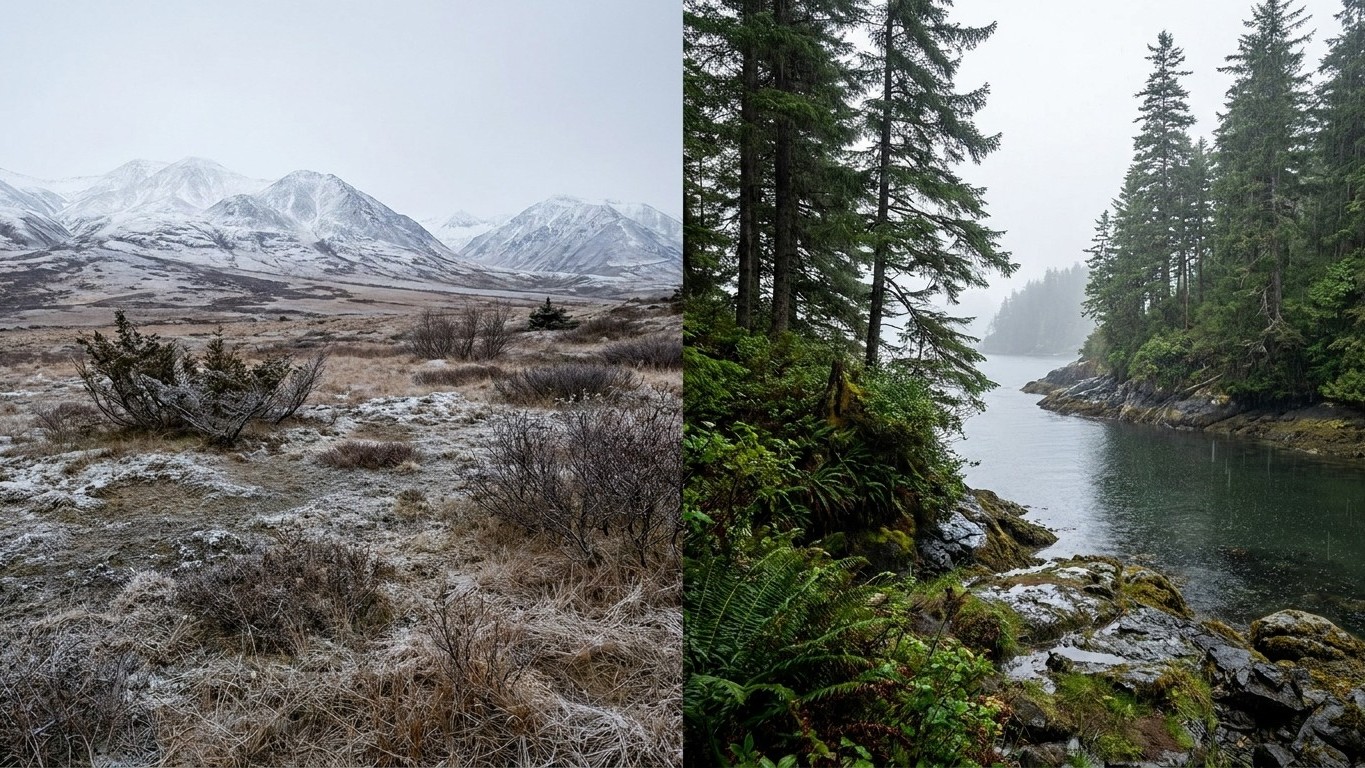

Vermont’s growing conditions run from the mild shoreline of Lake Champlain to the exposed ridgelines of the Green Mountains and the Northeast Kingdom, a span the USDA hardiness system rates 3b to 5b. Most trees, shrubs and perennials this site tracks can handle that range. A handful cannot, and a much longer list depends on which end of the state a reader lives in.
What will not survive a winter in Vermont

Crossing Vermont’s 3b-5b hardiness range against the 65 landscape plants documented on this site turns up four that fail everywhere in the state: no county, no valley, no lakeside pocket is warm enough to keep them alive through an average winter. That is a short list, and it deserves to be named plainly rather than buried under caveats.
All four fail for the same reason: Vermont is colder than they can take, not warmer. Ficus carica, the common fig, is built for winters that barely touch freezing. Hydrangea macrophylla, the big-leaf hydrangea gardeners often bring north from milder catalogs, sets its flower buds on wood that a Vermont winter routinely kills back. Lagerstroemia indica, crape myrtle, is a plant of the mid-Atlantic and the South. Magnolia grandiflora, the southern magnolia with its glossy evergreen leaves, belongs to the same warmer world.
| Plant | Type | Where the mismatch falls |
|---|---|---|
| Ficus carica (fig) | Fruit | Needs milder winters than this territory offers |
| Hydrangea macrophylla | Shrub | Needs milder winters than this territory offers |
| Lagerstroemia indica (crape myrtle) | Tree | Needs milder winters than this territory offers |
| Magnolia grandiflora (southern magnolia) | Tree | Needs milder winters than this territory offers |
Worth remembering: “hardy” only ever means “will survive.” A plant that clears the cold-tolerance bar can still sulk here for other reasons, heat, humidity, wind exposure, none of which the hardiness rating measures. Passing this test is the minimum, not a guarantee of a plant that thrives.
The plants that work in part of the state and not the rest
This is where a state-level page earns its keep. Thirty-one of the plants this site documents are hardy in part of Vermont’s 3b-5b range and not the rest, and every one of them fails at the cold end. None fail because Vermont gets too warm for them; the whole state sits too far north for that to be the issue here. The split is between how much cold each plant can absorb before that cold becomes fatal.
Fails only in the coldest zone, 3b
Nineteen plants clear zones 4a through 5b but drop out in 3b, the harshest slice of Vermont’s range, typically the Northeast Kingdom and the higher valleys of the Green Mountains. Among fruiting plants: Diospyros virginiana, Morus rubra, Prunus domestica, Pyrus communis, Rubus idaeus, Rubus occidentalis, Sambucus canadensis. Among perennials: Heuchera americana, Monarda didyma, Phlox paniculata, Salvia nemorosa. Among shrubs: Ilex glabra, Kalmia latifolia, Weigela florida. Among trees: Betula nigra, Cercis canadensis, Nyssa sylvatica, Platanus occidentalis, Quercus rubra.
Fails across 3b, 4a and 4b
Twelve plants need more warmth still, dropping out across three of the state’s colder zones and holding on only in the mildest pockets, generally close to Lake Champlain. Fruiting plants: Asimina triloba, Fragaria virginiana, Fragaria x ananassa, Prunus persica. Perennials: Amsonia hubrichtii, Lavandula angustifolia, Hylotelephium spectabile. Shrubs: Buxus sempervirens, Fothergilla gardenii, Itea virginica. Trees: Cornus florida, Liquidambar styraciflua.
| Plant | Type | Zones in Vermont where it fails |
|---|---|---|
| Diospyros virginiana | Fruit | 3b |
| Prunus persica | Fruit | 3b, 4a, 4b |
| Monarda didyma | Perennial | 3b |
| Lavandula angustifolia | Perennial | 3b, 4a, 4b |
| Kalmia latifolia | Shrub | 3b |
| Buxus sempervirens | Shrub | 3b, 4a, 4b |
| Quercus rubra | Tree | 3b |
| Cornus florida | Tree | 3b, 4a, 4b |
A reader in Burlington and a reader in the Northeast Kingdom are not reading the same verdict on any plant in this bucket. Finding out which zone applies means checking a county-level map rather than guessing from the state average; the insulation page on this site carries that county-by-county zone picture for Vermont and is the place to look before planting any name on this list.
The soil and the summer they will be planted into
Vermont’s official state soil is the Tunbridge series, a Spodosol formed under conifers: sandy, acid, strongly leached, with a surface layer running about 79 percent sand and 21 percent clay, no measurable silt, and a surface pH near 3.5. Organic matter sits around 75 percent in the mapped surface horizon, a figure that reflects a natural forest litter layer rather than a worked garden bed. Where a cultivated bed on this same series would fall is a different, lower number, and only a soil test on the actual planting site answers that.
What that composition means for a woody plant going into the ground is mostly a drainage story. A sandy, well-drained profile like Tunbridge sheds water quickly, which is good news for winter survival since standing water around roots in cold ground kills more shrubs and young trees than the cold itself does. The acidity is real too: a surface pH near 3.5 favors plants that tolerate strongly acid ground and works against species that want a neutral or sweeter soil, though the reader’s own yard, especially anywhere fill has been brought in or a foundation graded, can sit far from this representative value.
Summer rainfall across the reference station averages about 11.9 inches over June, July and August, with June the wettest at 4.26 inches and August the driest at 3.54. That number does not translate directly into a watering plan. The same 3.54 inches of August rain soaks into a sandy, Tunbridge-type profile and drains through within a day, while the identical rainfall sitting on a denser clay soil elsewhere in the state holds moisture at the root zone for a week or more. Reading the rainfall figure alongside the soil texture, rather than as a number on its own, is what tells a planter whether a given summer is generous or stingy for a new tree or shrub.
When to plant, here
Vermont’s growing season, bounded by a last spring frost running April 30 to May 10 and a first fall frost running October 3 to October 13 at the reference station, gives a woody plant two realistic windows to go into the ground. The logic behind both is the same: a young tree or shrub needs time to grow new roots before it is asked to either leaf out fully or face a hard freeze, and root growth happens on its own schedule regardless of the calendar date a gardener has in mind.
| Window | What it suits | Main risk |
|---|---|---|
| Spring, after the last frost (April 30 to May 10) | Most trees, shrubs and perennials; a full growing season ahead to establish roots | A late frost catching new growth if planted before the window closes |
| Autumn, roughly six to eight weeks before the first frost (October 3 to October 13) | Many trees and shrubs, which root while the soil stays warm after leaf drop | Not enough time to root before the ground freezes, especially in the coldest zones |
The autumn window is the one to treat with more caution in Vermont than in milder states. In the 3b and 4a stretches of the state, the gap between a reasonable planting date and the first fall frost is short, leaving less time for root establishment before winter than a gardener near Lake Champlain would get. And these frost dates are averages recorded at one reference station over 1991-2020, not a guarantee for any single year or any specific hillside; a frost can arrive early or late of that window in either season.
Whichever window is used, water through the plant’s first full season regardless of what its drought-tolerance rating says elsewhere on this site. Those ratings describe plants with established root systems already reaching several feet into the soil. A newly planted specimen has none of that yet, and depends on supplemental water until its roots catch up.
Where to read about each one
Thirty of the plants this site documents are hardy across the whole of Vermont’s 3b-5b range, and that group covers all three categories a Vermont garden typically draws from. Among trees: Acer rubrum, Acer saccharum, Amelanchier canadensis, Carpinus caroliniana, Ginkgo biloba, Juniperus virginiana, Picea abies, Pinus strobus, Quercus alba, Thuja occidentalis and Tilia americana. Among shrubs: Aronia arbutifolia, Clethra alnifolia, Hydrangea paniculata, Ilex verticillata, Physocarpus opulifolius, Spiraea japonica, Syringa vulgaris and Viburnum dentatum, alongside fruiting shrubs like Aronia melanocarpa and the two blueberries, Vaccinium angustifolium and Vaccinium corymbosum. Among perennials: Achillea millefolium, Asclepias tuberosa, Baptisia australis, Anacis verticillata, Echinacea purpurea, Iris sibirica and Rudbeckia fulgida.
The hardiness figures behind every plant named on this page come from a university extension plant database, the North Carolina Extension Gardener Plant Toolbox, crossed against Vermont’s own USDA hardiness range to produce the three groupings above: hardy everywhere, hardy in part, and hardy nowhere in the state. These are hardiness ranges, describing whether a plant survives a given winter low, and they measure something different from the apple variety adaptation ranges held elsewhere on this site, which come from a separate fruit-variety table and describe how a variety performs across a growing season rather than whether it lives through the cold.
A plant clearing this hardiness test is a starting point, not a finished plan. Where in the yard it goes, what soil it meets there, and which of the two planting windows above suits it are the next questions, and each deserves its own look before a shovel goes in the ground.