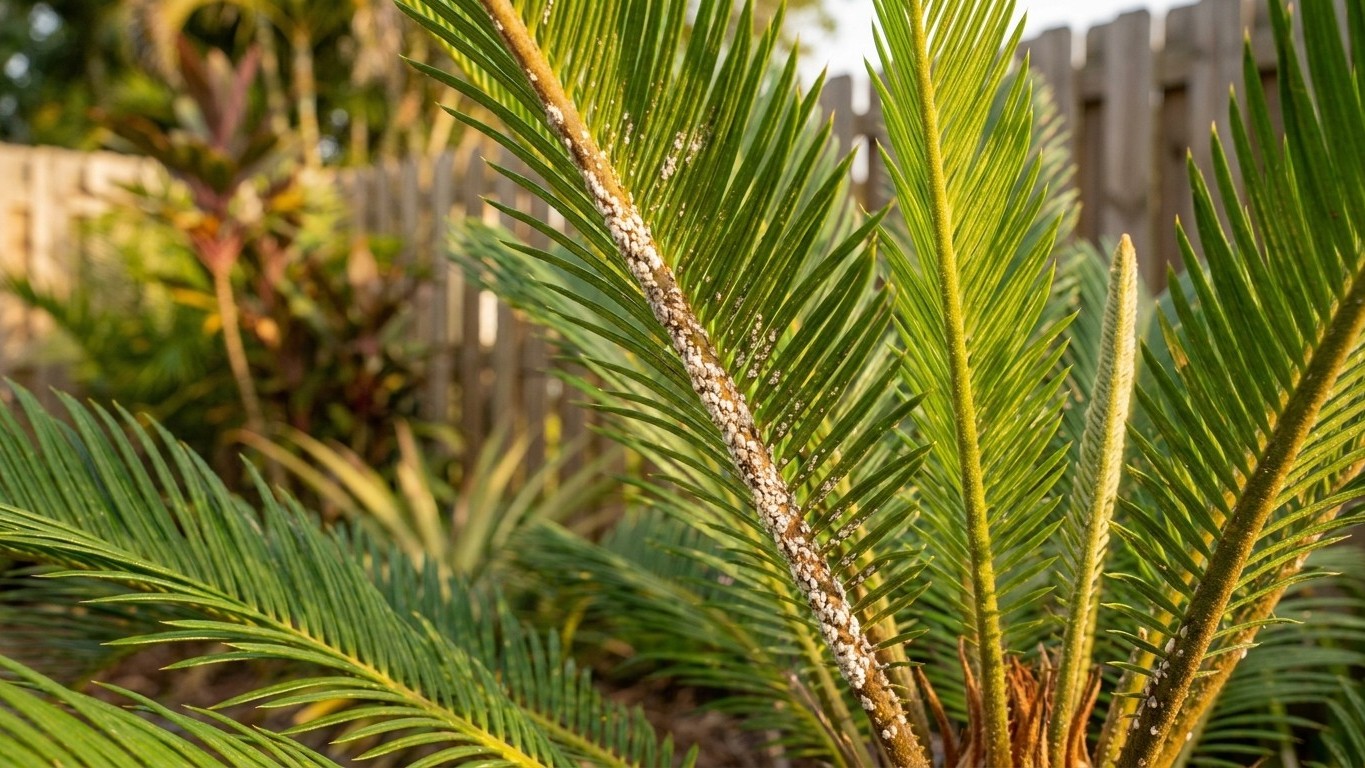

Cycad aulacaspis scale doesn’t take a real break in most of Florida, the insect stays active through mild winters and only slows down during genuine cold snaps, so infestations can turn up in almost any month once cycads start pushing new fronds. Nothing stops it in one move. Catching new plants before they carry scale onto a property, cutting away badly infested growth, and letting predators build up around outdoor plantings do most of the work between them.
The weeks to watch

UF/IFAS Extension doesn’t publish a fixed calendar window for cycad aulacaspis scale specifically. The Florida pest data that does carry seasonal detail covers other insects: eastern lubber Grasshoppers, active from March or April through October or November and peaking in July and August, and chilli thrips, heaviest during long, hot, dry stretches. Nothing comparable exists in print for this scale. In practice, that means treating the general hot-season pattern as the closest available guide and checking cycads through the whole year rather than circling one month on a calendar.
The hot, dry stretch
Scale populations, much like chilli thrips, tend to build fastest when the weather turns hot and dry for extended periods. In most of Florida that lines up with late spring through summer, which is also when cycads push new fronds. A soft, freshly unfurled leaflet gives young crawlers a spot to settle before the surface toughens up, so new growth and hot weather often arrive together.
Cooler months bring a slowdown, not a stop
Cold doesn’t reset this population the way it does with some pests. In north Florida, occasional freezes slow reproduction and crawler movement but rarely wipe out an Established infestation. Farther south, where frost is rare or absent, there’s no real off-season at all, and inspection has to be a habit rather than a spring-only task.
Reading the calendar from your last frost

The one date most Florida gardeners actually plan around is the last spring frost. For the Jacksonville area, NOAA’s 1991-2020 climate normals put that window between February 16 and March 7 (station USW00013889). That range matters more for tender vegetables than for an established cycad, but it still marks the point where nighttime lows stop threatening new growth and fronds start flushing again.
Three of the past thirty years at that Jacksonville station saw no freeze at all, and the site itself is inland, a nearby coastal yard often runs a few degrees milder. Farther south, in central and south Florida, frost is rare enough that the whole growing calendar flips: summer heat is the tough season there, not winter cold, and a “last frost” date barely applies.
The insect answers to soil and air warmth, not to a printed date. An early, mild spring can have crawlers moving weeks before a north Florida frost window even closes; a late cold snap pushes activity back just as long. Two steps make this usable for any yard:
- Find the local last-frost window from NOAA’s climate normals for the nearest station, or use February 16 to March 7 as a rough stand-in for north Florida.
- Expect the first visible scale activity on new frond growth to trail that window by several weeks rather than land on a fixed day, sooner after a warm spring, later after a cool one.
What it attacks, and what the damage looks like

Long before anyone spots the insect itself, cycad aulacaspis scale shows up as fronds turning yellow, then brown, starting at the tips or margins and working inward. A heavily infested plant can look scorched, almost like drought or freeze damage, even when soil moisture and temperatures are fine. Look closer and the underside of the fronds, along with the trunk and sometimes the roots on badly hit plants, carries a crusty white-to-gray coating, hundreds of tiny, flattened scale insects packed together, occasionally thick enough to resemble a dusting of salt.
The damage comes from the immobile, feeding stage of the insect, not from the tiny crawlers that hatch and disperse. Once a scale settles and inserts its mouthparts, it stays in that one spot for the rest of its life, pulling fluid from the tissue underneath. That’s the stage doing the visible harm, and it’s also the hardest stage to reach, since its waxy covering shields it from most contact treatments.
This scale targets cycads almost exclusively, and not all of them equally:
- King sago (Cycas revoluta), the species most commonly and severely affected in Florida landscapes
- Queen sago and other Cycas species
- Zamia species, including Florida’s native coontie
- Dioon and Encephalartos species grown as ornamentals
Pale, thinning fronds paired with a whitish crust at the base of the leaflets is the pattern worth checking for before blaming drought stress, a nutrient problem, or cold damage.
How Florida sits in this pest’s range

On this site, cycad aulacaspis scale is documented in one territory: Florida. That narrow footprint reflects where the insect has become a persistent landscape problem rather than an occasional find, cycads grow outdoors year-round across the state, giving the pest a constant host base that a colder climate simply wouldn’t provide.
Being the only territory covered here puts Florida at the edge of what this site tracks for the species, not necessarily the edge of where it exists biologically elsewhere in the country. Within Florida, the picture isn’t uniform either: the available source material doesn’t break severity down by region, so there’s no basis here for ranking north Florida against central or south Florida on this particular pest. What clearly shifts by region is climate, not the fact of infestation, a cycad in Jacksonville gets a real winter slowdown that one in Fort Myers or Miami doesn’t.
That difference matters more for expectations than for treatment. A gardener in a milder part of the state should plan on checking cycads in every season, while one farther north can count on a genuine winter lull even though the insect rarely disappears entirely from an established planting.
What actually works against it

- Inspect before you buy or accept a cycad. The scale spreads mainly on infested plant material, so checking the base of the fronds and the trunk of any new sago or other cycad before it goes in the ground stops the most common way new infestations start, and it costs nothing but a few minutes.
- Quarantine new plants for a few weeks. Keeping a newly acquired cycad away from established plantings lets a hidden infestation reveal itself before it spreads by wind, birds, or contact with tools and clothing.
- Prune out and destroy heavily infested fronds. Cutting away the worst-hit leaves and bagging them for disposal, rather than composting on site, removes a large share of the feeding population at once. This works on light to moderate infestations but does nothing for scale already established on the trunk or roots.
- Wash down remaining foliage. A strong jet of water can dislodge crawlers and some settled scale from leaf surfaces, useful on plants too large to prune heavily. It’s a mechanical fix, not a lasting one, since it can’t reach the trunk or root zone.
- Support natural predators. UF/IFAS Extension has worked with predatory beetles as biological control for this scale, and where those predator populations get established, they can hold light infestations in check over time with no ongoing input from the gardener. Avoiding broad insecticide use on and around cycads helps those predators survive.
- Bring in a professional once the trunk or roots are involved. After scale has built up thickly on the trunk or spread into the root system, mechanical and cultural steps alone rarely bring it back under control, and that’s the point where targeted treatment from a licensed applicator becomes the more realistic option.
Common questions
Is cycad aulacaspis scale harmful to people or pets?
No. It doesn’t bite or sting and has no known effect on humans or animals, the damage is limited entirely to the plants it feeds on.
Can an infested cycad recover once it’s been treated or pruned?
It depends on how far the infestation has gone. A plant caught early, with pruning and predator support, often bounces back with new, clean growth. One with scale packed thickly on the trunk or roots, especially a king sago, has a much lower chance of full recovery.
Does this scale spread to palms or other landscape plants nearby?
No. Its host range sits almost entirely within the cycad family, so palms, shrubs, and other ornamentals growing right next to a heavily infested cycad typically show no damage from it at all.