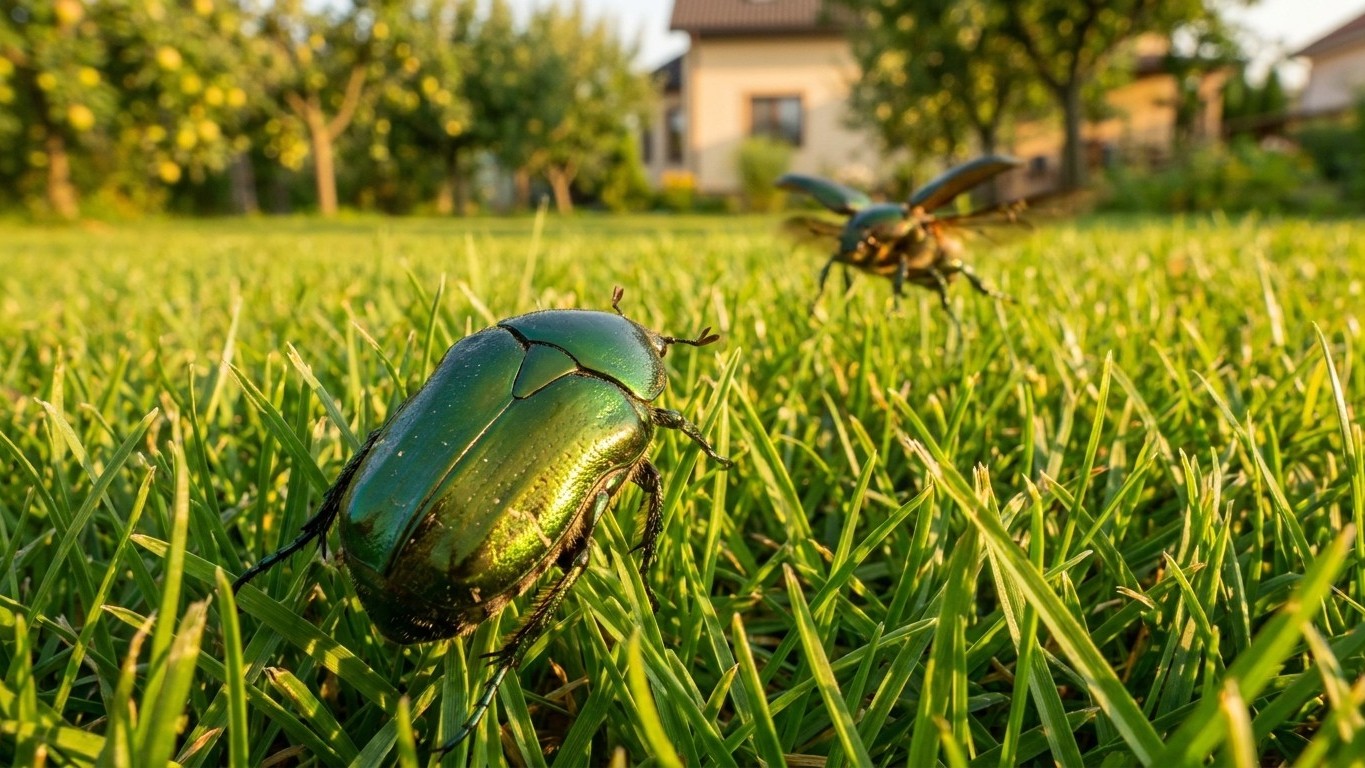

Green June beetles show up in Nebraska gardens as thumb-sized, metallic-green scarabs that fly clumsily over lawns and ripening fruit from early July into August. There’s no local emergence date published for this species specifically, so the surest sign is behavior: adults buzzing low over turf on hot afternoons, and grubs that crawl on their backs across sidewalks after a heavy rain.
The weeks to watch

Nebraska Extension (UNL) does not publish a specific emergence window for the green June beetle in its vegetable garden insect guidance. Its NebGuide on vegetable garden insects covers the twostriped grasshopper and the squash bug in detail, but the green June beetle isn’t named with a Nebraska-specific date range. That means the timing below follows the general biological pattern documented for this species across its range, not a Nebraska-specific measurement.
Adult flight
Adults are typically active from late June through August, with numbers peaking in July. This is a single-generation insect: one wave of adults per year, not repeated flights like some garden pests. Once that flight window closes for the season, adult activity drops off fast, usually by early September.
Grub activity
The grub stage works on a different clock. Larvae feed near the soil surface through the fall, burrow deeper to overwinter, then resume feeding in spring before pupating and emerging as adults in early summer. That means the grubs causing turf and soil damage in April and May are the offspring of last year’s adult flight, not this year’s.
Reading the calendar from your last frost

The one date most Nebraska gardeners actually track is the last spring frost, which falls between April 12 and April 23 at the reference weather station used for state climate normals. That’s a normal, not a guarantee. Gardens outside town, especially at higher elevation or in low-lying rural spots, often see frost linger one to two weeks longer, so check your own county before setting a date in stone.
The green June beetle doesn’t answer to a calendar. It answers to soil temperature. Grubs become active once soil near the surface warms into the 60s and 70s, and that threshold, not the frost date itself, is what triggers visible feeding and the odd sight of larvae crawling across driveways.
- Start with your local last frost date (April 12 to 23 at the reference station, later in many rural areas).
- Add roughly six to eight weeks for soil to warm enough at the surface to trigger noticeable grub activity, meaning damage in lawns and garden beds often shows up sometime in June, well after transplants have been in the ground.
That gap matters for row covers. Covers protecting seedlings from frost can come off once the transplant is established, but if grub damage is a known problem in a given yard, waiting to till or disturb soil until after that six-to-eight-week window can help avoid stirring up larvae right as they’re most active.
What it attacks, and what the damage looks like

The first sign most people notice isn’t the beetle itself. It’s ragged, oozing wounds on ripening fruit, sometimes with a scab of sap and fruit flies gathered around the damaged spot. In lawns, the giveaway is raised, irregular tunnels of loosened soil, sometimes with grubs visible on the surface after rain, moving on their backs in a way no other common grub does.
Adults feed on ripening, thin-skinned fruit and will enlarge wounds already started by birds or other insects. Grubs feed underground on decaying organic matter and plant roots, and heavy populations can loosen turf enough that it pulls up like a loose carpet. Crops and areas most often affected include:
- Ripening peaches and other soft, thin-skinned tree fruit
- Grapes nearing harvest
- Ripening tomatoes, especially fruit touching the ground
- Turfgrass and lawns with rich organic matter or heavy mulch
- Compost piles and garden beds high in decaying plant material
Both life stages cause damage, but they call for different responses. Adults are the visible, catchable stage and the ones actually chewing fruit. Grubs do the underground damage to turf and roots, and once they’re established a few inches down, there’s very little a home gardener can do to reach them directly. That split is why timing matters: catching the adult stage is realistic, catching the grub stage usually isn’t.
How Nebraska sits in this pest’s range

This pest is documented on this site in just one territory, Nebraska, and that narrow footprint says something real: Nebraska sits near the edge of where this species is commonly reported, rather than in the middle of dense, well-documented populations found across the eastern and southeastern United States. That edge position is consistent with how the species is generally described in entomological literature, as more common and better studied in warmer, more humid regions to the east and south.
No neighboring state’s data was used to build this page, and none should be assumed to apply directly to Nebraska conditions. What the narrow documentation does suggest is that gardeners here are more likely to encounter light, sporadic activity in a given year rather than the reliable, heavy pressure seen in states closer to the core of the range. If green June beetles show up in a Nebraska yard, it’s worth noting the observation to a local extension office, since range-edge populations are exactly the kind of data that helps refine future guidance.
What actually works against it

Start cheap and work up. Once grubs are established under turf, most of what’s on this list stops being useful, so timing matters as much as the method itself.
- Reduce excess organic matter and thick mulch near soil that has had grub problems before. Grubs feed on decaying material near the surface, so a leaner, better-aerated lawn gives them less to eat and less cover to hide in.
- Hand-pick adults in the morning while they’re sluggish from cooler overnight temperatures, and drop them into soapy water. This only works during the adult flight window, roughly late June through August; it does nothing for grubs already in the soil.
- Harvest ripening fruit promptly and don’t leave overripe or bird-damaged fruit hanging or lying on the ground. Adults are drawn to fruit already showing wounds or sugar, so removing that attractant early cuts down on repeat visits.
- Cover ripening fruit with mesh or row cover once fruit starts to color. This works only while fruit is still on the plant and only if the cover is secured at ground level; adults will find any gap.
- Avoid tilling or heavily disturbing soil during peak grub activity if a yard has a known history of damage, since disturbed soil doesn’t stop grubs already present but can make surface damage more visible and doesn’t reduce the population.
Some gardeners apply beneficial nematodes to lawns as a grub treatment. Many report using them for scarab grubs generally, but trial results specific to green June beetle larvae are mixed, and no consistent mechanism has been established for how reliably they reach this species at the depth it burrows. Treat that option as unproven rather than a guaranteed fix.
Common questions
Does Nebraska Extension track green June beetle emergence dates?
No. Nebraska Extension’s published vegetable garden insect guidance covers the twostriped grasshopper and squash bug with specific timing, but it does not list a Nebraska-specific emergence window for the green June beetle.
Are green June beetle grubs the same ones damaging lawns in fall?
Often yes. Grubs feed near the surface in fall, move deeper to overwinter, then resume feeding in spring before pupating into the adults seen in July and August.
Can row covers stop adult beetles from reaching ripening fruit?
Yes, if secured tightly at ground level once fruit begins to ripen. Covers only work while fruit is still developing on the plant and have no effect on grubs already living in the soil.