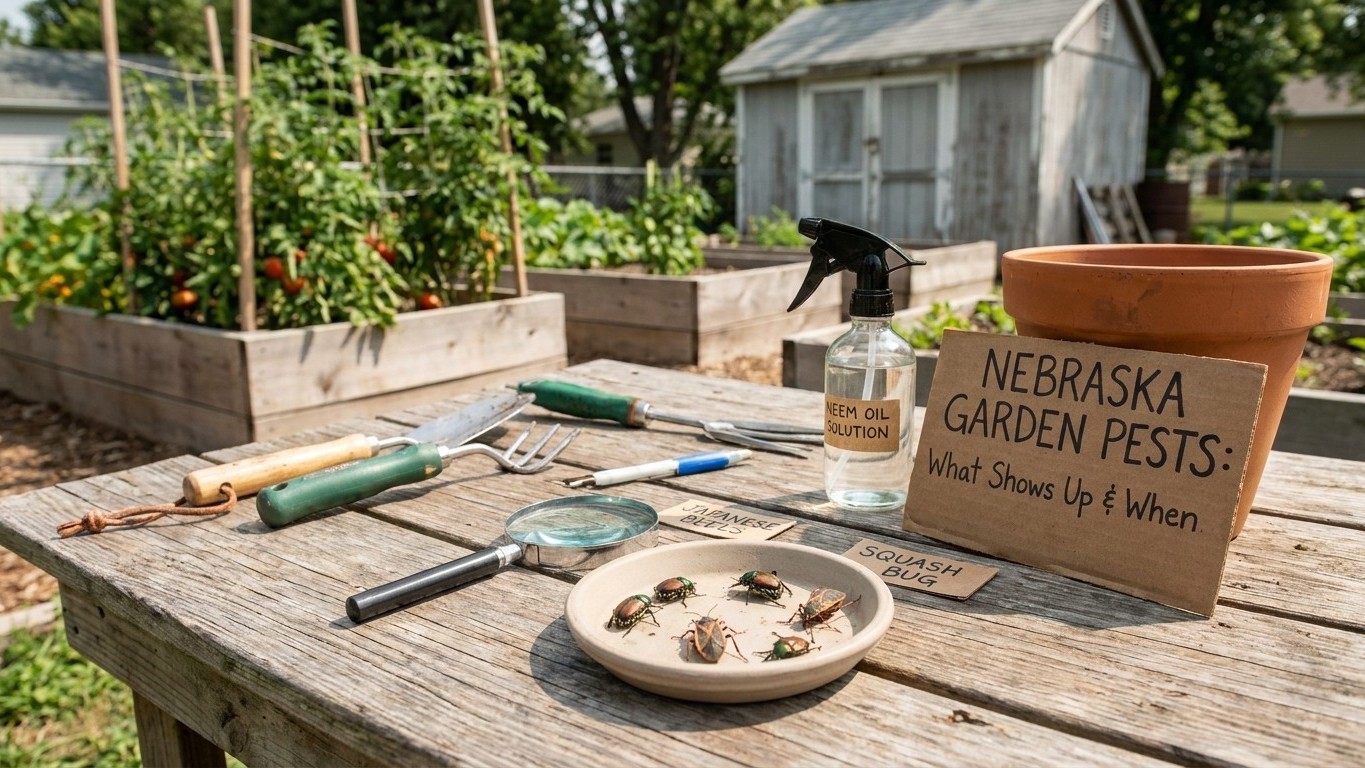

In a Nebraska garden, the pests that actually hit your vegetables come down to about ten repeat offenders — grasshoppers, squash bug issues, cucumber beetle problems, squash vine borer damage, tomato hornworm damage, Japanese beetle outbreaks, blister beetle swarms, Bean leaf beetle Nebraska damage on emerging bean plants, and a handful of others that show up on a fairly predictable schedule year after year. Grasshoppers alone are worth watching closely: nymphs hatch around mid-May near Omaha, and they’re small and slow enough in late May to still be manageable before they turn into the winged adults that flood gardens by midsummer. Walk the edges of your garden now and look for hopping nymphs in the grass before you decide whether spraying is even necessary.
What Nebraska gardens actually deal with

Nebraska’s mix of open grassland, hot summers and vegetable-heavy home gardens favors insects that either migrate in from surrounding fields or breed fast once the weather warms. This list, drawn from UNL Extension’s guide to vegetable garden insects, is not exhaustive. Pressure varies by county and by year, and an unfamiliar bug is always worth a photo to your local extension office before you decide it’s one of these ten.
Imported cabbageworm

The damage comes from a smooth, velvety green caterpillar about an inch long that blends into the leaf so well it’s often missed until the holes are obvious. It chews ragged gaps in cabbage, broccoli and kale leaves and will bore into forming heads. This pest, Imported cabbageworm in Nebraska, is best managed early: floating row cover installed at transplant keeps the white adult butterfly from laying eggs in the first place, which beats trying to pick caterpillars off later.
Bean leaf beetle

Adults are small, oval, about a quarter inch, colored anywhere from yellow to red with black spots and a black-margined edge. They chew round to oval holes between leaf veins on young bean plants and can scar developing pods. Seedlings in their first two weeks are the most vulnerable stage, so that’s the window to scout closely.
Cucumber beetles

Two look-alikes turn up on squash, melon and cucumber plants: one is yellow with three black stripes running lengthwise, the other yellow-green with black spots, both around a quarter inch. They feed on seedling leaves and flowers and carry bacterial wilt from plant to plant as they move. A wilting cucurbit seedling with beetle feeding nearby is worse news than the chewing alone suggests, since the wilt may already be underway.
Blister beetles

These are narrow, soft-bodied beetles up to three-quarters of an inch, often gray and black striped, that show up in tight feeding clusters on tomato, potato and bean foliage. A cluster can strip a section of foliage in a day. Handle them with gloves rather than bare hands, since their body fluid raises blisters on skin.
Squash bug

Adults are flat-backed, brownish-gray, shield-shaped bugs about five-eighths of an inch long. Nymphs are gray with black legs. Eggs sit in bronze clusters on the underside of squash leaves. UNL Extension notes squash bugs run one generation a year, but all life stages are present through summer, so checking leaf undersides on a regular basis matters more than trying to time one single treatment.
Squash vine borer

The adult is a day-flying moth with an orange and black body that reads more like a wasp than a moth at a glance. The actual damage comes from a cream-colored larva that tunnels into the base of the stem, causing sudden wilting even with wet soil underneath. Once the larva is inside, spraying the leaves does nothing. The sawdust-like frass at the entry hole is the only early warning worth acting on.
Grasshoppers
Nymphs look like small, wingless copies of the adult, and Nebraska gardens see twostriped, differential, migratory and redlegged grasshoppers, ranging from tan to green with distinguishing markings on the legs and back. UNL Extension puts the twostriped grasshopper’s hatch around mid-May near Omaha, with winged adults moving into gardens by July and August. The best control window is mid-to-late June, while nymphs are still in the third or fourth instar and concentrated at field edges, before they scatter and mature. Gardeners farther north deal with a similar early-season grasshopper surge, covered in Garden Pests in North Dakota.
Japanese beetle
Adults are compact, about half an inch, with a metallic green head and thorax, copper-brown wing covers, and small tufts of white hair along the abdomen’s sides. They skeletonize leaves between the veins on roses, beans and many ornamentals through the hotter weeks of summer. Hand-picking into soapy water in the morning, when the beetles are sluggish from the cool air, cuts numbers without any spray.
Green June beetle
This one runs larger, up to an inch, metallic green with duller bronze edges on the wing covers, and flies low with an audible buzz on hot afternoons. Adults scar ripening fruit and grape skins while the grubs feed underground on organic matter and turf roots. Damage tends to track beds with heavy organic mulch or compost, since that’s where the grubs concentrate. Home gardens in more humid parts of the country deal with a heavier version of this pressure, covered in Garden Pests in North Carolina.
Tomato and tobacco hornworms
Both are large green caterpillars, three to four inches at full size, with pale diagonal stripes and a horn at the tail end, black or blue on the tomato hornworm and reddish on the tobacco hornworm. They strip tomato foliage overnight and chew into green fruit. The caterpillar’s color hides it well against the leaves, so dark droppings on the lower foliage are often the first sign something is there.
Telling damage apart

Chewed leaf edges with visible bite marks, or whole sections missing, point to something with mandibles: grasshoppers, beetles, or caterpillars working alone or in a cluster. Round or ragged holes eaten between the leaf veins, leaving a lace-like skeleton behind, usually mean Japanese beetles or cucumber beetles rather than caterpillars, which tend to eat inward from the leaf edge.
Wilting is the trickiest symptom because three different causes can look almost identical from a few feet away. A squash or melon vine that wilts despite moist soil, with a hole and sawdust-like debris near the stem base, points to a squash vine borer larva tunneling inside. A plant that wilts and browns from one side with no visible stem damage more often means bacterial wilt spread by cucumber beetle feeding. Wilting spread evenly across a whole bed, with no chewing marks anywhere, usually traces back to watering, either the soil dried out between waterings or it stayed soggy long enough to suffocate the roots.
Sticky residue on leaves is rarely the pest itself but a sign one is feeding nearby. Aphid-type feeding leaves a clear, sticky film, sometimes followed by black sooty mold growing on top of it. That’s different from the dry, dusty stippling of pale speckles left by mites, which shows fine webbing on the underside of the leaf once numbers build.
A few quick checks separate insect damage from disease or a watering fault before anything gets sprayed:
- Turn the leaf over. Eggs, nymphs or the insect itself confirm a pest. Uniform yellowing with no insects present leans toward disease or nutrient stress.
- Check the stem base. Soft, dark, collapsing tissue points to a soil-borne disease or rot, not chewing insects.
- Note the pattern. Damage scattered across a whole bed overnight usually means a mobile pest like grasshoppers. Damage confined to one plant, spreading slowly over days, points to disease or a borer already inside the stem.
- Feel the soil. Wilting with dry soil an inch down is a watering problem before it’s anything else.
Getting this distinction right decides whether the next step is a spray, a row cover, or just a change to the watering schedule, and treating the wrong cause wastes a season’s effort on the right plant.
When each one shows up
Pest activity in Nebraska gardens tracks plant growth stages more closely than the calendar. Cabbage, broccoli and kale transplants are vulnerable to cabbageworm butterflies laying eggs the moment the leaves are big enough to hide a caterpillar, so scouting should start the week transplants go in, not weeks later. Bean and cucurbit seedlings face bean leaf beetles and cucumber beetles almost as soon as the first true leaves unfold, since both overwinter as adults nearby and move in fast once a host plant appears.
Grasshoppers follow a slower arc. UNL Extension puts the twostriped grasshopper’s hatch around mid-May near Omaha, and for several weeks after that the nymphs stay small, wingless and clustered near field edges and roadsides before spreading into gardens. Mid-to-late June, while nymphs are still in the third or fourth instar, is the easiest window to knock them back, according to UNL Extension. By July and August the survivors are winged adults, more mobile and harder to stop, moving freely between fields and gardens. These figures come from the Omaha area specifically. Gardens farther west or in the Panhandle, where spring soil warms more slowly, can see hatch and activity shift later in the season.
Squash bugs build differently. UNL Extension describes one generation a year, but because eggs, nymphs and adults all overlap through summer, a squash planting can carry every life stage at once by midsummer, which means a single scouting pass in June is not enough. Blister beetles tend to appear in early summer, often in tight clusters that seem to show up on a single plant overnight. Japanese beetles and green June beetles follow behind, both peaking in the hotter weeks of midsummer, with green June beetle activity concentrated in the muggiest stretches.
Hornworms are the latecomers. Damage is often the first sign, weeks before the caterpillar itself is big enough to spot, since its green color matches the tomato foliage almost exactly. By the time a hornworm reaches its full three to four inches, it has already done most of the damage it’s going to do, which is why checking the lower leaves for dark droppings earlier in the season catches the problem before it’s visible from a distance.
What actually works
Prevention beats reaction for nearly every pest on this list. Rotating cucurbits, beans and brassicas to a different bed each year breaks the cycle for pests that overwinter in soil near last year’s host plants, including squash bug and bean leaf beetle. Floating row cover, installed at transplant and sealed at the edges, keeps cabbageworm butterflies, cucumber beetles and squash vine borer moths from ever reaching the plant, though it has to come off once flowers need pollinating unless you hand-pollinate underneath it.
Encouraging natural predators
Ground beetles, lady beetles, lacewings and parasitic wasps all take a bite out of soft-bodied pests and young beetle larvae, and their numbers build faster in a garden that isn’t sprayed broadly. Leaving a strip of flowering plants, especially in the carrot and dill family, gives parasitic wasps somewhere to feed as adults between hosts. Broad-spectrum insecticides kill these predators along with the target pest, which is part of why a garden treated repeatedly can end up with worse pest pressure the following year, not less.
Targeted intervention
Hand-picking works well for anything large enough to see and slow enough to catch: hornworms, Japanese beetles, blister beetles and squash bugs all go into a bucket of soapy water without much fuss, especially in early morning when beetles are sluggish from the cool air. For squash vine borer, once the larva is inside the stem, no spray reaches it. Slitting the stem to remove the grub, then mounding soil over the wound to encourage new roots, is the only step that works after egg-laying.
Bacillus thuringiensis, sold as Bt, is a bacterial insecticide that controls caterpillar pests like imported cabbageworm and hornworms without harming bees or predatory insects, since it only affects insects that ingest it and carry the right gut chemistry to activate it. It does nothing against beetles, bugs or grasshoppers, which is a common source of disappointment when a gardener applies it broadly and expects it to cover every pest at once.
Diatomaceous earth and garlic sprays, both popular home remedies, have little to no measurable effect on grasshoppers or squash bugs once populations are established outdoors, since rain washes them off and neither reaches insects hiding under leaves or inside stems. They’re not harmful to try, but they shouldn’t replace row cover or hand-picking as the main plan.
What control costs
Hand-picking costs nothing but time, and for most home gardens it’s the cheapest control by a wide margin. Ten minutes a day checking the undersides of squash leaves for eggs, or picking hornworms off tomato foliage, adds up to maybe an hour a week during peak pressure, with no ongoing purchase.
Row cover and other physical barriers cost more upfront, since the material and hoops have to be bought once, but they last several seasons if stored dry and handled carefully, and they need almost no time after installation beyond occasional edge-sealing. The tradeoff is that they have to come off during bloom for pollinated crops, which opens a window right when squash bugs and cucumber beetles are most active.
Biological controls, including Bt and encouraging predator insects, sit in the middle. Bt needs reapplying every week or two through the growing season because it breaks down in sunlight and rain, and it only works on caterpillar stages, so timing the spray to young larvae matters more than how much gets applied. Encouraging predators costs nothing but patience. It takes a season or two of avoiding broad sprays before the beneficial population builds up enough to matter.
Sprays, whether an insecticidal soap, a pyrethrin, or a synthetic insecticide, usually cost the most in repeat applications, since most break down within days and have to go back on after every rain and every new hatch. They’re also the option most likely to knock back the predator insects that would otherwise do some of the work for free.
| Method | Upfront cost | Time per season | Repeat frequency |
|---|---|---|---|
| Hand-picking | None | Low to moderate, daily checks in season | Ongoing, as needed |
| Row cover / barriers | Moderate, one-time | Low after installation | Reusable for several seasons |
| Biological controls (Bt, predators) | Low | Moderate | Bt every 1-2 weeks, predator buildup takes seasons |
| Sprays | Low to moderate per application | Moderate to high | After every rain and new hatch |
For a typical home garden, hand-picking paired with row cover during the vulnerable seedling stage costs the least overall, since it avoids the recurring purchase that sprays and repeated Bt applications require.
Local help
Nebraska Extension identifies pest specimens and tracks how pest pressure shifts from one county to another, and its county offices are the fastest way to get confirmation of the pest before spending money on a fix. Reach the statewide directory through the UNL Extension website. For more on growing in this state, see our other Nebraska guides.
One Pest Worth a Closer Look
UNL Extension’s vegetable pest calendar is a solid starting point for tracking the usual suspects in a Nebraska garden, but it doesn’t cover everything that can turn up on your plants. Case in point: the bean leaf beetle, which gets no mention in that calendar despite being a real concern for anyone growing snap beans or soybeans. If you’ve spotted chewed leaves on your bean plants and wondered why the standard advice doesn’t seem to address it, that page fills in the gap — when this beetle shows up in the season and what actually works to stop it.
Common questions
Do I need to spray for grasshoppers every year?
Not necessarily. Grasshopper numbers swing a lot from year to year depending on the previous summer’s weather and how much habitat is nearby. Scouting in late May and treating young nymphs in June only if numbers look high is more useful than spraying on a fixed schedule.
Are ladybugs actually helping or is that just something people say?
They’re helping. Both adult and larval lady beetles eat soft-bodied pests and beetle eggs, and a garden that avoids broad-spectrum sprays usually builds up a bigger population of them over a season or two. Buying and releasing ladybugs bought in bulk rarely works, since most fly off within a day or two of release.
My tomato leaves have holes but I can’t find a caterpillar anywhere, what’s going on?
Check the lower and inner leaves closely, since hornworms match the foliage color almost perfectly and tend to hide during the day. If there’s no caterpillar and the holes look more skeletonized between the veins, look for beetles instead, since Japanese beetles and cucumber beetles leave a different pattern than caterpillar chewing.
Is it too late to save a squash plant once vine borer damage shows up?
Often, yes, if the wilting is already severe, but a plant with only one affected vine can sometimes be saved. Slit the stem where the frass is visible, remove the larva, and mound moist soil over the wound to encourage new roots to form above the damage.