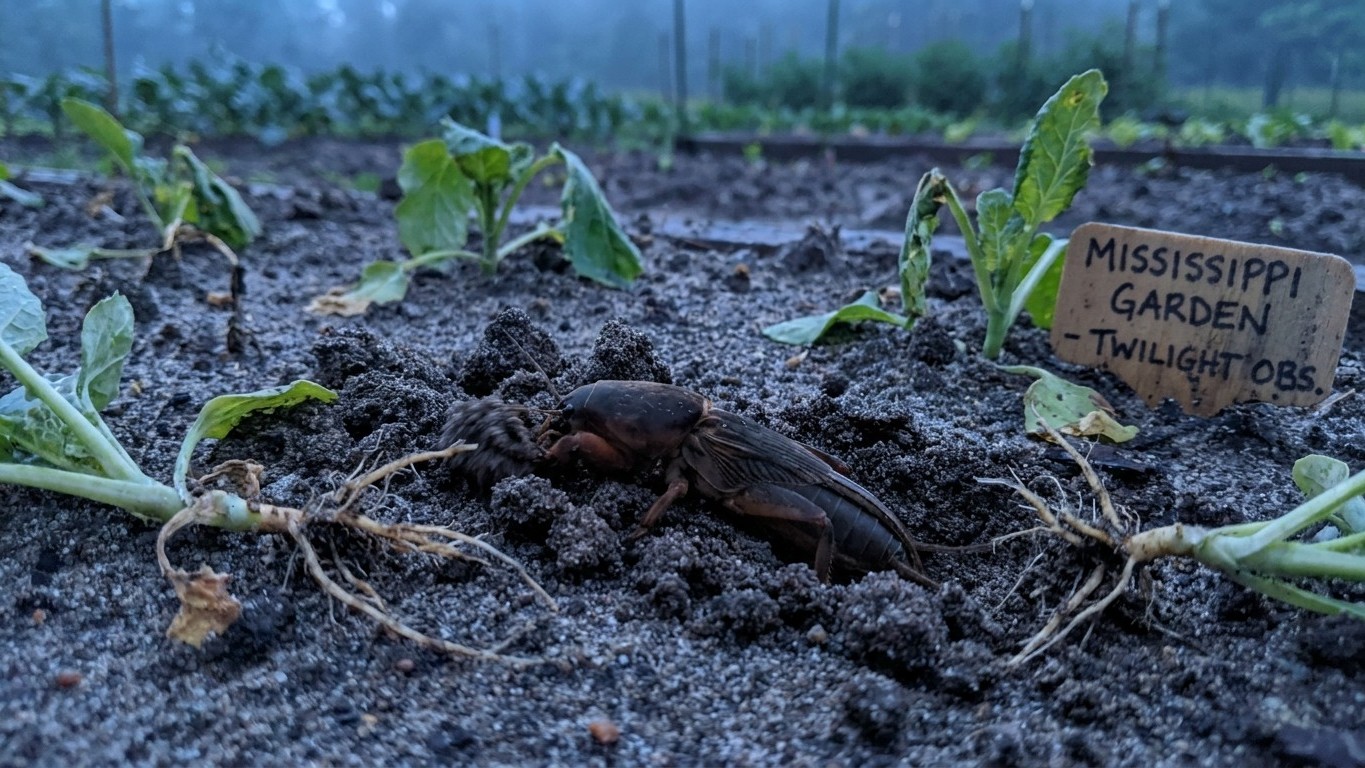

Mole crickets show up in Mississippi mainly in the southern half of the state, where sandy soils give them the loose, easy-digging ground they need to tunnel and lay eggs. Mississippi State University Extension flags them as a home-garden concern there, though it doesn’t set a firm calendar date. Moist, well-drained soil, reduced sandy-bed plantings, and physical barriers are what actually slow them down.
The weeks to watch

Mississippi State University Extension Publication 2347, Insect Pests of the Home Vegetable Garden, doesn’t publish a specific flight or activity window for mole crickets the way it does for squash vine borer or leaf-footed bugs. It flags the insect for the southern half of the state, especially on sandy soils, and stops there. No date range, no peak week named for this pest specifically.
That gap means gardeners have to lean on the general biology of the insect rather than a state-specific calendar. Mole crickets are nocturnal and their activity tracks soil warmth far more closely than it tracks a printed date.
Spring flight
Adults become mobile once soil has warmed enough in spring, moving at night, often on humid evenings after rain. This is when tunneling near the soil surface becomes visible and when egg-laying happens in loose, sandy beds.
Summer and fall feeding
Once eggs hatch, nymphs feed on roots and tender stems through the warm months, doing most of their damage underground where it’s easy to miss until a plant wilts. Activity tapers as soil cools in fall, with the insects retreating deeper until the ground warms again the following spring.
Reading the calendar from your last frost

The one date most Mississippi gardeners actually track is the last spring frost, which falls between March 6 and March 22 according to NOAA’s 1991-2020 climate normals for the reference weather station. That’s a 30-70% freeze-probability band, not a guarantee, and it comes from an airport station. Suburban and rural gardens often see their own last frost land later, sometimes by one to two weeks, so check your county’s extension office for a local adjustment.
Mole crickets don’t consult that frost date directly. They respond to soil temperature, and soil lags behind air temperature by days to weeks depending on mulch, sun exposure, and rainfall. That’s why an early warm spring can put adults on the move well before a “typical” year would suggest, and a cool, wet spring can push activity later.
- Start from your local last frost window (March 6 to March 22 at the reference station, adjusted for your own county).
- Add the lag before soil actually warms enough for mole cricket activity: gardeners in sandy-soil areas commonly see the first tunneling or seedling damage roughly four to six weeks after transplanting, once the ground has had time to heat up.
That two-step math is a planning tool, not a fixed appointment. If you’re using row covers to block egg-laying adults, plan to have them on by the earlier end of that frost window and be ready to pull them once seedlings need pollinator access.
What it attacks, and what the damage looks like

The first sign is rarely the insect itself. Most gardeners notice a seedling that wilts despite normal watering, or small ridged tunnels pushed up through loose soil like miniature mole trails. Grass or garden beds in sandy areas can show irregular brown patches where roots have been severed underground. By the time the damage is visible above ground, the insect has usually been working the root zone for a while.
Crops and plantings most commonly affected in home settings include:
- Vegetable seedlings and transplants, especially in loose sandy beds
- Root vegetables, where underground tunneling disturbs developing roots
- Turfgrass adjacent to garden beds, showing thinning or browning
- Young bean and pepper transplants set into freshly tilled sandy soil
Both nymphs and adults tunnel and feed, but nymphs do the bulk of root-level damage over the growing season since they stay underground longer and feed continuously. That distinction matters for treatment: once nymphs are established several inches down around root systems, anything applied at the soil surface has a much narrower window to reach them. Adults, which move and fly more, are more exposed and easier to intercept early in the season.
How Mississippi sits in this pest’s range

This pest is documented in one territory on this site, which means the coverage here is narrow rather than broad. That’s different from widespread pests like squash vine borer, where the difference between territories is mostly timing. For mole crickets, Mississippi’s own extension guidance already draws a line inside the state itself, flagging the southern half and its sandy soils rather than describing a uniform statewide presence.
That internal split matters more than any comparison to neighboring states. A gardener in the Delta’s heavier clay soils is working with a very different risk profile than one on the Gulf Coast’s sandy loam, even though both are technically in the same state. Mississippi State University Extension Publication 2347 doesn’t rank counties or assign severity levels, so there’s no official gradient to cite beyond that broad southern-half, sandy-soil flag. Treat the guidance as a soil-type indicator first and a geographic one second.
What actually works against it

- Manage soil moisture. Mole crickets favor moist, well-drained sandy soil. Cutting back on excess irrigation, especially in beds already flagged as sandy, makes the ground less inviting without any added cost.
- Time transplanting around the frost window. Getting seedlings established and hardened off before soil hits peak warmth gives roots a head start before nymph feeding ramps up.
- Use a soapy water drench to check for activity. Many gardeners pour a diluted soap solution over suspect tunnels to flush mole crickets to the surface for identification. It’s a detection method people rely on regularly; it confirms presence, it doesn’t claim to kill the population.
- Hand-pick after dark. Since adults surface and move at night, a flashlight check after sundown lets you remove individuals directly from exposed soil or turf edges.
- Install row covers over seedbeds in spring. A physical barrier during the adult flight period blocks egg-laying in loose soil before nymphs ever get established.
- Clear debris and reduce mulch near sandy beds. Fewer hiding spots at the soil surface means fewer places for adults to shelter between nighttime movements.
- Rotate root crops out of heavily tunneled beds. Moving susceptible plantings to a different bed the following season interrupts the local population’s easy access to food.
None of these measures do much good once nymphs are already several inches deep, feeding on roots from below. At that point, the season’s crop in that bed is largely at the mercy of what’s already underground, and the real payoff comes from applying these steps before the next spring’s flight rather than mid-season.
Common questions
Do mole crickets in Mississippi damage lawns as well as vegetable gardens?
Yes. Turfgrass next to sandy garden beds can show the same tunneling and root disruption as vegetable plots, since the insect doesn’t distinguish between a lawn and a garden bed as long as the soil is loose and moist.
Is clay soil a reliable way to avoid mole crickets?
Mississippi State University Extension flags sandy soils specifically for this pest, and denser clay soil is generally less hospitable to their tunneling. It’s not stated as a guarantee, but soil texture is the clearest environmental factor named in the local guidance.
Can I still plant vegetables if my county extension office doesn’t publish a mole cricket forecast?
Yes. Since Mississippi State University Extension Publication 2347 doesn’t give a specific window for this pest, use the last spring frost date for your county as your planning anchor, then watch for the general spring-flight and summer-feeding pattern rather than waiting on a forecast that doesn’t exist.