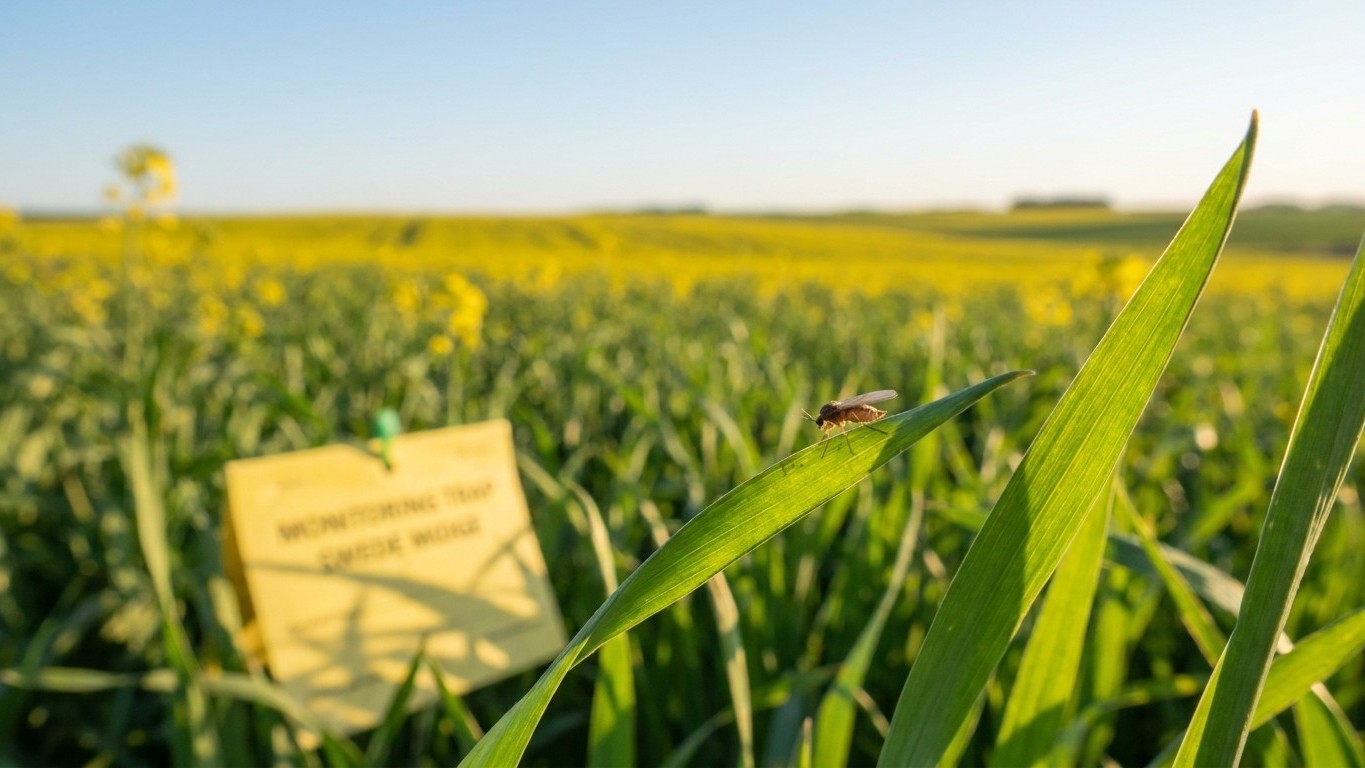

Swede midge shows up in Manitoba as soon as soil temperatures climb into the high 50s Fahrenheit in spring, typically from mid-May through June, with new generations emerging every three to four weeks until the first hard frost. Nothing eliminates an established population outright, but tight crop rotation, pheromone trap monitoring, and well-timed insecticide applications keep numbers low enough that canola and vegetable brassicas escape serious damage.
What Swede Midge Is and Why Manitoba Growers Pay Attention

Swede midge (Contarinia nasturtii) is a tiny fly, barely bigger than a gnat, that feeds exclusively on plants in the cabbage family. That includes canola, mustard, cabbage, broccoli, cauliflower, kale, rutabaga (the plant that gave the insect its common name), and turnip. The insect is not native to North America. It was first confirmed on this continent in Ontario in 2000, likely arriving in imported plant material or soil, and it spread through vegetable-growing regions of Ontario and into Quebec within a decade.
Manitoba matters here because it’s one of the largest canola-producing provinces in Canada, and canola is exactly the kind of crop swede midge targets. Provincial agriculture departments and industry groups have run pheromone trap surveys across the Prairies for years specifically because a midge that devastates broccoli fields in Ontario would be an economic problem of a different scale in a province where canola covers millions of acres. The insect doesn’t need much to get started. A single mated female can lay dozens of eggs, and because the larvae feed hidden inside growing points, an infestation can go unnoticed until the damage is already done.
When Swede Midge Shows Up in Manitoba
Timing follows soil temperature, not the calendar. Overwintering pupae sit in the top few inches of soil, and adults begin emerging once sustained soil temperatures reach roughly 59°F. In a typical Manitoba spring, that lines up with mid-to-late May, though a cool, wet spring can push emergence into June. Adults themselves are short-lived, surviving only two to three days, just long enough to mate and for females to locate host plants and lay eggs in the tightest, most protected part of the plant: the growing tip.
What makes this pest hard to manage is the sheer number of generations packed into a single growing season. Manitoba’s summers are usually warm enough to support two to three, sometimes four, generations between May and September. Each cycle from egg to adult can complete in as little as two to three weeks under warm conditions. That means a field that looked clean in early June can show significant distortion by late July, simply because the population compounded through a couple of overlapping generations. Pupae from the final generation drop into the soil in late summer or early fall and stay there until the following spring, which is part of why crop rotation plays such a large role in control.
Weather Conditions That Speed Things Up
Warm, humid stretches favor faster development and higher survival for both eggs and larvae. Manitoba growers who track degree-days alongside trap counts tend to get a better read on when a second or third generation is building, rather than relying on calendar dates alone. Extended drought slows things down since larvae need moisture in the growing point to survive, but it rarely stops an established population entirely.
Recognizing Swede Midge Damage
The larvae themselves are almost impossible to spot without a hand lens. They’re translucent white to yellowish and stay tucked inside leaf folds and growing points, which is exactly why most infestations are diagnosed by the damage pattern rather than by finding the insect.
On canola, look for:
- Swollen, distorted growing points that fail to bolt normally
- Multiple small shoots branching from a single point instead of one main stem
- Puckered, crinkled leaves near the top of the plant
- Scarring or a corky texture on stems just below the growing tip
On vegetable brassicas like broccoli or cauliflower, the classic symptom is “blindness,” where the plant loses its main growing point and never forms a proper head. Instead it pushes out a cluster of small, useless side shoots. Cabbage can end up with multiple small heads instead of one, and kale or Brussels sprouts often show twisted, thickened stems that farmers sometimes mistake for herbicide injury or a nutrient deficiency at first glance. That mix-up costs valuable time, since by the time the real cause is confirmed, another generation may already be underway.
What Stops Swede Midge in Manitoba Fields and Gardens
No single tactic handles this pest on its own. Manitoba’s approach, developed alongside the broader canola industry’s pest monitoring efforts, leans on a combination of early detection, cultural practices, and precisely timed chemical control when populations justify it.
Pheromone Trap Monitoring
Because larvae are hidden and adults are so short-lived, the most reliable early-warning tool is a pheromone trap that attracts male midges. Traps get checked weekly starting in mid-May and continuing through the season. A sudden jump in trap counts signals that egg-laying is underway and that a spray decision needs to happen within days, not weeks, since the larvae move into protected plant tissue almost immediately after hatching. Growers who skip trapping and rely on visual scouting alone are usually a generation behind by the time they notice damage.
Crop Rotation and Field Placement
Since pupae overwinter in soil at the site of the previous crop, planting canola or another brassica in the same field year after year gives the population a running start. A rotation of at least two, ideally three, years away from any brassica crop lets overwintering pupae die off without a host plant nearby to sustain the next generation. Distance matters too. New canola fields placed a significant distance from the previous year’s brassica ground, rather than immediately adjacent, reduce the odds that emerging adults simply walk or fly a short hop into a fresh host.
Field Sanitation and Residue Management
Tilling under crop residue after harvest disrupts the soil layer where pupae settle in for winter, though this needs to be balanced against Manitoba’s broader push toward reduced tillage for soil conservation. Where tillage isn’t an option, growers lean more heavily on rotation distance and trapping to compensate.
Insecticide Timing
When trap counts and weather conditions point to an active egg-laying period, a well-timed insecticide application aimed at adults and newly hatched larvae, before they burrow into growing points, is far more effective than spraying after distortion symptoms appear. Once larvae are inside plant tissue, they’re largely shielded from contact insecticides, which is the core reason trap-based timing outperforms damage-based timing for this particular pest.
Host-Free Buffer Periods
Some vegetable growers in swede midge-affected regions have had success leaving a field completely free of any brassica host for an extended stretch, sometimes an entire season, to starve out a localized population before replanting. This is more practical on smaller vegetable operations than on large canola acreage, but it illustrates the same underlying principle: cut off the host, and the population has nowhere to go.
Why Manitoba’s Risk Differs From Ontario’s
Ontario’s vegetable-growing regions dealt with severe, established swede midge populations well before the Prairies had reason to worry. Manitoba’s canola acreage, planted on a large scale with rotation built into standard agronomic practice already, has a natural buffer that smaller, intensively grown vegetable operations don’t share. That’s part of why provincial monitoring programs treat swede midge as a watch-list pest for canola rather than a currently entrenched problem the way it is for broccoli and cauliflower growers further east. Continued trapping remains the main tool for catching a shift in that status early, before a localized detection turns into a field-level infestation.