
Manitoba gardeners deal with a mix of soil-dwelling maggots in spring, leaf-chewing beetles like the Japanese beetle Manitoba gardeners find skeletonizing foliage by early summer, vine borers like the Squash vine borer Manitoba growers find wilting whole squash plants in midsummer, and fruit- or bark-boring insects like the Apple maggot Manitoba gardeners spot by late summer, the Corn earworm Manitoba gardeners find tunneling into sweet corn ears around the same time, or the Spotted wing drosophila Manitoba berry growers watch for as soft fruit ripens, a rhythm shaped by the province’s short, intense growing season. No Manitoba government office publishes its own home-garden pest list, so the identifications below draw on extension services in North Dakota and Minnesota, states that share Manitoba’s climate and many of the same crops. The biology crosses the border. The calendar doesn’t always match exactly.
What Manitoba gardens actually deal with

The province’s growing season runs short and fast, with hard winters that kill off some pest populations and warm, humid summers that let survivors and border-crossing insects build numbers quickly once the soil warms. That overlap with the northern Great Plains matters here: the most detailed pest lists for this exact climate and crop mix come from just south of the border, and treating them as likely rather than confirmed is the honest approach until a provincial office weighs in on a specific case, whether the concern is a garden vegetable pest or a tree-boring threat like the Emerald ash borer in Manitoba.
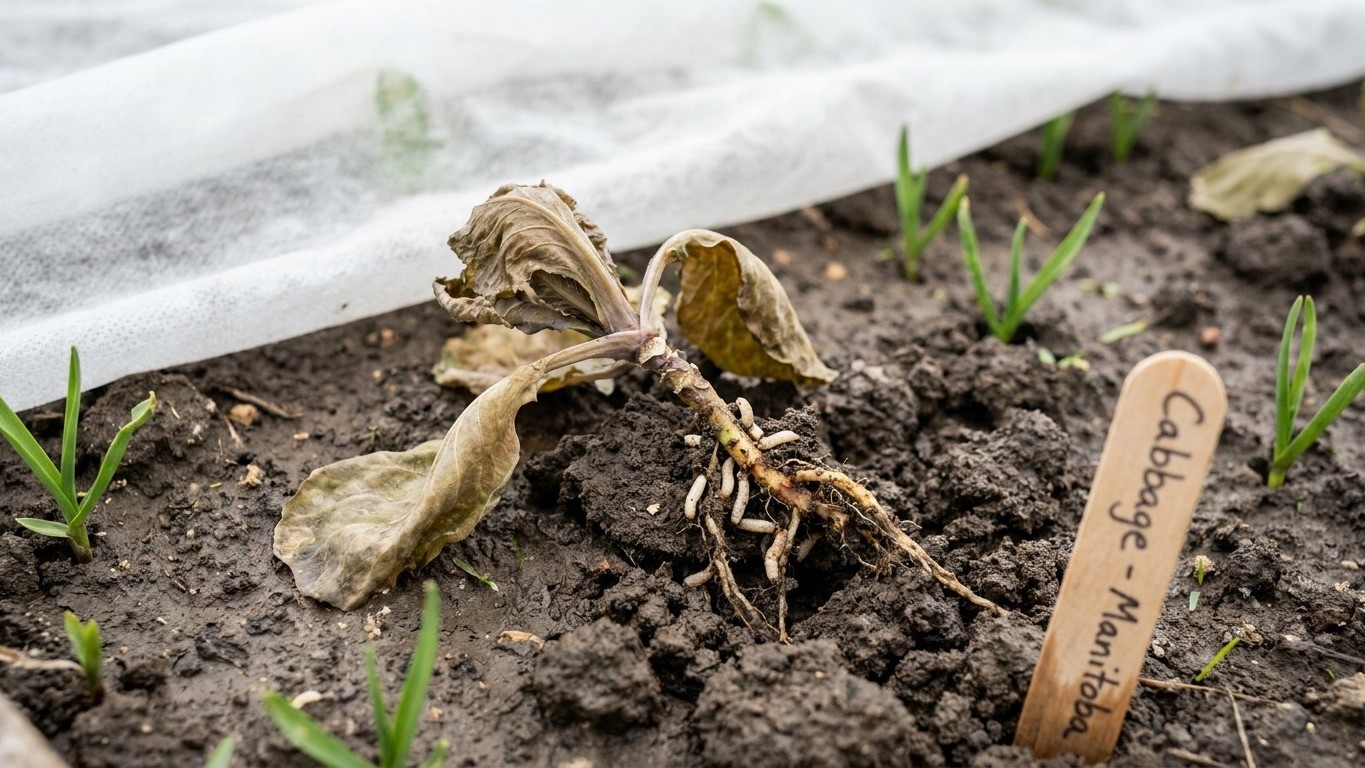
Cabbage maggot
The Cabbage maggot Manitoba gardeners find is a small white legless larva, about 1/4 inch long, that tunnels into cabbage, broccoli, and radish roots as seedlings emerge in cool spring soil. Plants wilt suddenly despite moist soil. Row cover laid down at seeding, before the adult fly finds the bed, blocks it completely, and it also helps against the Swede midge in Manitoba, another brassica pest whose larvae distort growing points and cause blind, crumpled heads later in the season.
Onion maggot
The Onion maggot Manitoba gardeners deal with is a white larva that attacks onion, leek, and garlic seedlings in the same cool spring window, causing yellowing and collapse at the base of young plants. Later in the season, gardeners may also notice the Boxelder bug in Manitoba clustering on warm walls and boxelder or maple trees nearby, though it rarely damages garden crops directly. Rotating away from the allium bed for a year, paired with row cover over new transplants, keeps the fly from laying eggs at the stem.
Colorado potato beetle
The Colorado potato beetle Manitoba adults overwinter in soil and walk into potato patches as plants emerge, rounded shells striped yellow and black, about 3/8 inch long. The soft orange larvae that follow strip leaves to the stem within days. Hand-picking both stages off leaf undersides every few days keeps small plantings ahead of an outbreak.
Three-lined potato beetle
Slimmer than the Colorado beetle, with three dark stripes on a yellow-orange back, the Three-lined potato beetle Manitoba gardeners encounter shows up on potato and related nightshades in late spring. The larvae feed hidden under a coating of their own dark excrement, an unmistakable identifying sign. Removing that first generation by hand limits the second flush in midsummer.
Striped cucumber beetle
Yellow with three bold black stripes down its back, the Striped cucumber beetle Manitoba gardeners find with three black stripes, about 1/5 inch long, it chews ragged holes in cucumber, squash, and melon seedlings and can spread bacterial wilt capable of killing the whole vine. It often shares the same squash and melon patch with the Squash bug Manitoba gardeners find later in the season. Row cover at seeding, removed once flowers need pollinators, is the most reliable defense.
Yellowheaded spruce sawfly
The Yellowheaded spruce sawfly Manitoba produces pale green larvae with a yellow-brown head that strip new spruce growth bare from the top of the tree down, in late spring and early summer, enough in a heavy season to stunt a young tree for years. Because larvae feed in clusters, a strong water jet or hand removal early in the infestation controls a small planting without spraying.
Squash bug
Flat, brownish-gray adults about 5/8 inch long gather at the base of squash and pumpkin vines by early summer, sucking sap until leaves blacken and collapse, a symptom often mistaken for wilt disease. Bronze egg clusters on leaf undersides give warning before adults appear; crushing them weekly cuts the population early.
Squash vine borer
The moth resembles a wasp more than a typical moth, but the damage comes from a cream-colored larva tunneling inside the stem base, invisible until the vine wilts overnight. Sawdust-like frass pushed out of a small hole at the stem is the giveaway. Wrapping the base of young vines in foil before egg-laying starts in early summer blocks the larva outright.
Swede midge
This tiny fly, barely 1/16 inch, lays eggs in the growing point of broccoli, cabbage, and related crops, twisting new growth into a distorted, unharvestable mess rather than leaving obvious holes. With several overlapping generations through the season, strict rotation off brassica ground for at least two years is the only dependable control once it’s established.
Emerald ash borer
A metallic green beetle about 1/2 inch long targets ash trees rather than vegetables. By the time D-shaped exit holes and a thinning canopy show up, larvae have already been tunneling under the bark for a year or more. There’s no home garden fix once a tree is infested, only early reporting and never moving firewood, since that’s the main way it spreads.
Boxelder bug
Flat, black adults with red-orange wing edges, about 1/2 inch long, cluster on boxelder and maple trees before moving onto house walls each fall looking for a place to overwinter. They cause little real plant damage and are mainly a nuisance indoors; sealing entry points around the house matters more than any spray in the yard.
Japanese beetle
Metallic green with copper-brown wing covers, about 1/2 inch long, adults skeletonize rose, grape, and other leaves through midsummer, feeding in groups that draw more beetles toward an already-damaged plant. Hand-picking into soapy water during cool morning hours, when they move slowest, works better than most sprays.
Corn earworm
The moth lays eggs directly on fresh corn silk, and the striped caterpillar that hatches rides the silk down to feed on kernels at the tip, invisible until the husk is pulled back at harvest. A few drops of mineral oil applied to fresh silk smothers young larvae before they reach the ear.
Spotted wing drosophila
This fruit fly, only about 1/8 inch long, lays eggs in ripening fruit while it’s still firm, so raspberries and cherries can look fine on the outside while carrying larvae inside. Picking fruit as soon as it ripens and clearing dropped or overripe fruit promptly denies the fly a place to breed.
Apple maggot
The adult fly is small and black with white-banded wings, but the damage comes from the larva it deposits inside developing apples in late summer, leaving winding brown tunnels through the flesh that only show up once the fruit is cut open. Red sticky-ball traps hung a few weeks before the usual harvest window catch adults before they lay eggs.
Telling damage apart
Reading the damage correctly matters more than spotting the insect itself, because half the culprits behind wilted or spotted plants aren’t insects at all. Chewed, ragged edges on leaves almost always point to a chewing insect: beetle adults or larvae, or a caterpillar working at night and hiding by day. That kind of damage looks torn, not smooth, and usually starts at the leaf margin and works inward.
Stippling, a fine pale speckling that leaves a leaf looking dusty or bronzed rather than torn, comes from sap-sucking insects piercing individual cells rather than biting through tissue. Squash bugs produce this pattern on squash and pumpkin foliage, and it’s often mistaken for early wilt disease since the leaf can go from stippled to collapsed within days once feeding is heavy enough to interrupt water flow to the leaf tip.
Wilting has three separate causes
A wilted plant with moist soil underneath usually means something has cut off its internal plumbing, either a root maggot chewing through roots below ground or a borer larva tunneling through the stem above it. A wilted plant with dry, cracked soil is a watering problem, plain and simple, and no pesticide will fix it. A wilted plant with soft, discolored stem tissue and a smell of rot points toward disease, often a soil-borne fungus that moves in once a plant is already stressed by poor drainage or crowding.
Sticky residue on leaves, often followed by a black, sooty film, signals sap-suckers again, this time leaving behind the sugary excretion known as honeydew that mold grows on. Holes punched cleanly through fruit, as opposed to chewed at the surface, usually mean a larva has already fed its way in and out, and by the time the hole is visible the damage inside is done. None of these signs require a lab to diagnose. They require slowing down and looking at where exactly on the plant the problem started.
What actually works
Prevention beats intervention in nearly every case, and the cheapest prevention is timing. Planting a few weeks later or earlier than the neighborhood norm, so a crop’s most vulnerable stage misses a pest’s peak emergence window, avoids a problem before it starts. Cabbage and onion maggots time their egg-laying to cool spring soil, so pushing brassica and allium transplants out a little later, once soil has warmed past that narrow window, sidesteps the worst of it without any product at all.
Rotation works on the same logic over a longer stretch. Moving related crops to a different bed each year strands root maggots and soil-dwelling larvae in ground that no longer offers their preferred host, and it’s free, requiring only a garden plan instead of a purchase. Physical barriers, mainly floating row cover laid over beds at seeding and sealed at the edges, block egg-laying adults outright for crops like cucumber, squash, and brassicas, though the cover has to come off once flowers open and need pollinator access.
Encouraging natural predators pays off over a season rather than overnight. Ground beetles, parasitic wasps, and birds all take a steady bite out of pest populations, and a garden that skips broad-spectrum spraying gives them room to build up. Once prevention has failed and a pest is established, targeted intervention makes sense: hand-picking beetles and egg masses, crushing clusters on sight, and reserving any spray for a confirmed, active infestation rather than a calendar schedule.
A few widely marketed remedies don’t hold up. Garlic or hot pepper sprays wash off in the next rain and need constant reapplication to do much of anything. Ultrasonic pest-repelling stakes have no solid evidence behind them for insect control. And planting marigolds throughout a vegetable bed, despite its reputation as an all-purpose pest cure, offers only modest, inconsistent protection at best.
What control costs
Hand-picking costs nothing but time, and for most home gardens it’s the cheapest option by a wide margin, since it needs no purchase and works on nearly every beetle and larva listed above. The time cost adds up over a season, though, since it has to be repeated every few days during a pest’s active window rather than done once.
Row cover and other physical barriers ask for a modest upfront purchase but get reused for several seasons if handled carefully, which spreads that cost thin over time. Biological controls, meaning beneficial insects either encouraged in the yard or purchased and released, cost more upfront and don’t offer instant results, since they need time to establish and hunt down prey at their own pace. Sprays, whether conventional or organic-labeled, tend to be the most expensive option over a full season because most need reapplication after every rain and every week or two of new growth, and none of them address the pest that’s already tunneled inside a stem or fruit.
| Method | Upfront cost | Repeat frequency | Best suited to |
|---|---|---|---|
| Hand-picking | None | Every few days during active season | Beetles, larvae, egg masses |
| Barriers / row cover | Low to moderate | Reused several seasons | Seedlings and transplants before egg-laying |
| Biological controls | Moderate | Established once, monitored yearly | Ongoing suppression of soft-bodied pests |
| Sprays | Low per application, high over a season | After every rain or new growth | Confirmed active infestations only |
For a typical home vegetable patch, hand-picking combined with row cover at the right moment covers most of what shows up on this list without ever reaching for a bottle.
Local help
Since no Canadian province publishes a home-garden pest list to match the U.S. extension data above, the right next step for identifying an actual specimen or reporting an outbreak is Manitoba’s own agriculture office. Manitoba Agriculture handles specimen identification and tracks pest activity across the province, and it’s the source to check before treating any insect as confirmed locally.
Common questions
Are these pests actually confirmed in Manitoba?
Not officially. The list above comes from extension services in North Dakota and Minnesota, states that share Manitoba’s climate and crops but not its provincial government. Treat the list as a strong likelihood based on shared biology, and confirm any specific finding with Manitoba Agriculture.
Which pest does the most damage to home vegetable gardens?
Among the pests documented for this region, root and stem borers like squash vine borer and swede midge tend to cause the most complete crop loss, since damage is often invisible until the plant collapses, compared to leaf-feeders like Japanese beetle where damage is visible early and manageable with hand-picking.
Do I need to spray on a schedule to prevent pests?
No. Scheduled spraying wastes money, kills off the predator insects that would otherwise help, and does nothing against pests already inside a stem or fruit. Spraying makes sense only after a confirmed, active infestation, and prevention through timing and barriers handles most of the risk beforehand.
When should I start watching for garden pests in Manitoba?
Based on the seasonal pattern documented for this region, watch cool spring soil for root maggots as soon as brassica and allium seedlings emerge, then shift attention to beetles and vine borers as temperatures climb into early summer, and finally to fruit- and bark-feeding pests as crops ripen in late summer.
Related guides
- Garden Pests in Saskatchewan: What Shows Up, When, and How to Stop It
- Garden Pests in Ontario: What Shows Up, When, and How to Stop It
- Garden Pests in New Brunswick: What Shows Up, When, and How to Stop It
- Garden Pests in British Columbia: What Shows Up, When, and How to Stop It
- Garden Pests in Prince Edward Island: What Shows Up, When, and How to Stop It