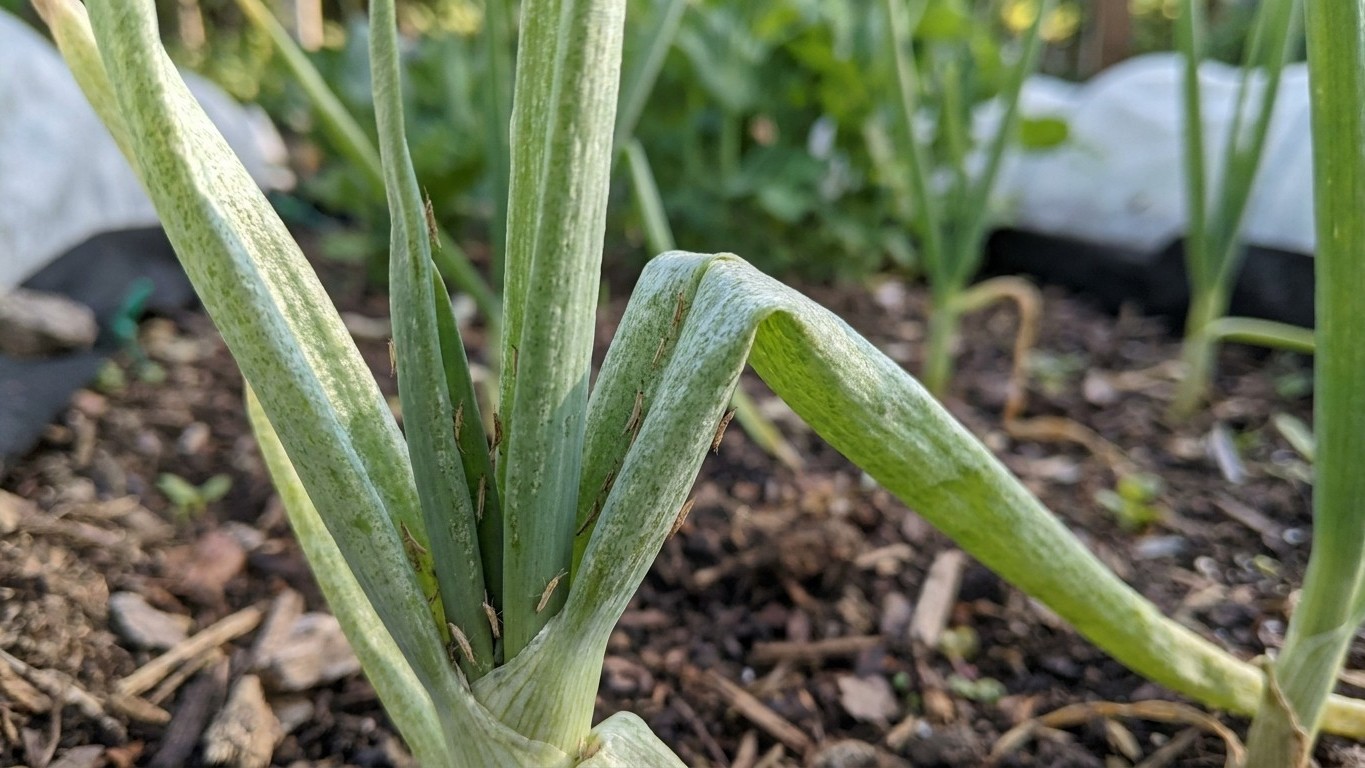

Onion thrips show up in British Columbia gardens as soon as spring soil warms past the mid-50s Fahrenheit, usually working through several overlapping generations from late spring into late summer. Row covers, tight crop rotation, and quick cleanup of allium debris are what actually keep populations down, since once thrips are tucked into leaf sheaths, sprays and traps do little.
The weeks to watch

Onion thrips (Thrips tabaci) become active in British Columbia once daytime soil and air temperatures push consistently past the low-to-mid 50s Fahrenheit, which in most of the Lower Mainland and southern valleys lines up with mid-to-late spring. No British Columbia extension bulletin publishes a fixed calendar window specifically for onion thrips flights, so the timing below follows the general biology of the species rather than a province-specific date.
First generation, spring
Adults that overwintered in plant debris, weeds, or nearby vegetation begin moving into new onion, garlic, and leek plantings shortly after transplanting or seeding, once temperatures stay warm enough for feeding and egg-laying to resume. This first wave is often the easiest to miss, since populations start small and damage looks like faint silvering rather than obvious injury.
Summer generations, the real pressure
Onion thrips can complete a generation in roughly two to three weeks under warm conditions, so a single spring arrival can turn into three, four, or more overlapping generations by the time summer heat sets in. Hot, dry stretches, common in the Interior and in dry Lower Mainland summers, tend to push numbers up fastest, since thrips reproduction speeds up with heat and slows sharply in cool, wet weather.
Reading the calendar from your last frost

British Columbia gardeners don’t plan around a thrips date; they plan around frost, and thrips timing follows from there. At Vancouver International Airport, the average last spring frost falls on March 18, based on Environment and Climate Change Canada’s 1981-2010 climate normals. That’s a mean date, not a guarantee: in roughly half of all years, frost arrives later than March 18, and gardens outside the immediate Lower Mainland, especially in the Interior, the Kootenays, or higher elevations, run weeks behind that coastal station.
To work out roughly when thrips pressure builds on your own onions, garlic, or leeks, the math runs in two steps:
- Start from your local average last frost date (March 18 at Vancouver’s climate station, later inland or at elevation), and treat it as a midpoint, not a safe cutoff.
- Onion family transplants typically go in a few weeks on either side of that date, and gardeners commonly report the first signs of thrips feeding showing up within three to four weeks of transplanting, once the plants have leafed out enough to feed on.
That arithmetic gives a range, not a single day. If you want row covers in place before thrips arrive, the safest move is to have them on at transplanting and plan to lift them only once bulbs need pollinator access or once the covers start trapping too much heat.
What it attacks, and what the damage looks like

Most British Columbia gardeners notice onion thrips damage before they ever spot the insect itself. Leaves develop silvery-white streaks or papery blotches where the surface tissue has been scraped away, and heavily fed-on leaves can curl, twist, or turn a dull silver-gray across large patches. In onions, this feeding damage on the leaves translates directly into smaller bulbs, since the plant loses photosynthetic surface at the exact time it should be building bulb size.
The crops most commonly affected in home gardens include:
- Onions
- Garlic
- Leeks
- Shallots
- Chives
- Cabbage and other brassicas, as a secondary host
Both the immature nymphs and the winged adults feed by rasping the leaf surface and sucking up the released plant fluid, but the nymphs do most of the damage in a home garden setting. Unlike adults, nymphs can’t fly to a new plant when conditions get crowded, so they concentrate in the folds where new leaves emerge from the neck of the plant, tucked into a space that’s hard for any spray to reach. That’s the detail that matters for treatment: once nymphs have settled into those leaf sheaths, contact measures applied to open leaf surfaces largely miss them.
How British Columbia sits in this pest’s range

Onion thrips are one of the most widely distributed insect pests of alliums in North America, present wherever onions, garlic, and related crops are grown in any quantity. That wide range means the difference between British Columbia and other growing regions is mostly a matter of timing, not whether the pest shows up at all. A grower in a warmer, drier interior valley will generally see thrips activity ramp up earlier and hold on longer through summer than a grower on the cooler, wetter coast.
British Columbia’s climate is not uniform enough to give onion thrips a single provincial season. The Vancouver Int’l A station, the source for the frost date used here, sits in a mild coastal microclimate; growers in the Okanagan, the Fraser Valley’s inland edges, or higher-elevation gardens work with different soil-warming timelines and should expect thrips activity to shift accordingly, generally later and more compressed where springs stay cool longer. No published source ranks British Columbia’s onion thrips pressure against other provinces or U.S. states, and none of the figures here should be read as a severity claim, just a note that the pest is common and its arrival tracks local warming rather than a fixed provincial calendar.
What actually works against it

For home gardeners already seeing damage or trying to head it off, the effective measures run cheapest and easiest first, with a clear point where each one stops helping:
- Time planting to avoid overlap with old allium debris. Overwintering adults emerge from last year’s plant residue and nearby weeds, so a planting site with no leftover onion or garlic material nearby gives thrips fewer places to start from.
- Cover new transplants with floating row cover. A physical barrier keeps flying adults from reaching young plants at all. This only works if it goes on before thrips arrive and stays sealed at the edges; once adults are already inside, or the cover has to come off for pollination or heat relief, the barrier stops doing anything.
- Hand-pick or remove heavily infested leaves. Useful on light, early infestations where thrips are still concentrated in a few leaf folds. Once populations spread across a whole planting, picking off leaves can’t keep pace with the reproduction rate.
- Rotate alliums away from last year’s planting site. Since thrips overwinter near where they fed, moving onions, garlic, and leeks to a different bed each year, ideally several beds away, cuts down on adults finding new plants close to their overwintering spot.
- Clear crop debris promptly after harvest. Removing spent onion and garlic tops rather than leaving them to break down in place takes away the sheltered spot where the next generation of adults would otherwise overwinter. This won’t help if neighboring untended plots or wild onion relatives nearby still host a population.
Some gardeners also try reflective mulches, believing the light disrupts thrips landing on foliage, but trial results on home-garden-scale plantings are mixed and don’t establish a clear mechanism. None of these home measures require any pesticide, and none of them do much once thrips have already settled deep into leaf sheaths, which is exactly why timing and prevention carry more weight here than any single fix applied after damage appears.
Common questions
Do onion thrips survive winter in British Columbia?
Adults overwinter in plant debris, weeds, and other sheltered vegetation rather than dying off completely, which is why cleaning up old allium residue in fall reduces the population that emerges the following spring.
Can row covers fully stop onion thrips?
Row covers block flying adults from reaching a crop, but only if they’re in place before thrips arrive and sealed tightly at the edges. Once thrips are already established under the cover, or the cover comes off for pollination, the barrier no longer offers protection.
What does onion thrips damage look like on garlic compared to onions?
Both crops show the same silvery, rasped patches on leaves, but garlic tends to show curling and twisting more visibly along its flatter leaf blades, while onion damage more directly tracks with smaller bulb size at harvest.