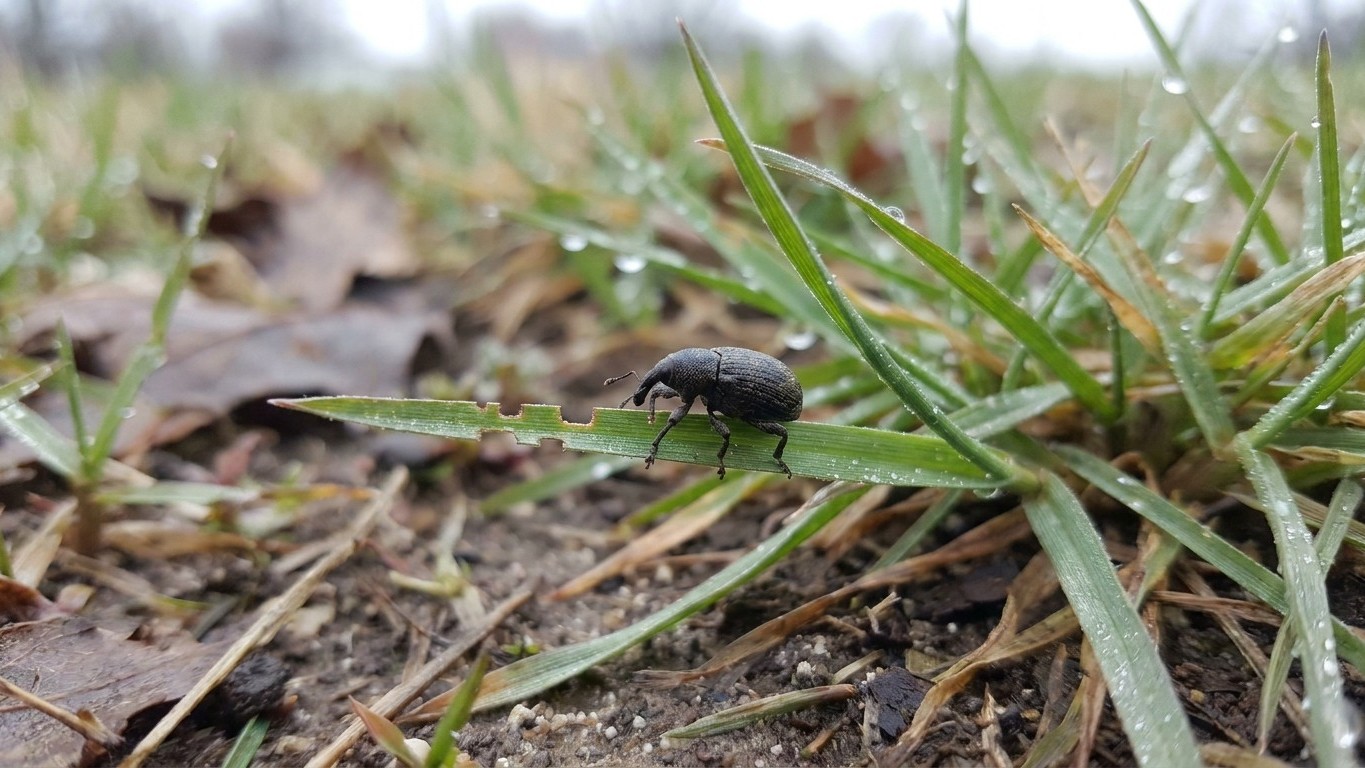

Hunting billbugs move into Missouri lawns as soil warms in spring, with adults active by late spring and the more damaging larvae feeding through summer into early fall. There’s no chemical fix once larvae are established inside grass crowns and stems: the only real control window is before egg-laying starts, which means timing and turf management matter more than anything applied after damage shows.
The weeks to watch

Adult hunting billbugs begin walking (they rarely fly) across Missouri turf as soon as soil temperatures climb out of the cold range in spring, and larval feeding, the stage that actually kills turf, runs from late spring through the hottest weeks of summer. University of Missouri Extension / MU IPM does not publish a specific emergence window for hunting billbug the way it does for several other landscape pests tracked in its Missouri Environment and Garden newsletter, so what follows for timing is the general pattern for this species in the transition zone rather than a Missouri-specific date.
Spring adult activity
Overwintering adults hide in thatch, leaf litter, and grass crowns through the cold months and start moving once the ground warms in spring. This is when the small, round feeding notches on grass blades near the crown first appear, though they’re easy to miss because the damage is minor compared to what comes next.
Summer larval feeding
Females lay eggs inside grass stems in late spring, and the larvae that hatch tunnel downward, feeding first inside the stem and later on the crown and roots. This is the stage responsible for the dead, easily-pulled patches homeowners actually notice, and it runs through the warm months. For comparison, MU’s IPM calendar notes that other Missouri pests peak on tighter schedules: Japanese beetles emerge mid to late June and peak the second week of July, squash vine borers emerge around June, and bagworms need control in June because by July they’re nearly too large to treat. Hunting billbug simply isn’t tracked on that same published calendar.
Reading the calendar from your last frost

Hunting billbugs respond to soil warmth, not to a page on the calendar, so a cold, late spring pushes adult activity back and a warm one pulls it forward. The most useful anchor a Missouri homeowner has is the last spring frost date, which for the Kansas City area (Kansas City International Airport station) runs April 6 to April 20 according to NOAA’s 1991-2020 climate normals. That’s a range, not a single day, and it shifts with location: the downtown Kansas City station typically clears frost about five days earlier than the airport, and lawns in southern Missouri warm up sooner still.
- Start from your local last-frost window (April 6 to April 20 for the Kansas City area, earlier for downtown or southern Missouri).
- Expect adult billbug activity to begin as soil temperatures rise in the weeks following that frost-free period, with egg-laying and the start of larval feeding following as the ground continues to warm through late spring.
Because MU Extension doesn’t publish an exact weeks-after-frost figure for this species, treat this as a planning tool, not a countdown. If you’re planning preventive lawn care such as dethatching or overseeding to reduce egg-laying sites, doing it in the weeks right after your local frost date, rather than waiting until damage appears, is the more useful move.
What it attacks, and what the damage looks like

A homeowner usually notices hunting billbug damage as a patch of lawn that looks drought-stressed even after watering, or that pulls up like loose carpet with almost no root resistance. Look closer at the base of affected grass and you’ll often find a fine, sawdust-like material called frass, a telltale sign that a larva has been tunneling inside the stem. Adult feeding on its own leaves small notches or holes in grass blades near the crown, but it’s the larval stage boring into stems and then feeding on crowns and roots that does the destructive damage, and by the time it’s visible, the insect is already inside the plant tissue.
Hunting billbug favors Warm-Season turf, with the heaviest pressure on:
- Zoysiagrass, its primary host in Missouri lawns
- Bermudagrass
- Occasionally Kentucky bluegrass and other Cool-Season lawns growing near infested warm-season turf
Because the larval stage does the real harm and it’s already hidden inside the stem or crown by the time symptoms appear, identifying the insect early, from adult feeding notches or frass, matters more than trying to catch the larvae once the damage is showing.
How Missouri sits in this pest’s range

This site currently documents hunting billbug in a single territory, Missouri, which means the state sits near an edge of the insect’s known range rather than in the middle of well-established, heavily documented turf-pest territory. Hunting billbug has historically been more associated with warmer, southern lawns built on zoysiagrass and bermudagrass, and its presence in Missouri reflects the spread of those warm-season turf varieties into the transition zone rather than a pest that’s been tracked here for generations the way Japanese beetles or bagworms have.
With only one territory documented, there’s no basis here for ranking Missouri’s severity against other states or claiming a trend one way or another. What can be said is narrower and more useful: Missouri lawns growing zoysiagrass, particularly in warmer microclimates and southern parts of the state, are the setting where this pest is most likely to actually show up, while cooler-season lawns further from that turf type carry less exposure.
What actually works against it

Cultural prevention beats any treatment applied after larvae are already inside the grass, and the cheapest steps come first.
- Run a soap flush test in early spring. Mix a small amount of dish soap into a bucket of water and pour it over a suspect patch of lawn; adult billbugs, if present, will surface within a few minutes. This costs nothing and tells you whether adults are active before eggs are laid.
- Reduce thatch through regular dethatching and proper mowing height. Females lay eggs into grass stems within the thatch layer, so a thinner thatch layer gives them fewer places to do it.
- Overseed damaged patches with less-susceptible turf. Rotating away from a zoysiagrass monoculture in trouble spots reduces the amount of preferred host material available.
- Keep turf well-watered and fertilized through summer. Healthy, well-irrigated turf tolerates root feeding better and recovers faster than drought-stressed lawn, though this manages the symptom rather than the insect.
- Apply beneficial nematodes to soil while larvae are still young, typically earlier in the summer feeding period. Nematodes actively seek out grubs in the soil, but they need to reach the larvae before they mature and pupate, and they can’t reach larvae still feeding deep inside a stem.
Once larvae have tunneled well into the crown or stem, no cultural or biological measure reaches them. At that point the damage for the season is largely set, and the practical response shifts to helping the turf recover and putting prevention in place before the following spring’s adult activity.
Common questions
Does Missouri have an official hunting billbug forecast or treatment calendar?
No. University of Missouri Extension / MU IPM publishes seasonal notes for several landscape pests through its Missouri Environment and Garden newsletter, but hunting billbug is not one of the species given a specific published window there.
Can hunting billbug damage be confused with drought or grub damage?
Yes, and often is. All three produce brown, easily-pulled turf, but billbug damage typically comes with sawdust-like frass at the base of grass shoots, a sign that points specifically to a stem-boring larva rather than root grubs or simple water stress.
Is hunting billbug limited to zoysiagrass lawns in Missouri?
Zoysiagrass is its primary host here, but bermudagrass is also at risk, and lawns with a mix of warm- and cool-season grass can see spillover feeding on adjacent bluegrass, particularly where zoysiagrass patches are already infested.