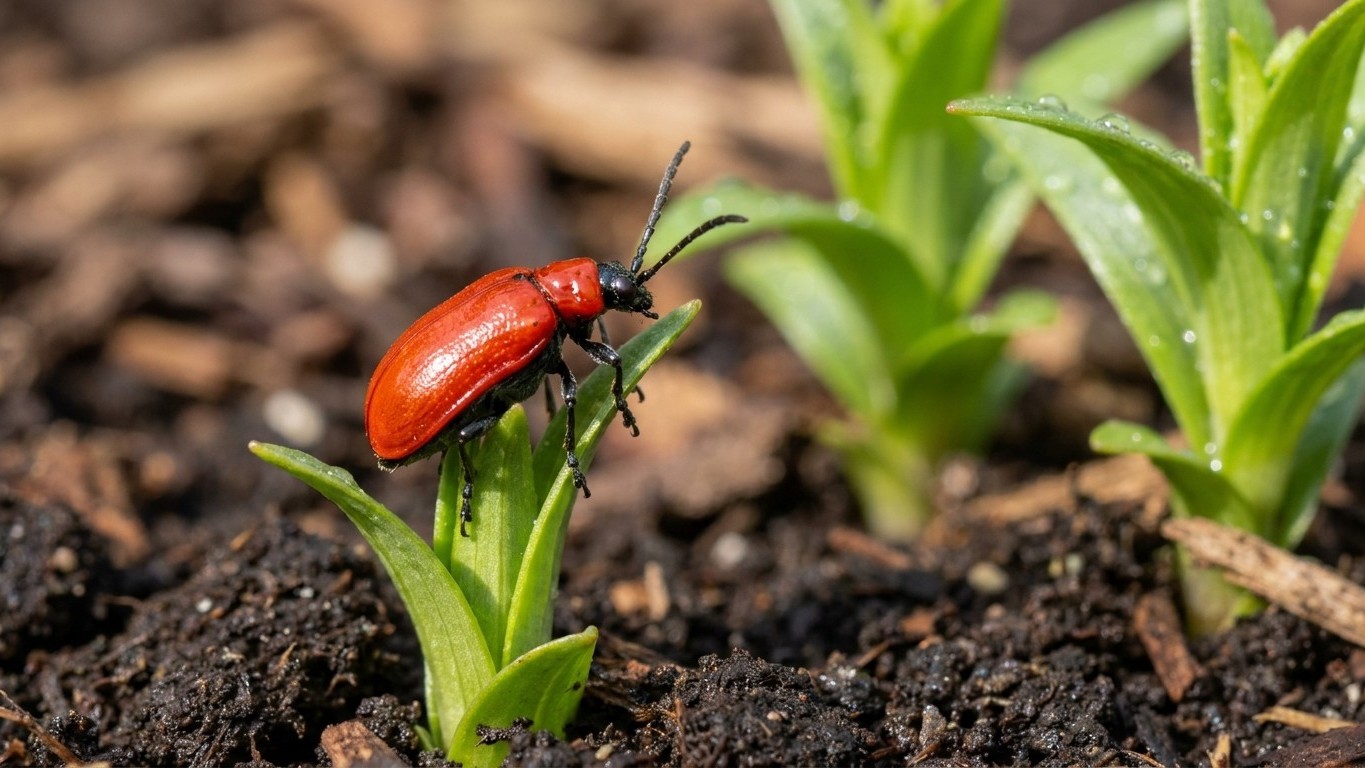

The lily leaf beetle typically arrives in Connecticut gardens in April, right when true lily shoots poke a few inches out of the soil. Adults that overwintered in leaf litter and soil crawl out, find those tender new shoots, and start feeding and laying eggs almost immediately. Stopping it comes down to timing: catching adults before they lay eggs, scraping off egg clusters, and removing larvae before they strip a plant bare.
This is not a pest you can ignore for a season and fix later. A single female can lay hundreds of eggs over the spring and summer, and both the adults and the slug-like larvae feed on lily foliage, flowers, and stems. Left unchecked on a bed of Asiatic or Oriental lilies, the damage can go from a few chewed leaves to a completely skeletonized plant within a few weeks.
What the Beetle Looks Like at Each Stage

The adult is hard to miss once you know what you’re looking for: a bright scarlet-red beetle about 3/8 inch long, with a black head, black legs, and black antennae. It moves fast and drops to the ground the instant it feels threatened, often landing on its back with its black underside facing up, which makes it blend into garden soil and mulch. That defensive trick is one reason gardeners lose track of beetles they were sure they’d just seen.
The larvae look nothing like the adults. They’re soft, orange to brownish-yellow grubs that feed on the undersides of leaves, and they cover themselves with their own dark, wet excrement as a defense against predators. It’s an effective strategy against birds, but it also means a leaf that looks like it’s covered in mud or bug droppings is usually hosting a larva underneath that coating. Eggs are small, orange-red, and laid in irregular rows along the leaf midrib or vein, usually on the underside.
The Connecticut Timeline: When to Watch and When to Act
Lily leaf beetle adults overwinter in soil, leaf litter, and plant debris near where lilies grew the previous year, sometimes several feet from the original bed. In Connecticut, they typically emerge in early to mid-April, tracking closely with the first flush of lily foliage. That overlap is not a coincidence. Adults need actively growing lily tissue to feed and to lay eggs, so their emergence is timed to the plant’s growth, not the calendar date alone.
Egg-laying runs from late April through June, with larvae hatching within a week or two and feeding heavily through most of June. This is the window when damage accelerates fastest, since larvae eat far more tissue per beetle than adults do. By midsummer, larvae drop to the soil to pupate, and new adults emerge in July and August to feed again before finding overwintering sites in fall. In practice, that means Connecticut gardeners are dealing with this insect from early spring through the first hard frost, though the heaviest damage window is April through June.
One detail that trips people up: New England generally sees one generation per year, but the extended adult activity period (spring emergence, summer feeding, fall preparation for overwintering) makes it feel like the pest never really leaves. That’s part of why control has to be a season-long habit rather than a one-time spray.
True Lilies vs. Daylilies: Knowing What’s Actually at Risk
This is the mix-up that causes the most confusion in home gardens. The lily leaf beetle feeds on true lilies, meaning plants in the genus Lilium, such as Asiatic lilies, Oriental lilies, Turk’s cap lilies, Easter lilies, and tiger lilies. It also feeds on fritillaria, a related bulb plant.
Daylilies, in the genus Hemerocallis, are a completely different plant family despite the shared common name, and they are not a host for this beetle. If you’ve got daylilies covered in chewed foliage, something else is responsible (deer, slugs, or a different insect), and treating for lily leaf beetle would be wasted effort. Confirming which plant you’re actually growing before spending money on treatment is worth the five minutes it takes to check.
What Actually Stops It
No single tactic wipes out an established lily leaf beetle population. The pest responds best to a combination of physical removal, timing, and, where needed, targeted products.
Hand-picking and egg removal
Checking lily plants two or three times a week from April through June is the single most effective free tactic available. Adults are easiest to catch early in the morning when temperatures are cooler and they’re less likely to bolt for the ground. Because they drop and play dead when disturbed, it helps to hold a container underneath the leaf before touching the beetle, so it falls into soapy water rather than escaping into the mulch.
Eggs are laid on the undersides of leaves in short, irregular rows. Running a thumb along the underside of new lily leaves and crushing or scraping off any orange egg clusters before they hatch removes a huge chunk of the next generation before it ever becomes a larva. Larvae themselves can be picked off too, though gloves are worth using given the fecal coating they carry.
Targeted products
For heavier infestations, neem oil and insecticidal soap applied directly to larvae and adults offer a lower-impact option, since they break down quickly and have less residual effect on beneficial insects than longer-lasting chemicals. Spinosad-based products, derived from a naturally occurring soil bacterium, have shown effectiveness against larvae when applied while they’re young and still feeding openly on leaf undersides.
Systemic insecticides containing imidacloprid are sometimes used against this pest, but they carry real drawbacks. Because lilies flower and attract pollinators, systemic products taken up through the roots and expressed in nectar and pollen raise legitimate concerns for bees. Home gardeners who want to keep lilies and support pollinators are generally better served by hand-picking and targeted contact treatments rather than a systemic approach.
Biological control in progress
Researchers in the Northeast, including work coordinated through University of Rhode Island’s biological control program, have released parasitic wasps in the genus Tetrastichus that specifically target lily leaf beetle larvae and eggs. These wasps have established in parts of New England, and where populations are present, they’ve measurably reduced beetle numbers over several seasons. This kind of biocontrol won’t eliminate the pest from a home garden overnight, but it’s a sign that pressure from this beetle may ease somewhat in areas where the wasp populations take hold over the coming years.
Garden cleanup that actually matters
Because adults overwinter in leaf litter and debris near lily beds, clearing fallen leaves and dead plant material from around lilies in late fall removes some of their favored shelter. It won’t stop beetles from flying in from a neighbor’s yard, but in a garden where lilies have struggled for several years running, reducing overwintering habitat on-site is one more factor working in the gardener’s favor rather than against it.
Gardeners who’ve dealt with Japanese beetles or aphids sometimes assume the same casual approach will work here, spray once and move on. Lily leaf beetle doesn’t cooperate with that mindset. It rewards the gardener who checks leaves weekly starting the moment lily shoots break ground in April, because by the time visible chewing shows up on a mature leaf, the eggs for the next wave are usually already laid on the leaf right next to it.
Related guides
- Lily leaf beetle in Massachusetts: When It Shows Up and What Stops It
- Lily leaf beetle in Rhode Island: When It Shows Up and What Stops It
- Lily leaf beetle in Iowa: When It Shows Up and What Stops It
- Lily leaf beetle in Maine: When It Shows Up and What Stops It
- Lily leaf beetle in Newfoundland and Labrador: When It Shows Up and What Stops It