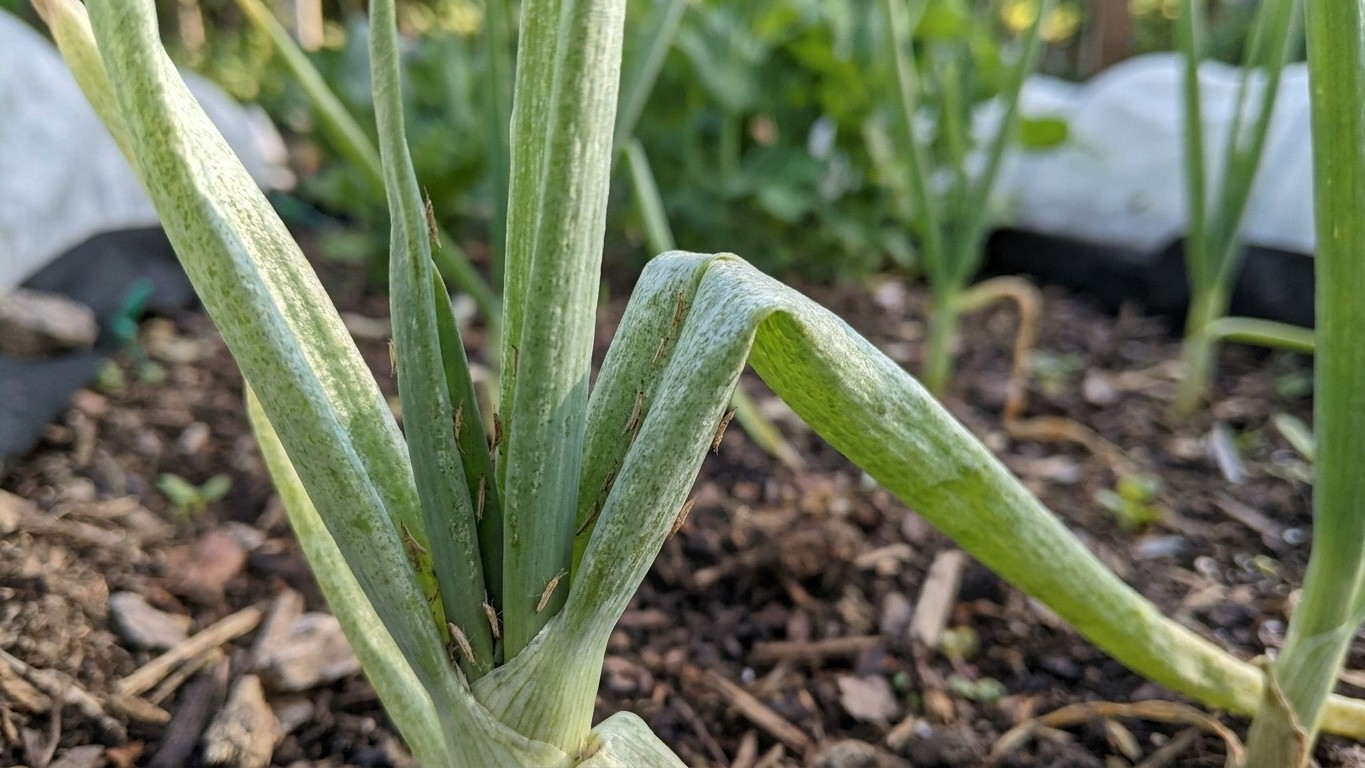

Onion thrips show up in Utah gardens as soil and air temperatures climb into the mid-60s°F, usually somewhere between late April and early June depending on elevation. Once established, they run through several overlapping generations all summer. The cheapest, most reliable defenses are cultural: reflective mulch, row covers put on before the first flight, and clearing garden debris where adults overwinter, not sprays applied after damage appears.
The weeks to watch

Onion thrips activity in Utah typically begins once daytime temperatures hold above the mid-60s°F for several consecutive days, which in most of the state lands somewhere between late April and early June depending on elevation and how sheltered the site is. Utah State University Extension does not publish a specific calendar window for onion thrips, so the timing below follows the general pattern documented for the species rather than a Utah-specific date range.
First generation, spring
The earliest adults emerge from soil, plant debris, or nearby weeds as temperatures warm. This first wave is usually small and easy to miss, since populations start low and build slowly before the weather turns consistently warm.
Summer generations, overlapping
Because a single generation can complete its cycle in a couple of weeks under warm conditions, adults, nymphs, and eggs are often present at the same time by midsummer. This overlap is what makes onion thrips populations explode fast once conditions favor them, and it’s why a garden that looked fine in June can show heavy damage by late July.
Late-season decline
Populations taper off as temperatures cool in early fall and host plants mature or get harvested. Adults that survive the season typically move into plant debris or soil to overwinter, which sets up next year’s first generation.
Reading the calendar from your last frost

The one date most Utah gardeners actually plan around is the last spring frost, and for the Salt Lake City area (station USW00024127) NOAA’s 1991-2020 climate normals put that window between April 12 and April 29. Onion thrips don’t answer to a calendar date, though. They respond to soil and air warmth, so a cold, late spring pushes their arrival back, and an early warm spell pulls it forward.
- Start from your last frost date, April 12 to April 29 for the Salt Lake valley (colder at higher elevation, milder in southern Utah).
- Add the time it takes soil and air to hold steadily in the mid-60s°F, then a couple of weeks more for a generation to develop under warm conditions. That puts first visible feeding damage roughly a few weeks after transplanting, once temperatures cooperate.
That arithmetic is a guide, not a guarantee. Treat the frost date as a normal built from thirty years of data, and treat the thrips timing as something that shifts with whatever spring actually does.
What it attacks, and what the damage looks like

Most gardeners notice the damage long before they see the insect responsible. Leaves develop silvery-white streaks or papery, bleached patches where the surface tissue has been scraped away, and heavily infested leaves can curl, twist, or turn brown at the tips. Look closely and you’ll often find tiny black specks scattered across the damaged areas, which are the thrips’ fecal droppings rather than a disease symptom.
Onion thrips feed on a range of garden crops, not just their namesake vegetable:
- Onions, garlic, leeks, and shallots
- Cabbage and other cole crops like broccoli
- Cucumbers and melons
- Beans
Both nymphs and adults cause damage by rasping the leaf surface and sucking the sap that pools underneath, but nymphs usually do the most cumulative harm because there are far more of them present at any given time during an active generation. Adults can fly and move plant to plant, while the earlier life stages, and especially the pupal stage, spend time in the soil where they aren’t feeding at all. That distinction matters for treatment: anything aimed at nymphs or adults still exposed on foliage has a chance to work, but nothing reaches thrips once they’ve dropped into the soil to pupate.
How Utah sits in this pest’s range

This site currently documents onion thrips in one territory, Utah, so there’s no cross-state comparison to draw on yet for how the state’s populations compare to neighboring states. What can be said with confidence is that conditions vary a lot within Utah’s own borders. The Salt Lake valley sits in a relatively mild pocket for a state this dry and this high, and NOAA’s frost-date data reflects that milder valley setting specifically. Most of Utah sits at higher elevation and stays colder longer into spring, which would push thrips activity later in those areas, while southern Utah’s warmer valleys likely see earlier activity than the Salt Lake data suggests.
That elevation spread means a gardener in St. George and a gardener in a mountain valley community are working with meaningfully different timelines even though they’re in the same state. Anyone outside the immediate Salt Lake area should treat the frost window and the resulting thrips timeline as a starting point to adjust from, not a fixed schedule.
What actually works against it

The most effective measures against onion thrips are cultural and preventive rather than reactive, and they work best in this order, cheapest and easiest first.
- Time planting to dodge peak population. Getting transplants in early, before the first generation builds up, gives plants a head start before thrips numbers climb. This works because it shortens the window when young, vulnerable growth overlaps with an active generation.
- Cover plants before the first flight arrives. Lightweight row covers placed at transplanting keep adult thrips from reaching foliage to lay eggs in the first place. This stops working the moment covers come off, or if thrips are already present underneath when the cover goes on.
- Use reflective mulch. Silver or reflective plastic mulch laid around alliums disrupts the visual cues thrips use to locate host plants, and it’s a widely used technique in commercial onion production. It only helps before an infestation is established; once thrips have settled into the leaf axils, reflective mulch on the ground no longer changes anything for them.
- Clear plant debris and nearby weeds after harvest. Adult thrips and pupae overwinter in old plant material and weedy borders, so removing that debris cuts down on the population that survives to start next year’s first generation. This is a between-season measure, not something that helps mid-infestation.
- Rotate allium and cole crops to a different bed each year. This reduces the odds that overwintering thrips emerge right next to a fresh host crop. It’s most useful in small gardens where the same few beds get planted year after year.
- Hose off or hand-remove thrips from foliage while populations are still visible and low. This buys time but has to be repeated often, since surviving thrips and unaffected eggs keep the population going. Once nymphs are tucked into tight leaf folds and axils where onions and leeks naturally hide them, physical removal from the outside stops reaching them at all.
Every measure on this list loses effectiveness once thrips have moved into the sheltered folds where onions and leeks naturally protect their own growing points. That’s the point at which prevention would have mattered more than any response applied afterward.
Common questions
Do onion thrips only attack onions?
No. While onions, garlic, and leeks are their main hosts, onion thrips also feed on cabbage and other cole crops, cucumbers, melons, and beans, so damage on a non-allium crop nearby doesn’t rule them out.
Can I use sprays to get rid of onion thrips fast?
Sprays only reach thrips stages exposed on the leaf surface. Nymphs tucked into leaf axils and any thrips that have already dropped to the soil to pupate are out of reach regardless of what’s applied, which is why prevention before an infestation builds tends to matter more than treatment after the fact.
Do row covers work if thrips overwinter in the soil already?
Row covers only stop thrips from flying in from elsewhere. If adults or pupae are already overwintering in the same bed’s soil or debris, covering the new crop traps that existing population inside with it rather than keeping it out, which is why clearing debris the season before matters as much as the cover itself.