
Common stalk borer shows up in Wisconsin gardens starting in spring, but the state’s extension service doesn’t publish a date specific to this insect. It falls inside the broader corn-pest calendar that runs April through September, with most corn pests, stalk borer included, not becoming noticeable until mid-August. Clearing grassy garden edges, using row covers early, and catching a wilted stem before the larva burrows deep are what actually cut the damage.
The weeks to watch

Wisconsin’s extension guide doesn’t name a flight or hatch date for the common stalk borer specifically. What it does give is the season it falls inside: garden insect pressure statewide runs from April through September, and within that stretch, corn pests as a group, which is where stalk borer belongs, don’t become abundant until mid-August. That’s the window a gardener here should actually watch, even without a species-specific date from the local office.
The general vegetable-garden season
April through September covers the full run of insect activity in a Wisconsin vegetable patch, from early cutworms in cool soil to late-season aphids before frost shuts things down. Stalk borer sits somewhere in the middle of that stretch, not at either end.
Where corn pests peak
The same University of Wisconsin-Madison guide notes that most corn pests don’t reach damaging numbers until mid-August, well after the plants have tasseled. For comparison, the guide also flags that squash vine borer, a different insect entirely, starts wilting squash vines in late July. That gap between the two matters: a gardener scouting corn in July for stalk borer signs is likely looking a few weeks too early, going by the pattern this source lays out.
Reading the calendar from your last frost

Stalk borer larvae don’t check a calendar. They respond to soil and plant temperature, so a cold, late spring pushes their activity back and a warm one pulls it forward, same as it does for the crops they attack. The one date most Wisconsin gardeners already plan around is the last spring frost, and it’s a reasonable anchor point for working out roughly when to start watching.
- NOAA’s 30-year climate normal for the Milwaukee-area station puts the last spring freeze between April 16 and April 29. That’s a range, not a single day, and it shifts by region across the state, especially near Lake Michigan, where the lakeshore stays milder into the fall than inland southern Wisconsin.
- Counting forward to the mid-August point when corn pests, stalk borer among them, typically become abundant works out to roughly 16 to 17 weeks after that frost window, depending on where your own last frost actually lands within the April 16 to April 29 range.
That span, four months give or take, is why row covers matter more in the first half of the season than the second: once plants are tall and the mid-August window arrives, a cover over the row does little except block pollinators.
What it attacks, and what the damage looks like

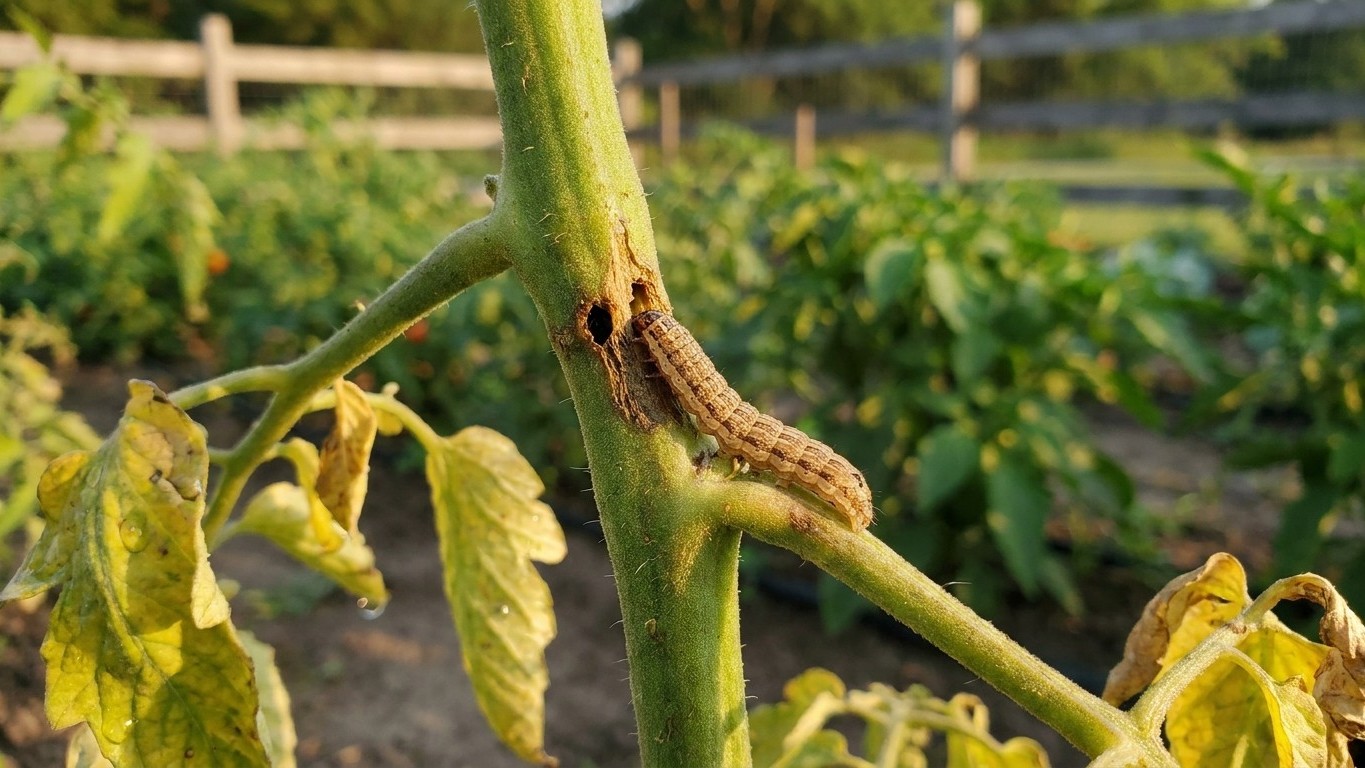
Most gardeners notice the plant before they ever see the insect. A single leaf, or the whole top of a young corn stalk, wilts suddenly while the rest of the plant still looks green and healthy. Look closer near the base and there’s often a small entry hole with a crumb of sawdust-like frass pushed out beside it. On broader-leafed plants like potatoes or dahlias, young larvae sometimes leave a ragged, shot-hole pattern across the leaf surface before they ever tunnel into a stem. The larva is the stage doing all of that damage; it feeds first on leaf tissue, then bores inward, and once it’s inside the stalk it keeps feeding there until it moves on or pupates.
- Corn
- Tomatoes and peppers
- Potatoes
- Beans
- Rhubarb
- Ornamentals such as dahlia, hollyhock, and iris
That range of hosts is part of what makes stalk borer tricky. A garden with a mixed bed of vegetables and flowers can have the insect moving from an ornamental border into the vegetable rows over the course of a season, since the larva will travel from one stem to another if the first one dries out or gets too crowded inside.
How Wisconsin sits in this pest’s range

Common stalk borer is a broadly distributed insect across the eastern and central United States, and Wisconsin sits well inside that range rather than near an edge of it. For a pest this widespread, the difference from one state to the next usually comes down to timing, not whether it shows up at all. A gardener in southern Wisconsin and one in central Illinois are both dealing with the same insect; they’re just watching for it on slightly different calendars, tied to how quickly the ground warms in spring.
Within Wisconsin itself, the same logic applies on a smaller scale. The lakeshore counties near Lake Michigan warm more slowly in spring and hold heat longer into fall than the inland south, which typically sees its first fall freeze in early October, while northern Wisconsin freezes considerably earlier. None of that changes whether stalk borer is present, only when its activity lines up with a given garden’s growing season.
What actually works against it

- Clear grassy weeds along garden borders in fall or very early spring. Stalk borer eggs overwinter in grass stems and weedy edges near the garden, not in the soil of the vegetable bed itself. Removing that vegetation before larvae hatch and migrate removes the launching point for the whole problem, and it costs nothing but time.
- Rotate susceptible crops away from those same weedy borders. Newly hatched larvae travel a fairly short distance from grass into the nearest stem. Planting corn, tomatoes, or dahlias farther from last year’s weedy edge lowers the odds they get found first.
- Scout for early wilting and slit the stem by hand. If a single leaf or shoot wilts while the rest of the plant looks fine, a gardener can often slit the stem lengthwise near the entry hole and remove the larva with a knife point or pin, then firm the soil around the base to help the plant recover. This only works while the larva is still near the entry point, before it’s tunneled far down the stalk.
- Use row covers during the early migration weeks, then remove them. A physical barrier over young transplants can keep migrating larvae from reaching the stem in the first place. It has to come off once flowering starts, both because pollinators need access and because by that point in the season the cover isn’t blocking anything useful anymore.
- Once a larva is established inside the stalk, none of the above helps. Row covers, hand-picking on the surface, and rotation all work by keeping the larva out or catching it early; once it’s feeding deep inside a stem, the plant is typically a loss for that season, and pulling and destroying the affected stalk mainly serves to reduce the population feeding the following year.
Common questions
When does common stalk borer show up in Wisconsin gardens?
The state’s extension guide doesn’t give a specific date for this species. It falls within the general garden pest season of April through September, and corn pests as a group, stalk borer included, typically don’t become noticeable until mid-August.
What does stalk borer damage look like on corn or tomatoes?
The first sign is usually a single wilted leaf or shoot tip while the rest of the plant stays healthy. A small entry hole with crumbly frass near the base of the stem is the next thing to check for.
Can a plant recover once the larva is inside the stem?
Sometimes, if it’s caught early. Slitting the stem near the entry hole and removing the larva by hand can save a plant while the larva is still close to where it entered. Once it’s tunneled deep, the affected stalk is usually not salvageable.