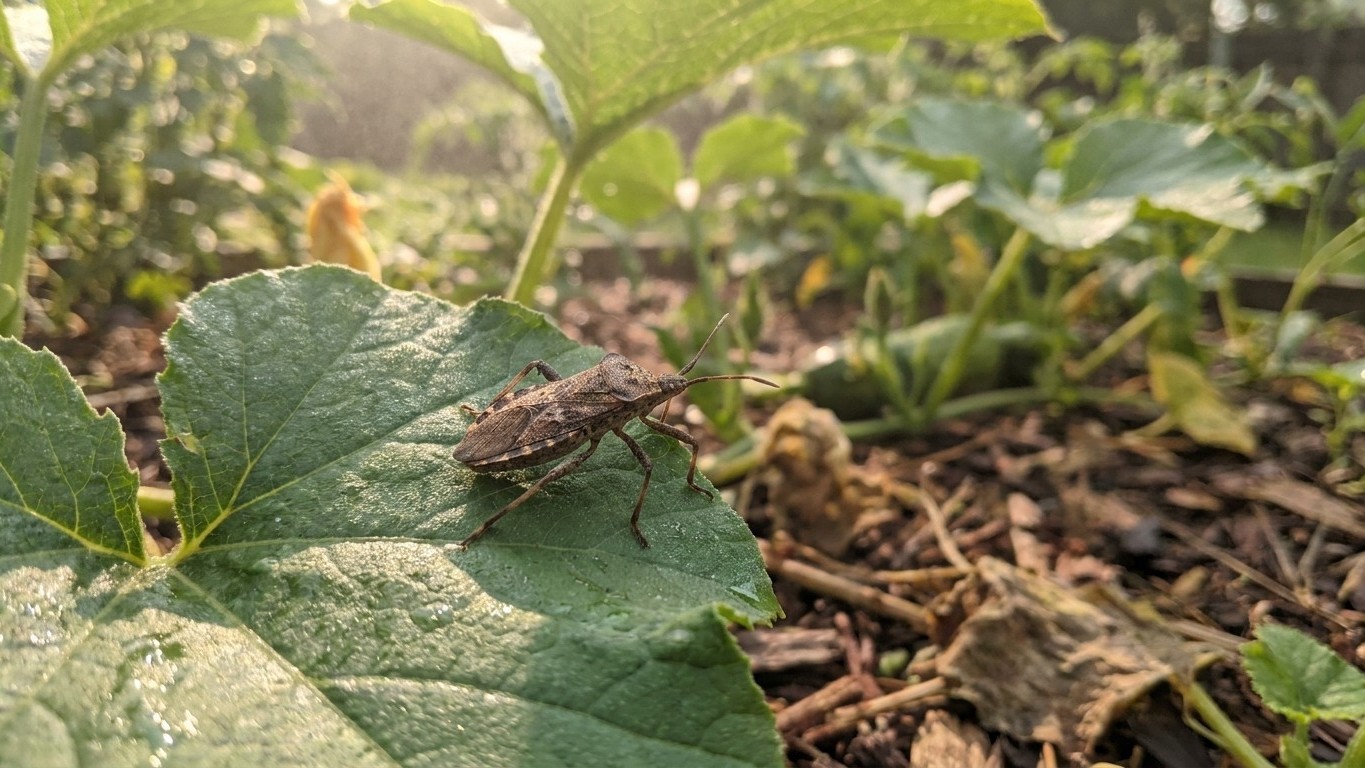

Summer Squash in Pennsylvania faces a short but recognizable list: squash vine borer, aphids, flea beetles, Japanese beetle, and occasionally brown marmorated stink bug feeding on the fruit itself. Each shows up at a different point in the growing season, tied more to plant stage than to a calendar date.
Which pests attack Summer Squash in Pennsylvania
Penn State Extension documents ten species as garden and field pests across the state, but only a handful of them have any business on a squash plant. Squash vine borer, aphids, flea beetles, and Japanese beetle are the ones that regularly show up on summer squash. Brown marmorated stink bug (Halyomorpha halys) belongs on this list too, though it behaves more like an opportunist than a specialist: it will feed on squash fruit when it’s around, but it isn’t tied to cucurbits the way squash vine borer is.
The rest of the Penn State Extension list has nothing to do with squash, and it’s worth saying why, because a gardener who sees the wrong name attached to the wrong crop stops trusting the source. Cabbage worms and leafminers work on brassicas and leafy greens, not vines. Colorado potato beetle is a nightshade specialist, potatoes, eggplant, tomato foliage, and skips cucurbits almost entirely. Onion maggot attacks the root systems of the onion family and has no reason to be near a squash hill. Tomato hornworm feeds on tomato-family foliage, not squash leaves, despite looking dramatic enough that people assume it eats everything. Spotted lanternfly (Lycorma delicatula) prefers tree of heaven and grapevines; it isn’t a vegetable garden pest at all, whatever its reputation from orchards and vineyards.
That leaves a short, honest list for anyone growing Summer Squash in this state: squash vine borer as the main threat, aphids and flea beetles as steady background pressure, Japanese beetle as a summer nuisance on leaves and blossoms, and stink bug as an occasional fruit feeder. Penn State Extension does not document a longer list of squash-specific pests for this territory, and padding it with generalist tree or field pests would be misleading. Knowing which four or five actually matter is more useful than a long list that includes things that will never touch the plant.
When each one shows up, and what it does first
Timing in Pennsylvania starts with the last spring frost, which falls between March 29 and April 6 at the Philadelphia reference station, with the northern tier and the Alleghenies running two to four weeks later. Squash goes into the ground after that date, once soil has warmed, and the pest sequence follows from there rather than from a fixed month.
Flea beetles are usually the first sign of trouble, showing up within the first couple of weeks after seedlings or transplants go in. The tell is a scatter of small round holes across young leaves, sometimes called shot-holing, concentrated on the first true leaves rather than the whole plant. A stand that’s still small and stressed can lose enough leaf tissue to slow it down permanently, which is why early damage matters more than the same damage later in the season.
Squash vine borer follows a few weeks after transplanting, once vines start to run. The first sign isn’t the insect, it’s a small pile of frass, sawdust-like material, sitting at the base of a stem, sometimes right before a vine that looked fine the day before suddenly wilts in the afternoon heat. By the time wilting shows up, the larva is already inside the stem.
Aphids build up steadily through the warm stretch of summer, and Pennsylvania sees an average of 24 days a year at or above 90°F, which is enough heat load to push aphid populations through several generations on the undersides of leaves. Look for curled or yellowing leaves and a sticky residue (honeydew) before the insects themselves are obvious. Japanese beetle arrives a bit later, feeding on leaves in a lace-like skeletonized pattern and often clustering on blossoms, usually once temperatures are reliably warm through the day. Stink bug feeding on fruit tends to show up last, leaving small discolored dimples on the rind rather than obvious external insects.
Telling the damage apart from everything else
A squash plant that looks sick isn’t always dealing with an insect. Pennsylvania’s summer rainfall averages about 12.7 inches across June, July, and August, with June the driest month at 4.04 inches, and a plant that wilts during a dry stretch is often just thirsty, not infested. The distinction matters because treating a watering problem like a pest problem wastes time and doesn’t fix anything.
Sudden wilting of one vine while the rest of the plant looks fine points toward squash vine borer, especially with frass at the stem base. Wilting of the whole plant that recovers overnight and returns the next hot afternoon is more likely drought stress, particularly during a dry June. Small round holes in leaves suggest flea beetle; ragged, larger holes with skeletonized leaf tissue point to Japanese beetle instead. Yellowing that starts at leaf margins and moves inward, without any visible insects, can be a nutrient issue rather than aphids, though a hand lens check under the leaf settles it either way.
| Symptom | Likely cause | What settles it |
|---|---|---|
| Sudden wilt, one vine only | Squash vine borer | Frass at stem base; split stem shows larva |
| Whole-plant wilt, recovers overnight | Drought stress | Soil dry below the surface; recovers after watering |
| Small round shot-holes in leaves | Flea beetles | Damage concentrated on young leaves early in the season |
| Ragged, skeletonized leaf tissue | Japanese beetle | Beetles visible on leaves and blossoms in daylight |
| Leaf yellowing, no insects visible | Nutrient deficiency or aphids | Check leaf undersides for aphid clusters and honeydew |
A local county extension office is the right place to send a photo or a sample when the cause still isn’t clear after checking these signs. Guessing from a symptom list is a starting point, not a diagnosis.
What actually works here, and what is a waste of time
Timing beats almost everything else on a short Pennsylvania growing season, and a physical barrier put in place early does more than most people expect. Row cover placed over young squash plants right after transplanting, before flea beetles or vine borer moths find them, blocks both pests during the vulnerable seedling stage. The cover has to come off once flowering starts, since squash needs pollinator access to set fruit, and that single timing decision matters more than any product applied afterward.
Checking stems at the soil line every few days through the early summer catches squash vine borer eggs or early tunneling before a vine collapses. Removing and destroying vines that show frass, rather than leaving them in place hoping the plant recovers, keeps a borer problem from spreading to nearby hills. Crop rotation, moving squash to a different bed than where it grew the previous year, reduces the odds of vine borer pupae overwintering right where next year’s plants will go in.
What tends to waste time is spraying anything after wilting has already set in on a squash vine borer-affected plant. Once the larva is inside the stem, surface treatments don’t reach it, and the plant is usually already lost. Broad, repeated treatments applied on a fixed schedule rather than in response to actual scouting also burn time and money without matching the real pressure a given garden is under, since pest levels vary a lot from one yard to the next even within the same county. Because material choice and legal use depend on the label and on state rules, a county extension office is the resource for what’s actually approved to use here, not a general gardening list.
Where to check this for your own county
Penn State Extension (extension.psu.edu) documents this list at the state level, and every county in Pennsylvania has a local extension office that adapts it to conditions on the ground. What’s documented statewide doesn’t tell a gardener whether squash vine borer is active in their specific township this year, since a species can be heavy in one part of a state and nearly absent thirty miles away.
Frost timing alone illustrates the range: a garden near Philadelphia and one in the northern tier or the Alleghenies can be planting squash two to four weeks apart, which shifts every pest date that follows.
The most useful next step for a specific yard is contacting the county extension office directly, ideally with a photo of the damage and, if possible, the insect itself. Local offices track what’s actually showing up that season and can confirm a diagnosis faster than working through a symptom list alone. A pest documented for the state is not a guarantee it’s in any one garden, and the county office is the place that knows the difference.