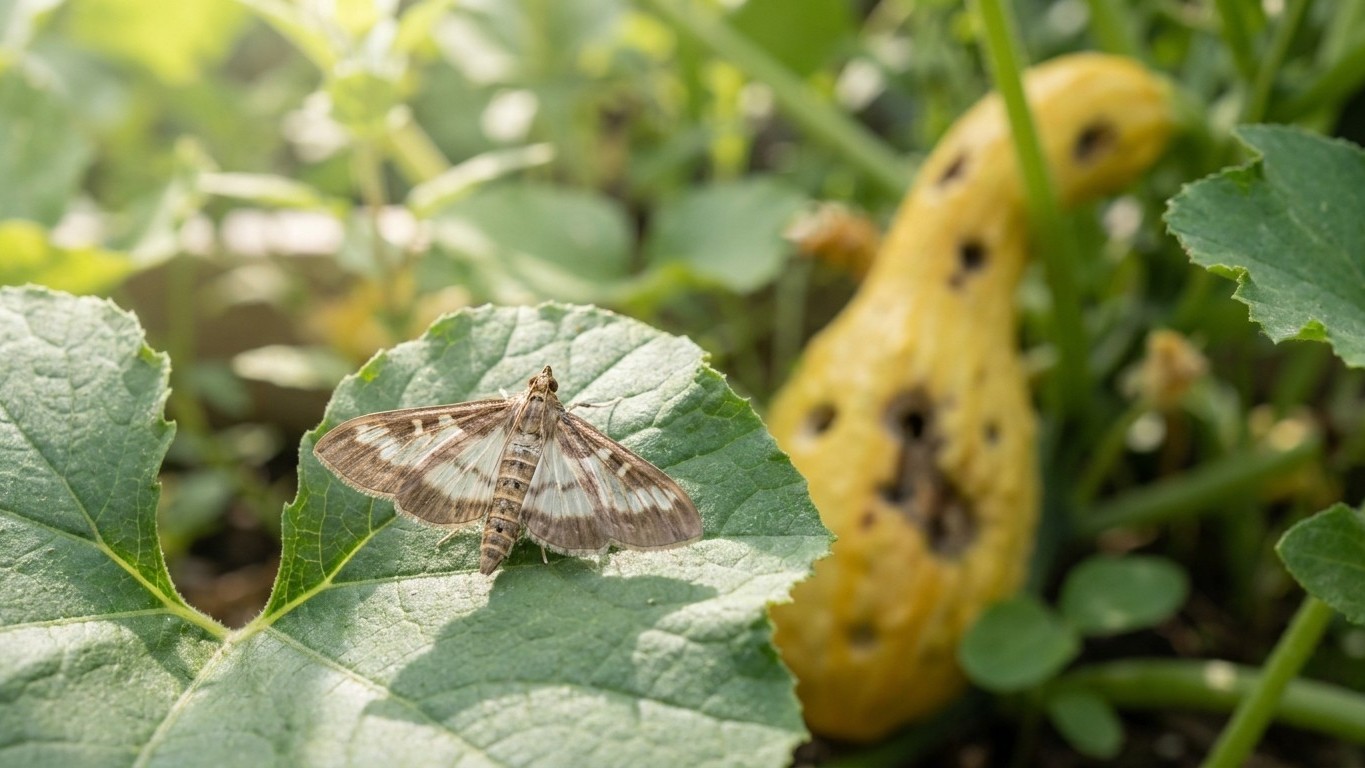

Three pests documented for this region actually target summer squash: the striped cucumber beetle, the squash vine borer, and the seedcorn maggot. Each one shows up at a different stage of the plant’s life, and each leaves a distinct signature. The rest of what gets blamed for a struggling squash patch here, from wilting leaves to stunted vines, usually traces back to something other than an insect.
Which pests attack Summer Squash in Prince Edward Island
University of Maine Cooperative Extension documents ten pests for this region: browntail moth, cabbage maggot, Colorado potato beetle, emerald ash borer, lily leaf beetle, seedcorn maggot, spotted wing drosophila, squash vine borer, striped cucumber beetle, and winter moth. That’s the full list as the service records it, and it isn’t a squash-specific list. Most of these ten have nothing to do with a squash bed.
Browntail moth, emerald ash borer, and winter moth are tree and shrub feeders. Browntail moth larvae strip oak and cherry foliage, emerald ash borer tunnels under the bark of ash trees, and winter moth caterpillars chew emerging leaves on fruit trees and hardwoods. None of the three has any reason to be in a vegetable bed. Cabbage maggot targets brassicas, meaning cabbage, broccoli, radish, and their relatives, not cucurbits. Colorado potato beetle is a nightshade specialist, feeding on potato, eggplant, and tomato foliage, and it will pass right by a squash plant. Lily leaf beetle, despite the name overlap with vine crops, feeds only on true lilies and fritillaries. Spotted wing drosophila attacks soft, thin-skinned fruit like raspberries and blueberries as they ripen, not squash.
That leaves three species that genuinely feed on summer squash: seedcorn maggot, which attacks the seed before it even sprouts; striped cucumber beetle, which arrives the moment seedlings break the surface; and squash vine borer, which shows up later and does the most damage per plant. If a gardener sees a pest on this list that isn’t one of those three, it’s almost certainly not what’s hurting the squash. A pest documented for the province doesn’t mean it’s documented as a squash pest, and separating the two is the difference between treating the right problem and wasting a season chasing the wrong one.
When each one shows up, and what it does first
Timing here runs off the frost-free window rather than a fixed date on the calendar. Charlottetown A’s climate normals put the average last spring frost at May 16 and the average first fall frost at October 17, a frost-free stretch of roughly 154 days. That average frost date is a midpoint, not a guarantee, since in one year out of two the actual frost lands later than May 16. Squash growers here typically wait past that date to plant, and the three pests fall into line behind it.
Seedcorn maggot: the first threat, before anything is visible above ground
Seedcorn maggot damage happens underground, in the first two to three weeks after seed goes in the ground, while soil is still cool and wet from spring. The maggot tunnels into the seed itself before it germinates, or into the sprout just below the soil line. The first sign a gardener sees is a gap in the row where nothing came up, not a chewed leaf.
Striped cucumber beetle: waiting at the surface for emergence
This one is active as soon as seedlings or transplants appear. Adult beetles overwinter nearby and are ready the moment the frost-free window opens, so damage on cotyledons and first true leaves can appear within days of a plant breaking ground. Small, ragged feeding holes on young leaves, sometimes several beetles visible on a single seedling, mark this stage.
Squash vine borer: the later, quieter threat
Adult moths fly and lay eggs at the base of the stem in the weeks after plants have established and started to vine, well into the frost-free season rather than right at planting. The first visible sign isn’t the moth or the egg. It’s a healthy-looking vine that suddenly wilts during the day, days to weeks after the egg was laid and the larva has already tunneled inside.
Telling the damage apart from everything else
Squash beds fail for plenty of reasons that have nothing to do with insects, and mistaking one for the other leads to treating a plant that doesn’t need it. The single most useful habit is checking the stem base and the soil line before assuming a pest is at work.
| What you see | Possible cause | What settles it |
|---|---|---|
| Vine wilts suddenly, sawdust-like material at the base | Squash vine borer | Frass and a small entry hole at the stem base; the wilt doesn’t recover overnight even after watering, unlike drought stress |
| Ragged holes or pitting on leaves and blossoms, seen during daylight | Striped cucumber beetle | Beetles visible on the plant while feeding; slug damage looks similar but happens at night and leaves a silvery slime trail |
| Seeds never come up, or seedlings collapse before breaking the surface | Seedcorn maggot | Digging up the planted seed shows a small legless white maggot inside it; cold, slow germination or seed rot from damp soil looks similar but shows no insect at all |
Yellowing leaves, blossom drop, or stunted growth without any of these specific signs point more often toward uneven watering, a nutrient gap, or a soil-borne disease than toward any of the three pests above. A local extension office can confirm what’s actually happening in a specific bed, and that confirmation matters more than a guess made from a photo.
What actually works here, and what is a waste of time
Row covers put in place at seeding or transplanting, and left on until flowering begins, block both the cucumber beetle and the vine borer moth from reaching the plant during the two windows when they do the most damage. That single practice, timed to this region’s short frost-free stretch, does more than most sprays applied after the fact. Covers have to come off once flowers open, though, since summer squash needs pollinators to set fruit, and leaving covers on through bloom trades one problem for another.
Rotating squash out of the same bed each year reduces the local buildup of overwintering cucumber beetles and vine borer pupae, since both spend part of the year in the soil near where they fed. Choosing transplants over direct seeding also shortens the window a germinating seed spends exposed to seedcorn maggot in cool spring soil, cutting the maggot’s odds without any treatment at all.
What doesn’t help: broad treatments applied without regard to timing, especially anything applied once flowers are open, since that’s also when pollinators are visiting the plant. Late intervention after a vine has already wilted from borer damage rarely saves that vine, since the larva is already inside the stem by the time wilting shows. And treating for a pest that isn’t actually present, because it appeared on a general list, wastes a step that could have gone toward the cover or the rotation that actually works.
Where to check this for your own county
Prince Edward Island’s own agriculture services are the right first stop for anything specific to a particular garden, since the pest documentation cited here comes from University of Maine Cooperative Extension, a neighboring service covering similar growing conditions rather than a PEI-specific pest survey. What’s documented at a regional level doesn’t describe what’s actually present in one garden bed. A pest count for the wider region says nothing about whether cucumber beetle pressure is heavy in one county and nearly absent in the next, and that kind of local variation is common even within a small province.
A garden a few miles from the coast, on lighter soil that warms faster in spring, can see seedcorn maggot pressure ease earlier than a garden on heavier inland soil that stays cool longer. The frost-free window itself shifts too, since Charlottetown A’s averages describe one reference station, and upland or northern parts of the province typically run behind it by days to weeks.
The next useful step for a squash grower here isn’t another list of pests. It’s a call or visit to the provincial agriculture office, or the nearest county extension contact, with a description or a sample of what’s actually showing up on the plant. That’s the only way to match what’s documented at the regional level with what’s really in the ground.