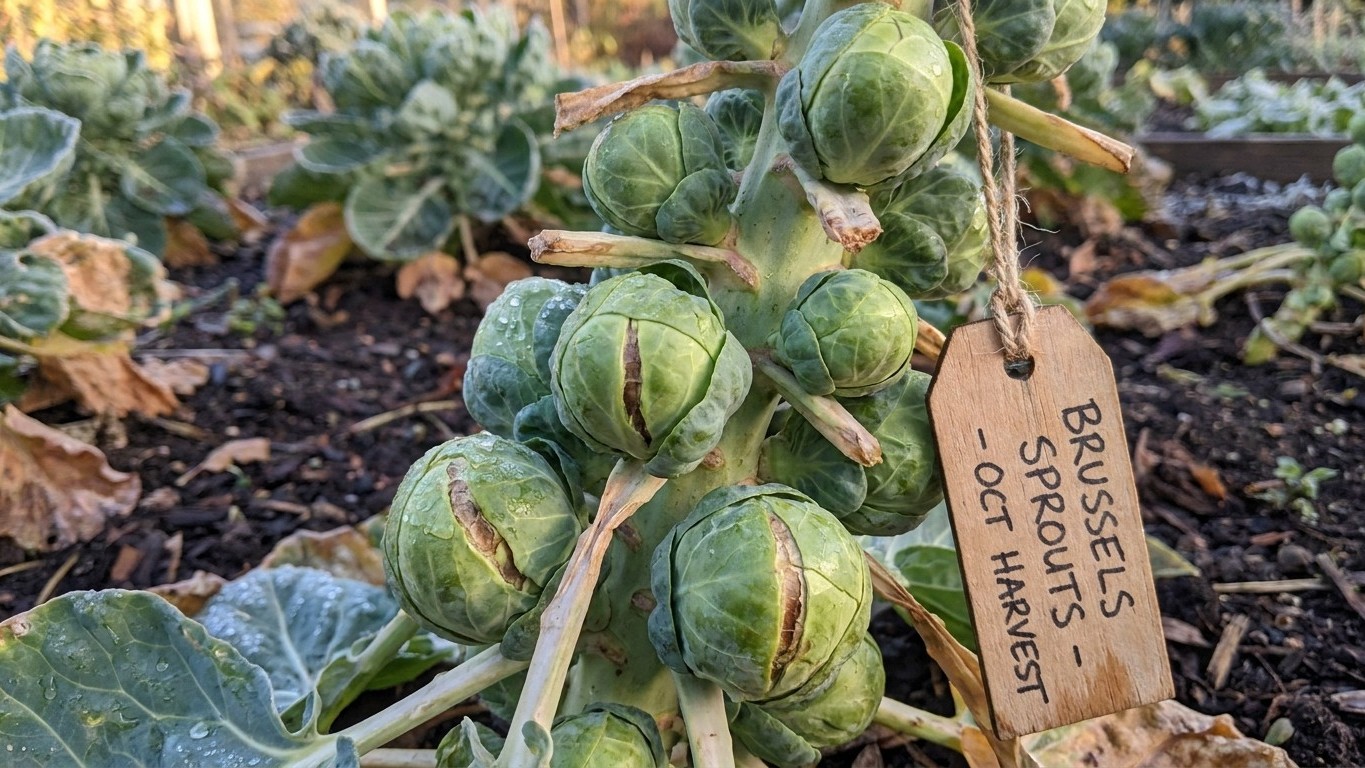

Loose or split Brussels sprouts almost always trace back to one moment: nitrogen or water applied after the sprouts have already started forming along the stalk. Utah State University Extension is blunt about it in their guide, Brussel Sprouts in the Garden: high nitrogen levels cause loose sprouts and splitting, and moisture fluctuations during heading split them open or turn them bitter. Both faults share the same trigger window, which makes them easy to prevent and just as easy to cause by accident.
The short answer
Once sprouts begin to form along the lower stalk, two things stop being helpful and start being harmful: extra nitrogen and uneven watering. Utah State University Extension states it directly, high nitrogen levels cause loose sprouts and splitting to occur, and separately, moisture fluctuations during heading will cause maturing sprouts to split open or develop bitter flavors. Two different inputs, two different faults, but the same trigger point. Before the sprouts form, feeding and watering generously is exactly right. After they form, the same habits work against the plant.
This matters more for Brussels sprouts than for almost any other fall crop, because the timing runs backward compared to what most gardeners are used to. Brussels Sprouts Are not a spring vegetable. They’re sown in early summer specifically so the sprouts mature as autumn cools down, and the plant tolerates a series of light frosts without serious damage. Count from your own first fall frost date, not from any spring benchmark, when you plan the nitrogen schedule and the harvest window.
The Extension guide is specific about the nitrogen schedule that keeps sprouts tight: applications go on at 4 weeks and again at 8 weeks after transplanting, and then feeding stops. That two-dose schedule is timed to build the plant’s frame and push early sprout development, not to feed the sprouts themselves once they’ve started forming. Adding a third round because the plant looks like it could use a boost is precisely the mistake that produces loose, split sprouts later.
Water follows a similar logic, but the mechanism is different. Nitrogen overfeeding pushes the plant toward loose, leafy growth instead of tight, compact sprouts. Water inconsistency works more mechanically, the outer sprout leaves swell and shrink with each wet-dry cycle, and the skin eventually cracks under the strain, similar to how a tomato splits after a heavy rain following a dry spell. Both problems are set at heading time, and both are avoidable with a plan made before the sprouts ever start to form.
Variety choice plays a role too, though it doesn’t override the nitrogen and water rules. Utah State University Extension names three varieties with their approximate days to maturity: Long Island Improved at 90 days, Jade Cross at 100 days, and Diablo at 110 days. A longer-season variety like Diablo gives you more calendar room before your first fall frost, which in turn gives you more margin for error if a nitrogen or watering mistake happens early. It doesn’t fix a mistake made at heading time, but it does buy a little slack.
What actually decides it

The short version is easy to state, but the reasoning behind it is what actually helps you avoid the problem next season. Two separate mechanisms are at work here, and they don’t respond to the same fix.
Why nitrogen loosens the sprout
Brussels sprouts form as tight, compact buds along the stalk, essentially miniature cabbages stacked one above another. That compactness depends on the plant directing its energy into building dense layers rather than pushing rapid leafy growth. Nitrogen is the nutrient most responsible for vegetative expansion, and once sprouts have started forming, extra nitrogen pushes the plant back toward that leafy growth mode. The result, according to Utah State University Extension, is loose sprouts and splitting. The plant isn’t damaged in a visible way, it’s simply growing the wrong way at the wrong time, expanding tissue that should be staying dense.
Why moisture swings split the head
Splitting from water works on a more mechanical principle. A maturing sprout has a fixed skin capacity. When soil moisture is inconsistent, wet stretches followed by dry stretches or the reverse, the inner tissue expands and contracts faster than the outer layer can adjust. Utah State University Extension notes that these moisture fluctuations during heading cause maturing sprouts to split open or develop bitter flavors, pairing a texture failure with a flavor failure in the same cause. Both stem from stress at the cellular level during a period when the sprout has very little tolerance for change.
Why tipburn isn’t a calcium shortage
A related but distinct problem is tipburn, browning at the edges of the Inner Leaves. Utah State University Extension is specific that this is caused by calcium deficiencies in the plant, but adds an important clarification: most soils in Utah are very high in calcium, so plants have access to plenty of this nutrient. The real issue is transport. When plants go through stress periods from heat, water, or nutrient swings, calcium is not adequately transported to the inner leaves, even though it’s present in the soil. This is the same transport failure behind tipburn in cabbage and blackheart in celery. Adding more calcium to the soil does nothing, because the soil was never short. The fix is uniform irrigation, moderate fertilizer additions, and mulches, all aimed at reducing the stress that interrupts transport rather than increasing a nutrient that was never scarce.
How to do it
Getting tight, unsplit sprouts comes down to sequencing the plant’s inputs correctly and watching for the stage when the rules change.
- Feed at 4 weeks after transplanting. This first nitrogen application builds the plant’s frame and supports early leaf and stalk development, the foundation the sprouts will form on later.
- Feed again at 8 weeks after transplanting. This second application is the last scheduled feeding. It supports the plant through the period leading into sprout formation.
- Watch the lower stalk for sprouts beginning to form. This is the stage marker, not a date. Once you see the first small sprouts developing low on the stalk, the feeding and watering rules change immediately.
- Stop applying nitrogen once sprouts begin to form. No additional feeding after this point, regardless of how the foliage looks. Extra nitrogen at this stage produces loose sprouts and splitting.
- Keep irrigation as even as possible through heading. Avoid letting soil dry out Completely between waterings and avoid sudden heavy watering after a dry stretch. Mulch helps buffer these swings.
- Let maturity run toward your first fall frost. Brussels sprouts are not seriously damaged by Temperatures below freezing, and quality actually improves after frost concentrates the sugars in the sprouts. Plan harvest around your own first fall frost date rather than a fixed date on the calendar.
- Harvest from the bottom of the stalk upward. Lower sprouts mature first, so working up the stalk over time matches how the plant actually develops.
What goes wrong

- Loose, leafy sprouts instead of tight buds. This is nearly always extra nitrogen applied after sprouts had already begun forming. There’s no fix once it happens, the correction is simply stopping all nitrogen at the sprout-forming stage in future plantings and holding to the 4-week and 8-week schedule only.
- Sprouts splitting open on the stalk. This comes from inconsistent soil moisture during heading, alternating dry and wet stretches rather than a steady supply. Mulch and a consistent irrigation schedule prevent the swings that cause it; there’s no rescue for sprouts that have already split.
- Bitter-tasting sprouts. The same moisture fluctuations that cause splitting can also push maturing sprouts toward bitter flavors, even in sprouts that never physically crack. Even watering through the heading period addresses both problems at once.
- Browning at the inner leaf edges (tipburn). This looks like a calcium shortage but usually isn’t, since most soils carry plenty of calcium already. The actual cause is a transport failure during heat, water, or nutrient stress. Adding calcium to the soil won’t help; uniform irrigation, moderate fertilizer additions, and mulches address the stress that’s blocking transport to the inner leaves.
- Concentric sooty-black spots on leaves (Alternaria leaf spot). This fungal disease spreads through overhead watering and lingering plant debris. Avoid overhead irrigation, remove diseased leaves and plants promptly, and rotate where brassicas are planted from year to year.
- Worms or loopers found inside the sprout heads at harvest. Cabbage Worms and loopers hide directly inside the sprouts, making them hard to spot until you’ve cut one open. Regular inspection of the heads during the growing season catches infestations before harvest.
- Seedlings dying soon after emergence. Flea beetles are the likely cause, attacking young seedlings before they’ve built any resilience. Protecting seedlings early in the season matters more than treating established plants later.
- Crinkled, distorted leaves. Aphids cause this kind of leaf damage, feeding on the underside of foliage and weakening the plant’s growth over time.
Common questions
Can I fix loose sprouts once nitrogen has already been overapplied?
No. Once sprouts have started forming and grown loose, that growth pattern doesn’t reverse itself. The correction applies to the next planting, holding strictly to nitrogen at 4 and 8 weeks after transplanting and stopping once sprouts begin to form.
Should I add calcium to the soil if I see tipburn?
Generally not necessary. Utah State University Extension notes that most Utah soils are already very high in calcium, so the deficiency shows up in the plant even though the soil supply is adequate. The actual fix targets the stress causing the transport failure, through uniform irrigation, moderate fertilizer additions, and mulch.
How do I know when sprouts have started forming, since that’s the stage that changes everything?
Look low on the stalk, near the base of the plant, where the first small sprout buds appear at the leaf joints. That’s the signal to stop nitrogen applications immediately, regardless of how many weeks have passed since transplanting.
Does frost ruin the sprouts, or does it help them?
Frost helps. Utah State University Extension notes Brussels sprouts are not seriously damaged by temperatures below freezing, and a period of cooling and frost is part of what develops their flavor. Plan your harvest window around your own first fall frost date rather than trying to beat the cold.