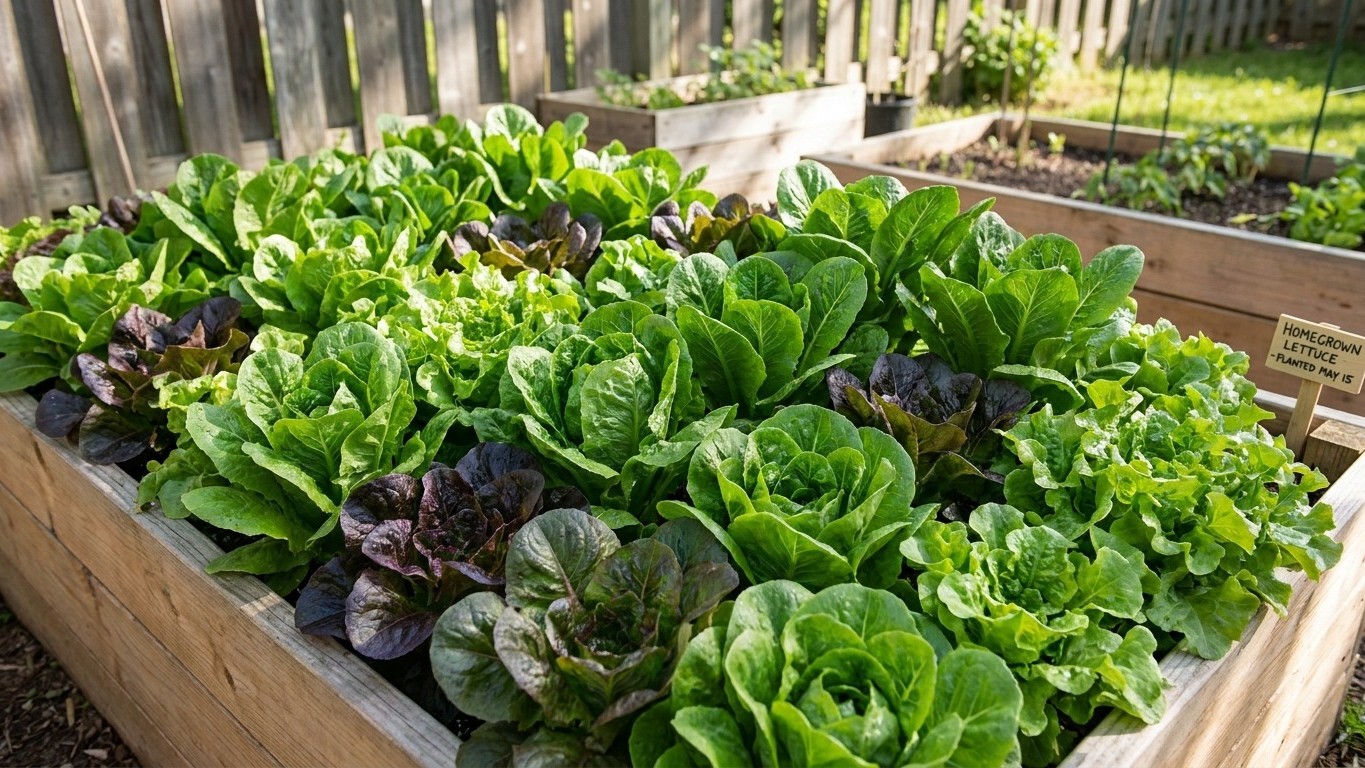

Eight to twelve inches between plants, twelve to eighteen inches between rows, full sun. That’s the lettuce spacing Utah State University Extension recommends, and it isn’t just about giving roots room. Lettuce loses fights with weeds it never sees coming, and tight spacing is the extension’s actual weed-control method, not a footnote to it. Get the numbers right and the canopy does the work a hoe usually does.
The short answer
Utah State University Extension gives one number for how close lettuce should stand: 8 to 12 inches between plants in the row, with 12 to 18 inches between rows, set in a location that will receive full sunlight. That’s the full instruction, with no asterisk about loosening up once plants start crowding each other. The spacing figure is the recommendation itself, not a starting point to widen out later.
The reasoning behind that number matters more than the number alone. The extension’s guidance states plainly that lettuce does not compete well with weeds, and that weed control is particularly important during establishment. Then it gives the fix directly: closely spaced plants will help control weeds. Not mulch, not a pre-emergent product, not a fixed hoeing schedule. Spacing. The extension calls dense plantings a way to reduce weed pressure, which reframes what spacing is doing in a lettuce bed. It isn’t a trade-off between yield and airflow. It’s the weed-management plan, stated as such.
That framing makes sense once you look at how lettuce actually grows. It’s shallow-rooted and fast to bolt toward maturity, and it doesn’t have the reach to shoulder aside a stand of crabgrass or pigweed once those get a head start. A wide-spaced row leaves bare soil between plants, and bare soil sitting in full sun is exactly the condition germinating weed seed wants. Close the gaps with lettuce foliage instead, and there’s less light hitting open dirt, which means less room for a weed seedling to establish before the lettuce canopy shades it out.
Full sun is part of the same package, not a separate requirement. The extension’s call for a location that will receive full sunlight is what pushes the rapid, even growth needed to close that canopy quickly. A partly shaded bed grows slower lettuce with gaps that stay open longer, and that longer window is exactly what weeds use to get ahead.
So the answer to how close lettuce should be planted has two parts that don’t separate cleanly. There’s the figure itself, 8 to 12 inches in the row and 12 to 18 inches between rows, and there’s the reason that figure exists, which is weed suppression through canopy closure. Treat it as only a spacing guideline, and a gardener can get the row width exactly right and still lose the bed to weeds by treating spacing and weeding as two different jobs instead of one.
What actually decides it

Canopy closure versus bare soil
Every inch of bare soil between lettuce plants is an inch of open real estate for weed seed sitting in that same soil, waiting on light and warmth to germinate. Space plants at the tighter end of the range, 8 inches, and the leaves meet sooner, shading that soil before weed seedlings can push through. Space at 12 inches or wider, and the gap stays lit longer, giving weeds a longer runway before lettuce foliage ever reaches over to close it.
Shallow cultivation protects the root system
Extension is specific here: cultivate shallowly and avoid root pruning to ensure uninterrupted growth. A hoe or cultivator that digs deep enough to slice through lettuce’s shallow roots doesn’t just risk the plant it hits directly. It stalls growth at exactly the stage the extension says matters most, establishment. That kind of damage is repairable in the sense that a plant can recover and keep growing, but the repair doesn’t hand back the growing days lost to the setback. A lettuce crop that stalls once rarely catches back up to the stand that never stalled at all.
Nitrogen timing keeps growth ahead of weeds and heat
The fertility instruction is tied to a stage, not a date on a calendar: 1/4 cup of 21-0-0 per 10 foot of row, applied 4 weeks after transplanting or at thinning, to encourage rapid plant growth. That timing matters because of what the extension says lettuce needs to taste right. Lettuce tastes best when plants grow rapidly and mature before the heat of summer. A nitrogen boost right at thinning or four weeks post-transplant is what keeps that growth rapid instead of gradual, which is also what keeps the canopy closing fast enough to keep weeds from getting a foothold in the first place.
How to do it
- Start by identifying your own last frost date. Every other date in this schedule counts backward or forward from that single point, not from a calendar month.
- If you’re growing Transplants indoors, count back five to six weeks from your last frost date and start seed then. Lettuce transplants take five to six weeks to size up before they’re ready to go into the garden.
- If you’re direct seeding instead, sow two to three weeks earlier than the transplant schedule would call for, since direct-seeded lettuce goes into the garden two to three weeks before transplants do. That earlier window works because lettuce tolerates cool soil that would set back warmer-season crops.
- Set transplants out near your last frost date itself, not well ahead of it. Lettuce transplants go into the garden close to that date rather than before it.
- Space every plant, whether transplanted or thinned from a direct-seeded row, 8 to 12 inches apart in the row, with 12 to 18 inches between rows, in a bed that gets full sun.
- Thin direct-seeded rows down to that same spacing once seedlings are up and identifiable, rather than leaving a crowded stand to sort itself out.
- Apply 1/4 cup of 21-0-0 per 10 foot of row either four weeks after transplanting or at the time of thinning, to push the rapid growth that closes the canopy and beats the summer heat.
- Cultivate shallowly for the rest of establishment. Skip deep hoeing near the row, and avoid root pruning so growth stays uninterrupted.
What goes wrong

- Spacing set too wide. Rows planted at 18 inches or more between plants leave bare soil that stays open for weeks. Remedy: hold to the lower end of the range, 8 inches, in beds with known weed pressure, since the extension ties dense spacing directly to weed control.
- Deep cultivation near the row. A hoe pulled through at normal digging depth slices lettuce’s shallow roots and stalls growth right when establishment matters most. Remedy: cultivate shallowly and hand-pull weeds close to the stems instead of hoeing deep.
- Skipping the nitrogen application. Without the 1/4 cup of 21-0-0 per 10 foot of row at thinning or four weeks post-transplant, growth slows and lettuce runs into summer heat before maturing, which the extension links directly to poor flavor. Remedy: apply on schedule rather than waiting to see if plants need it.
- Planting in a partly shaded bed. Reduced light slows canopy closure, which stretches out the window weeds have to establish in open soil. Remedy: choose a location that will receive full sunlight, exactly as specified, rather than a bed picked for convenience.
- Blurring the direct-seed and transplant schedules. Sowing seed and setting transplants on the same date leaves an uneven stand where some plants close the canopy late. Remedy: keep the two to three week gap between direct seeding and transplanting intact, both counted from the same last frost date.
Common questions
How far apart should lettuce plants be spaced in the row?
Utah State University Extension recommends 8 to 12 inches between plants in the row, with 12 to 18 inches between rows, in a location that gets full sun.
Why does close spacing count as weed control instead of just plant spacing?
Because lettuce does not compete well with weeds on its own, especially during establishment. The extension’s guidance states that closely spaced plants will help control weeds, making spacing the weed-control method rather than a separate step.
Can I fix lettuce that was planted too far apart?
Widening the gap further won’t help, and lettuce already spread out can’t retroactively close bare soil between rows. The practical fix is interplanting additional seedlings between existing plants to bring the stand back toward the 8 to 12 inch spacing, cultivating shallowly around the new plants to avoid disturbing established roots.
When should I apply nitrogen after planting?
Apply 1/4 cup of 21-0-0 per 10 foot of row either four weeks after transplanting or at the time of thinning direct-seeded rows, to encourage the rapid growth that helps lettuce mature before summer heat sets in.