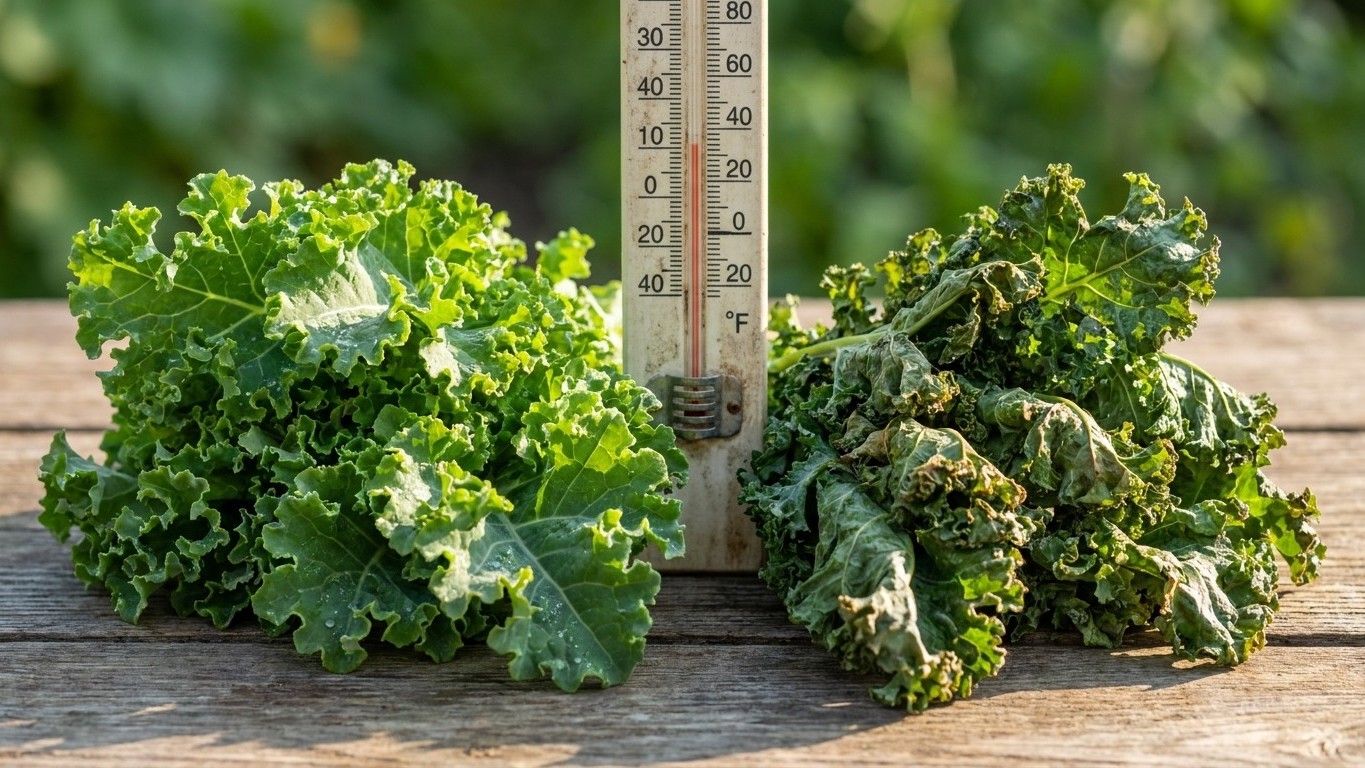

Kale turns bitter in summer because temperatures climb past the 75°F ceiling the plant needs, and according to Utah State University Extension‘s guide Kale in the Garden, high summer heat “reduces growth, decreases quality, and causes bitter or off flavors to develop.” The plant has two good seasons, not one: fast growth before the heat arrives, or a second flush after fall frost. Summer itself is the gap between them, not a season kale is built for.
The short answer
Utah State University Extension states plainly that “kale grows best when temperatures do not exceed 75 F.” Push past that line for any stretch of days and the same source says the results show up directly in the leaf: reduced growth, lower quality, and that sharp, off bitterness gardeners associate with midsummer kale. This is not a matter of the plant “going bad.” It is a documented Temperature response, and 75°F is the number the Extension guide gives as the working ceiling.
The more useful part of the guidance is the framing around it. The Extension publication doesn’t describe kale as a single-season crop with one harvest window. It describes two: “kale tastes best when plants grow rapidly and mature before the heat of summer or after fall frosts occur.” Read that sentence carefully and the whole plant makes more sense. There’s a spring crop that races to maturity while temperatures stay under control, and there’s a fall crop that comes into its own once frost has knocked the heat back out of the air. Summer, sitting between the two, is where the plant struggles rather than where it shines.
That’s a different mental model than most vegetables use. A tomato has one growing season and one harvest push. Kale has a rhythm with a dead zone in the middle, and if a gardener’s picture of the plant doesn’t include that gap, the bitter batch in July or August reads as a mystery instead of an expected outcome. It isn’t a disease, a pest, or bad seed. It’s the plant behaving exactly as the temperature dictates.
None of this means kale can’t survive summer. It often does, sitting in the garden through the hot months and returning to good flavor once nights cool. What the Extension guide is describing is a quality window, not a survival window. The plant can live through 90°F afternoons. It just won’t taste like the kale harvested in the cooler weeks on either side of that stretch.
What actually decides it
Three separate mechanisms are at work here, and the source gives hard numbers for some of them and none at all for others. Mixing those up is where a lot of garden advice goes wrong.
The temperature threshold
The 75°F figure is the only hard number Utah State University Extension attaches to heat and flavor. There’s no growing-degree-day formula in the source, and no secondary threshold for “extreme” heat versus “moderate” heat. The guidance is a single line: stay under 75°F for good growth and quality, and once temperatures exceed it, bitterness and reduced growth follow. Anything more granular than that (a specific number of hours above the line, a specific degree at which bitterness becomes severe) isn’t in the source, so it shouldn’t be treated as established fact.
Moisture swings
Heat isn’t acting alone. The Extension guide is direct about water: “moisture fluctuations will cause leaves to become tough and develop off flavors.” Summer is exactly when soil dries out fastest and when a gardener is most likely to let the plant swing between parched and soaked. The fix the source gives is specific: “about 1-2 inches of water are required per week,” delivered deep and infrequent rather than in light, frequent sips. Shallow, sporadic watering is the pattern that produces the fluctuation the guide warns about.
Soil heat
The third piece is what’s happening below the leaf, not above it. Hot soil stresses roots even when the air temperature is tolerable, which is why the Extension guide recommends mulch as a heat management tool: “apply organic mulches when temperatures increase above 80 F” specifically to cool the soil. Note that this is a different number from the 75°F growth threshold. The guide doesn’t say mulch stops bitterness outright. It targets soil temperature, which is one input among several, not a fix for the air-temperature problem on its own.
How to do it
- Set the transplant date from your own last frost. Utah State University Extension has kale going into the ground 4-5 Weeks Before the last frost date, earlier than most other garden crops. Count backward from whatever date your area typically sees its last frost, in weeks, not by a calendar month, since frost timing shifts by region.
- Choose a variety with a known days-to-maturity figure and race the clock. The source names three, all credited with cold hardiness: Starbor, a green variety at 55 days; Red Russian, a purple variety at 50 days; and Scarlet, a redleaf variety at 55 days. Picking the shorter-day option buys extra margin to mature before summer heat sets in.
- Water on a deep, infrequent schedule from the start. The 1-2 inches per week figure from the Extension guide applies through the growing season, and starting the habit early prevents the tough, off-flavor texture that comes from letting soil dry out between waterings.
- Feed once, on schedule. Apply nitrogen at 1/2 cup per 10 feet of row using a 21-0-0 fertilizer, timed to 4 weeks after transplanting or thinning, per the Extension guide. This is a single, dated application, not a repeating one.
- Mulch once soil temperatures pass 80°F. This is a soil-temperature trigger, separate from the 75°F air-temperature ceiling for growth and flavor. Watch the soil, not just the thermometer on the porch.
- Let the fall crop carry the plant through frost. Since the source describes mature kale only as “extremely hardy,” without attaching a specific temperature figure, don’t expect a precise cutoff. Young transplants are a different story: the Extension guide credits them with tolerating 25°F. Keep that distinction in mind rather than assuming both stages share one number.
| Variety | Type | Days to maturity |
|---|---|---|
| Starbor | Green | 55 days |
| Red Russian | Purple | 50 days |
| Scarlet | Redleaf | 55 days |
What goes wrong
- Treating summer as prime harvest time. The plant’s two good windows are before the heat and after fall frost, per Utah State University Extension. Planting to hit a midsummer harvest sets the crop up to mature right into the 75°F ceiling. Shift the schedule so maturity lands before that window opens, or plan a second sowing timed to mature after frost instead.
- Watering on a light, frequent schedule. Quick daily sprinkles keep the surface damp without delivering the 1-2 inches per week the source specifies, and the resulting fluctuation is exactly what produces tough, off-flavor leaves. Switch to a deep soak on a set schedule, letting the soil dry moderately between waterings rather than topping it off constantly.
- Skipping mulch until the plant already looks stressed. The Extension guide’s threshold for mulching is soil temperature above 80°F, not visible wilting. Waiting for leaf stress as the signal means the soil has already been overheating for a while. Check soil temperature directly and mulch proactively once it crosses that line.
- Applying nitrogen on the wrong timeline. The source’s application is dated to 4 weeks after transplanting or thinning, at a fixed rate of 1/2 cup per 10 feet of row with 21-0-0. Fertilizing earlier, later, or repeatedly outside that window isn’t the schedule the guide describes, and it won’t correct a heat-driven flavor problem regardless of timing.
- Assuming mature plants have the same cold limit as transplants. The 25°F figure belongs to young plants only. Mature kale is described as “extremely hardy” without a number attached, so don’t use the transplant threshold to predict how a mature plant will handle a hard freeze, and don’t assume there’s no limit at all just because none is given.
Common questions
Can kale recover its flavor after a bitter summer stretch?
The Extension guide frames flavor quality as tied to current growing conditions, particularly temperature and moisture consistency, rather than as permanent damage. As temperatures drop after fall frost, the guide describes that period as one of the two windows where kale tastes best, which suggests the plant’s flavor profile is responsive to conditions rather than fixed once heat stress occurs.
Is 75°F an air temperature or a soil temperature?
The Extension guide’s 75°F figure is presented as the ceiling for good growth and quality overall, while the separate 80°F figure is specifically tied to soil temperature and the decision to mulch. These are two distinct numbers for two distinct purposes, and the source does not merge them into one threshold.
Do all three named varieties handle heat the same way?
The Extension guide credits Starbor, Red Russian, and Scarlet with cold hardiness and gives each a days-to-maturity figure, but it does not attribute a separate heat tolerance figure to any one of them individually. Their advantage in a hot-summer garden comes from shorter maturity windows, which lets a gardener finish the crop before the 75°F ceiling becomes an issue, not from a documented heat trait unique to any single variety.
Why does the source recommend deep, infrequent watering instead of daily watering?
Because the problem it’s solving is fluctuation, not simply dryness. The Extension guide states that moisture fluctuations cause tough leaves and off flavors, and a deep, infrequent watering pattern delivering the specified 1-2 inches per week keeps soil moisture more even over time than frequent light watering, which tends to wet only the surface and dry out quickly in between.