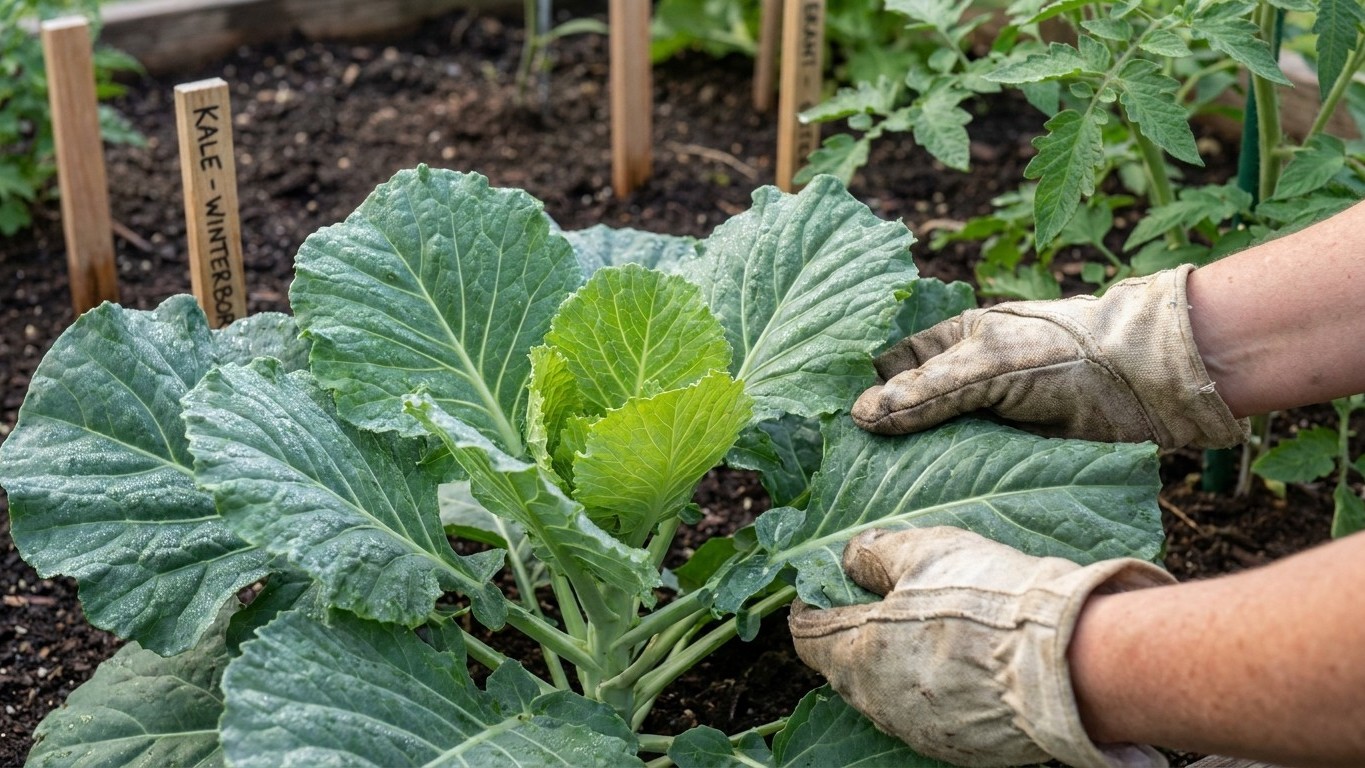

One kale plant, picked correctly, can feed you for months instead of weeks. The trick isn’t the variety you choose or the fertilizer you use. It’s how you cut the leaves. According to Utah State University Extension, kale should be harvested when leaves reach full size, with older leaves stripped off first so young leaves at the center keep growing. That single habit turns a single planting into a season-long harvest.
The short answer
Utah State University Extension is blunt about the method: pick full-size leaves from the outside of the plant, working your way in, and leave the young center leaves alone. Those center leaves keep pushing new growth for weeks after you’ve already harvested a full mess of greens from the same plant. This is why kale behaves less like a one-shot crop (think corn, which you harvest once and pull) and more like leaf lettuce or Swiss chard, where the plant regenerates as long as you don’t cut the growing point.
The numbers back this up. A 10-foot row yields 3 to 5 pounds of kale, according to the Extension’s figures, and that’s not a one-time weight from a single cutting. It’s the cumulative harvest across the plant’s productive life, gathered leaf by leaf as each one reaches full size. For planning purposes, the source recommends 5 to 10 feet of row per person for fresh eating, and an extra 15 to 20 feet per person if you’re planning to freeze or otherwise process a bigger batch.
What you don’t get from this source is a specific week-count for how long that harvest window stays open once you start picking. the Extension Names the method (strip old leaves, protect the young ones) and the storage life after harvest, but it doesn’t attach a number of weeks to “how long a single plant keeps producing.” That’s a gap worth knowing about rather than papering over with a guess. What’s documented instead is what happens after you’ve picked: kale holds for 2 to 3 weeks in storage at 32 degrees Fahrenheit and 95 percent relative humidity. That’s refrigerator-drawer territory for most home kitchens, not a walk-in cooler, but it’s close enough that a crisper drawer with high humidity settings gets you most of the way there.
So the short answer is this: pick outer leaves as they reach full size, leave the center alone, and the same plant will keep handing you pounds of greens far longer than a single cut-and-pull harvest ever would. The specific length of that stretch isn’t quantified in the Extension’s guidance, but the yield-per-row figures make clear it’s substantial, not a one-and-done event.
What actually decides it
Three separate mechanisms determine how a kale plant performs over a season, and the source gives hard numbers for some and none for others. Mixing them up is the fastest way to misjudge your garden.
The harvest method itself
This is the one mechanism with a clear behavioral rule attached: strip the oldest, outermost leaves first. Because kale grows from a central rosette, the growing point sits protected at the center as long as you don’t damage it. Removing older leaves actually reduces the plant’s shading and lets light reach the newer growth, which is likely part of why the practice sustains production. No harvest-window figure is given for how many total pickings this yields. But the mechanism itself, described plainly by Utah State University Extension, explains why a single plant can be visited again and again rather than harvested once.
Cold tolerance, and where the numbers stop
Here’s where two facts get confused constantly, and they shouldn’t be merged. Young kale plants, according to the Extension, tolerate Temperatures down to 25 degrees Fahrenheit. That’s a specific number for a specific life stage: Transplants and seedlings early in the season. Mature kale plants are described differently, as “extremely hardy,” but no Temperature figure is attached to that description. There’s no source-backed threshold for how cold a full-grown kale plant can take. Treat the 25-degree figure as a young-plant fact only, and don’t assume it caps out mature plant tolerance too. If anything, the language suggests mature plants handle more cold than that, just without a documented number.
Storage physics after the cut
Once a leaf is off the plant, a different mechanism takes over: moisture loss and respiration rate. The Extension’s figure, 2 to 3 weeks of storage life at 32 F and 95 percent relative humidity, reflects conditions that slow both processes. Warmer temperatures or drier air shrink that window considerably, though no alternate figure is given for less-than-ideal storage. The takeaway is that storage life is a separate variable from field productivity, and conflating the two (assuming a plant that produces for a long time also means each leaf keeps for a long time) is a mistake.
How to do it
- Get your kale into the ground early. Utah State University Extension places kale transplants outdoors 4 to 5 weeks before your last frost date, the earliest of the common brassicas the source covers. Count backward from your own local last-frost date: if your last frost typically falls in a given week, subtract 4 to 5 weeks from that week to find your target planting window.
- Choose a named variety if you want a days-to-maturity reference point. The source credits three: Starbor, a green kale at 55 days; Red Russian, a purple variety at 50 days; and Scarlet, a redleaf type at 55 days. All three are described as cold hardy, which matters given the early planting date above.
- Space and plan your row length based on how you intend to use the harvest. Figure 5 to 10 feet of row per person for fresh eating, and add another 15 to 20 feet per person if you plan to freeze or otherwise process a larger volume.
- Start picking once leaves reach full size, not before. Begin with the oldest, outermost leaves on each plant.
- Leave the young center leaves untouched. These are the ones that keep the plant producing after the outer leaves are gone.
- Repeat the outer-leaf harvest on a rotation as new leaves mature, working the same plants rather than pulling and replanting.
- Move freshly picked leaves into refrigeration as close to 32 F and 95 percent relative humidity as your kitchen setup allows, to get the full 2 to 3 week storage window the Extension documents.
What goes wrong
- Harvesting the center leaves along with the outer ones. This damages the growing point and cuts the season-long harvest short. Stick to outer, fully-sized leaves only, and let the center rosette keep working.
- Picking leaves before they reach full size. Small leaves cut early mean less total yield per row and more trips to the garden for a smaller return each time. Wait until a leaf is fully expanded before removing it.
- Planting kale on the same late schedule as tomatoes or peppers. Kale goes out 4 to 5 weeks Before the Last Frost, considerably earlier than most warm-season crops, and even earlier than other cold-hardy brassicas like cabbage and broccoli (2 to 3 weeks before frost) or Cauliflower (1 to 2 weeks before frost). Planting kale too late shortens the productive season before summer heat sets in.
- Assuming mature plants share the young transplant’s 25 F cutoff. The Extension gives 25 degrees Fahrenheit specifically for young plants and only describes mature kale as “extremely hardy” with no number attached. Don’t pull mature kale early out of a mistaken cold-tolerance assumption borrowed from the seedling stage.
- Storing harvested leaves in a warm, dry spot and expecting weeks of shelf life. The 2 to 3 week storage figure assumes 32 F and 95 percent relative humidity. A countertop or a warm refrigerator drawer won’t come close. Use the coldest, most humid part of your refrigerator, ideally a crisper drawer, to approximate those conditions.
- Underestimating row length for a household’s needs. Planting a short row and expecting it to cover both fresh eating and freezing usually falls short. Plan 5 to 10 feet per person for fresh use, then add 15 to 20 feet per person on top of that if processing is part of the plan.
Common questions
Can I harvest the whole kale plant at once instead of leaf by leaf?
The Extension’s guidance describes leaf-by-leaf harvesting, stripping older leaves while young ones continue growing, as the standard method. Cutting the whole plant at once would remove the growing point along with it, ending the plant’s productive life rather than extending it across a season.
How cold can mature kale plants actually tolerate?
Utah State University Extension doesn’t give a number for mature plants, only the description “extremely hardy.” The 25 degree Fahrenheit figure applies specifically to young plants, not mature ones, so there’s no documented threshold to cite for a full-grown plant’s cold limit.
Why does kale go into the ground so much earlier than broccoli or cauliflower?
The Extension lists kale at 4 to 5 weeks Before the Last Frost, earlier than cabbage and broccoli at 2 to 3 weeks before frost, and cauliflower at just 1 to 2 weeks before frost. Kale’s young-plant cold tolerance down to 25 degrees Fahrenheit is part of why it can go out sooner than the other brassicas covered by the same source.
How much kale should I plant for a family that wants to freeze some for later?
Start with the Extension’s baseline of 5 to 10 feet of row per person for fresh eating, then add an additional 15 to 20 feet per person if you plan to freeze or otherwise process part of the harvest. A 10-foot row typically yields 3 to 5 pounds, which helps translate row length into an expected pound count.