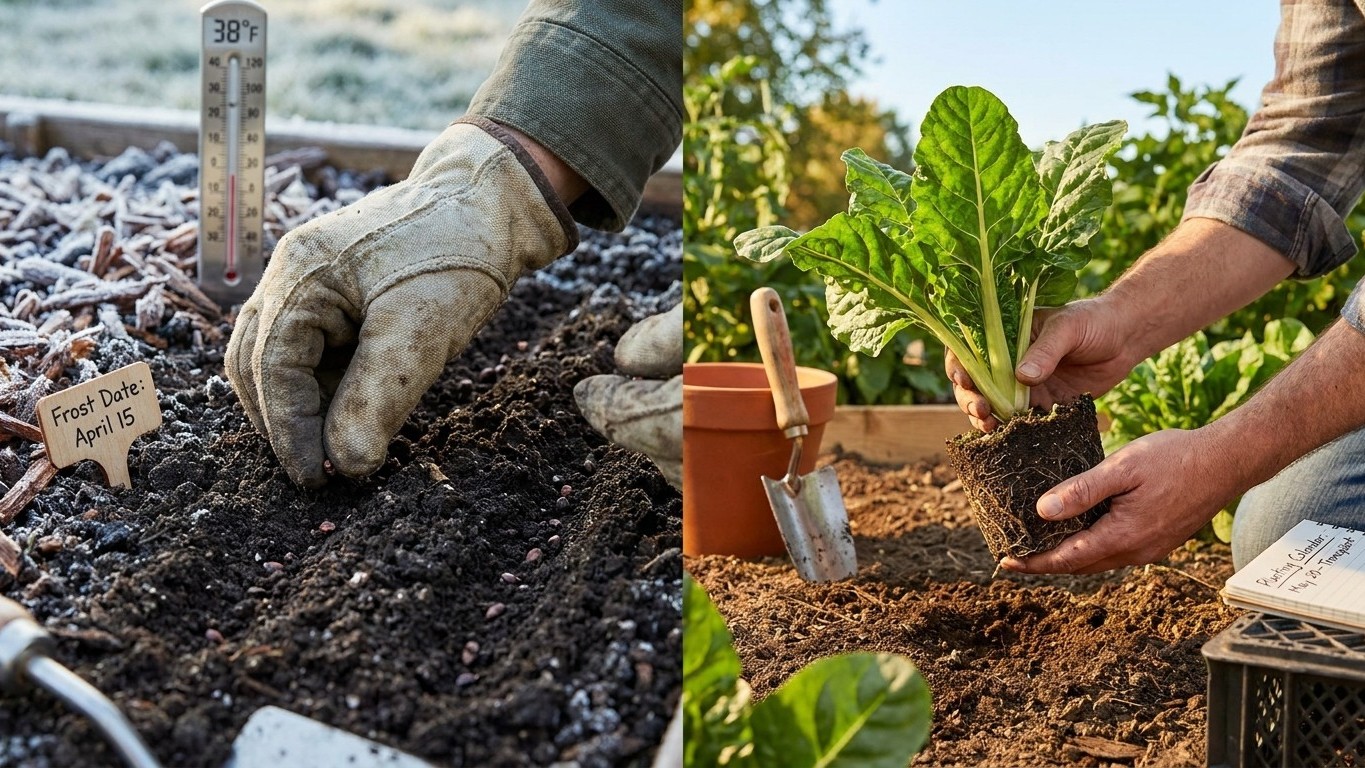

Two planting routes, two different countdowns: if you’re starting seed, put it in the ground three to four weeks before your last frost-free date. If you’re setting out transplants, wait until that frost date arrives. Utah State University Extension lays out both timelines in its fact sheet Swiss Chard in the Garden, and the gap between them isn’t arbitrary. It comes down to what the seed can tolerate versus what a young plant needs to survive.
The short answer
Start with the frost-free date for your area. That’s the anchor for everything else. Utah State University Extension states plainly that transplants should go into the garden near that date, while seeded chard can go in three to four weeks earlier. So if your last frost typically lands on a given date, direct-seeded chard can go into cold soil roughly three to four weeks ahead of it, and transplants wait until the date itself.
Why the difference? A seed is tougher than a seedling. It sits in the soil, protected, waiting for conditions to trigger germination. A transplant is already leafed out and exposed, with tender tissue that a late cold snap can damage. Utah State University Extension backs this up with a separate growth requirement: transplants need 5 to 6 weeks to reach a usable stage, defined as 4 to 6 mature leaves and a well-developed root system. That means if you’re growing your own transplants indoors, you have to start counting backward from your frost date by that same 5 to 6 week window, not from the seeding date used for direct sowing.
Here’s how the arithmetic actually plays out. Say your last frost-free date is a fixed point on the calendar. Direct seed goes into the garden bed three to four weeks before that point, because Utah State University Extension notes chard seed can be sown once soil reaches 40°F, a threshold that’s often met well ahead of the frost date itself. Transplants, on the other hand, are started indoors 5 to 6 weeks before you intend to set them out, and they don’t go outside until the frost date arrives, not before.
Two routes, two separate countdowns, both keyed to the same frost date but running in opposite directions. Seed gets a head start into cooler soil. Transplants get held back until the air itself is safe. Neither method is wrong. They’re just answering different questions: how cold can the seed handle, and how cold can the leafy top of a young plant handle.
What actually decides it

Soil Temperature sets the floor for seed
Seed timing isn’t governed by air temperature or frost risk the way transplants are. Utah State University Extension specifies that Swiss chard can be sown once soils reach 40°F, and germination performs best between 55°F and 75°F, taking 7 to 14 days to emerge. That’s a soil-temperature condition, not a calendar condition, which is exactly why seed can go in Weeks Before the frost-free date. The ground often warms faster than the air stabilizes, especially in beds with southern exposure or dark mulch.
Heat, not just cold, can stop germination
The fact sheet adds a ceiling most gardeners don’t expect: temperatures above 80°F reduce seed germination. This matters for anyone tempted to push seeding later into warmer soil for convenience. The window isn’t just “warm enough,” it’s a band, and overshooting it works against you as much as sowing too early into cold ground. This is a germination-stage limit, separate from the plant’s tolerance once it’s established and growing.
Transplant readiness is a size condition, not a date condition
The 5 to 6 week transplant window from Utah State University Extension comes with a condition attached: transplants aren’t ready by the calendar alone, they’re ready when they show 4 to 6 mature leaves and a well-developed root system. A tray started too late, or grown in poor light, might hit 6 weeks without meeting that benchmark, and setting it out anyway near the frost date invites transplant shock. The date is a guideline; the leaf count and root development are the actual checkpoint.
Frost tolerance is what governs the transplant date itself
The reason transplants wait until the frost-free date, rather than going out early like seed, is straightforward: young chard tops are more vulnerable to frost damage than a dormant seed sitting below the soil line. The plant’s aboveground tissue is what’s at risk, so the date used for setting out transplants is built around protecting that tissue, not around soil temperature or germination biology.
How to do it
- Identify your local last frost-free date. This single date anchors both planting routes, so it’s the first thing to pin down before counting backward or forward.
- For direct seeding, count back 3 to 4 weeks from that date. This is when Utah State University Extension says seeded chard can go into the garden, ahead of the transplant date, because seed tolerates cooler soil.
- Check soil temperature before sowing. Wait until the soil has reached 40°F. Sowing into colder ground won’t trigger germination reliably, regardless of the calendar.
- Expect 7 to 14 days for emergence if soil temperature falls in the 55°F to 75°F range, which the fact sheet identifies as best for germination.
- If starting transplants indoors, count back 5 to 6 weeks from your intended set-out date. That’s the growing time Utah State University Extension gives for reaching a usable transplant.
- Hold transplants indoors until they show 4 to 6 mature leaves and a well-developed root system, not just until the calendar hits 5 or 6 weeks. Size and root development are the real signal.
- Set transplants outside near the last frost-free date, not before it, since this is the date built around protecting tender young tissue from frost damage.
- Thin direct-seeded rows once plants reach 3 to 4 true leaves. Utah State University Extension notes the thinned plants aren’t waste: they can be eaten, or moved to fill in another spot in the garden if some roots are kept intact during the move.
- For a fall crop, count backward from your first fall frost instead of forward from spring. Utah State University Extension recommends planting 50 to 75 days before the anticipated maturity date, with that maturity date falling 2 to 3 weeks before the first fall frost. Established plants can handle light frosts once they’re mature.
What goes wrong

- Seeding into cold, wet soil before it hits 40°F. The seed simply sits without germinating. Check soil temperature directly with a probe rather than guessing from air temperature, and hold off sowing until the threshold is met.
- Sowing too late into soil that’s climbed above 80°F. Utah State University Extension is specific that this range reduces germination. If you missed the cooler window, wait for a cooler stretch or plan on the fall planting schedule instead of forcing seed into overheated ground.
- Setting out transplants that hit the 5 to 6 week mark but haven’t developed 4 to 6 mature leaves and a solid root system. A date on the calendar doesn’t guarantee readiness. Delay transplanting a few more days and check leaf count and root mass before moving plants outside.
- Moving transplants outdoors ahead of the frost-free date because seed-starting instructions got confused with transplant instructions. Seed goes in early, three to four weeks before the frost date, but transplants wait for that date. Keep the two schedules separate in your planning so an early seed date doesn’t get mistakenly applied to seedlings in pots.
- Letting direct-seeded rows go unthinned past the 3 to 4 true leaf stage. Crowded stands compete for light and water. Thin on schedule, and use the thinned plants as transplants elsewhere in the bed if you keep some root intact, or eat them instead of discarding them.
- Planning a fall crop by counting from the first fall frost alone without the maturity buffer. Utah State University Extension calls for maturity 2 to 3 weeks before that frost, worked back from a 50 to 75 day planting window. Skipping that buffer risks a crop that’s still immature when cold arrives, even though established plants can tolerate light frost once they’re grown.
Common questions
Can I sow chard seed directly into cold spring soil as soon as I can work the ground?
Only once the soil has reached 40°F, per Utah State University Extension. Working the ground earlier doesn’t help if the soil itself hasn’t warmed to that threshold, since germination won’t proceed reliably below it.
Is it better to direct-seed or start transplants indoors?
Utah State University Extension describes both as valid routes, just on different timelines. Seed goes in 3 to 4 weeks before the frost-free date; transplants are started 5 to 6 weeks ahead indoors and moved out near that same frost date. Neither is labeled superior in the fact sheet.
What do I do with the seedlings I remove while thinning?
Utah State University Extension notes they don’t have to be discarded. If some roots are kept intact during removal, they can be transplanted into another spot in the garden, or they can simply be eaten.
Does a light fall frost kill the crop?
Not according to Utah State University Extension, which states that plants can remain in the garden after light frosts once they’ve reached maturity, provided that maturity was timed to land 2 to 3 weeks before the first fall frost in the first place.