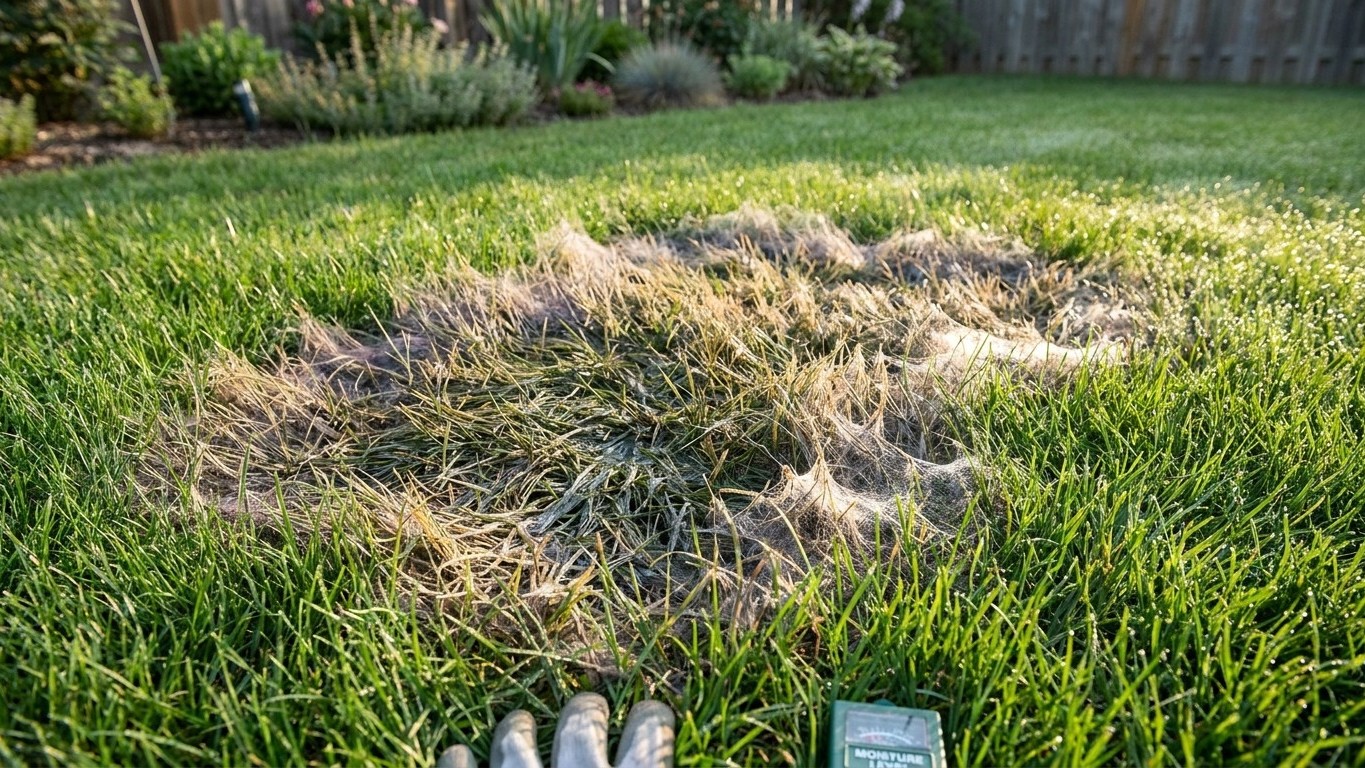

Pythium blight is a fast-moving fungal disease that shows up in cool-season lawns during hot, humid stretches of summer, turning healthy turf into greasy, matted patches within a day or two. It thrives where grass stays wet overnight and air can’t move through the canopy. Unlike most lawn problems that build slowly, this one can wreck a section of lawn between one evening and the next morning’s coffee.
What you are looking at

The first sign is usually a patch, small and irregular, roughly the size of a dinner plate to a few feet across, that looks dark and water-soaked, almost like someone spilled oil on the grass. By morning, that patch may carry a faint gray or purplish cast before fading to a dull straw-tan color. The edges are rarely crisp. Instead they blur into healthy grass, and the whole area often has a matted, greasy texture when you run a hand across it, which is where the disease gets its informal nickname, “grease spot.”
Look closer at an individual blade, ideally early in the morning while dew is still on the lawn, and you may see a thin cottony white growth clinging to the leaf, almost like spiderweb strands. This mycelium is the confirming detail. It disappears within an hour or two once the sun hits it and the leaf surface dries, so timing matters. If you only check at noon, you’ll miss it and be left guessing from the patch shape alone.
How the pattern spreads
Because the fungus moves through water on the leaf surface, affected areas often follow the direction of mowing or foot traffic, creating streaks rather than perfect circles. Low spots, drainage swales, and areas near downspouts tend to show symptoms first and worst, since water lingers there longest after evening irrigation or a summer thunderstorm. On a slope, watch for the blighted streak running downhill from a wet patch, a telltale sign that water movement, not just heat, is driving the damage.
What it is not
Before assuming disease, check the watering schedule. A lawn watered lightly and often, say every evening for ten minutes, almost never dries out between waterings, and that habit alone can produce greasy, matted patches that look disease-like but are really just waterlogged crowns suffocating in soggy thatch. Cutting back to fewer, deeper waterings often clears this up with no product applied at all.
Dog urine spots are another common mix-up. Those tend to have a bright green, lush ring around a dead center, a halo effect that Pythium blight doesn’t produce. Mower scalping leaves a different signature too: a uniform brown strip that follows the exact width and path of the mower deck, with clean, straight edges rather than the blurred, irregular border typical of a fungal patch.
Drought stress is worth ruling out separately, especially on Warm-Season lawns like bermudagrass or zoysia, which simply go dormant and tan-brown in dry heat without any greasy texture or morning mycelium. That dormancy is not death. The grass crown is alive underground, and a return to normal rainfall or irrigation brings the color back within a couple of weeks. Pythium blight, by contrast, kills the leaf tissue outright in the affected patch, and recovery there depends on new growth filling in from the margins, not on the same blades greening up again.
The conditions that bring it on
Pythium blight is a disease of cool-season turf, hitting lawns seeded with perennial ryegrass, tall fescue, and creeping bentgrass hardest. It shows up almost exclusively in summer, which is unusual, since most cool-season grass problems (winter kill, snow mold) happen in the cold months. This one strikes precisely when cool-season grass is already stressed by heat, making it the classic mid-to-late summer collapse for lawns that otherwise look fine the rest of the year.
The fungus needs two things at once: warmth and prolonged leaf wetness. Hot, muggy nights, where the Temperature barely drops after sunset and humidity stays high, let water sit on the grass blade for hours without evaporating. Add a lawn that’s already saturated from evening watering, heavy dew, or back-to-back storms, and the fungus has everything it needs to spread through the leaf canopy overnight. This is why the disease so often seems to appear out of nowhere between two mowing days.
Nitrogen plays a role too. Lawns pushed with a heavy feeding right before a hot, wet spell tend to grow soft, succulent leaf tissue that’s more vulnerable to infection than turf growing at a steady, moderate pace. Poor airflow compounds the problem, so lawns tucked against fences, hedges, or low-lying areas with little breeze tend to hold humidity longer than open, exposed turf, and those are usually the first spots to show symptoms.
Warm-season grasses like bermudagrass, zoysia, and St. Augustine are far less commonly affected by this particular disease. Their peak growth season overlaps with the same hot, humid weather that triggers Pythium blight in cool-season lawns, and vigorous warm-season turf generally outgrows the pressure. When warm-season lawns do struggle in summer, the cause is far more often drought stress, gray leaf spot, or take-all root rot than Pythium.
What to do now
Most cases of Pythium blight, especially small, contained patches, run their course once the weather breaks. A stretch of cooler, drier nights slows the fungus dramatically, and the lawn typically starts filling back in from the patch edges within a few weeks as the grass resumes normal growth. Patience, not a spray, is the right first move for a homeowner looking at a few scattered spots.
While you wait, stop watering in the evening and switch to early morning if you haven’t already, since this shortens the number of overnight hours the grass stays wet. Raise the mower deck slightly rather than lowering it, and avoid mowing the affected area while it’s still damp, since foot and wheel traffic through wet, infected grass is one of the most efficient ways to carry the fungus to a healthy part of the lawn.
A fungicide labeled for Pythium blight is worth considering only when the damage is spreading fast across a large area, when the lawn is a high-value surface like a putting green style yard, or when the same section fails every summer despite better watering habits. For an ordinary residential lawn with a handful of patches, most product labels and extension guidance treat chemical control as a measure for active, expanding outbreaks, not for cosmetic patches that are already stabilizing. Spraying a lawn that’s simply recovering on its own is money spent on weather, not on the disease. Home-garden fungicide options for Pythium are more limited than for many other turf diseases, and several professional-grade products are restricted-use, meaning they aren’t available over the counter to homeowners at all.
Preventing it next season
Watering timing is the single biggest lever available to a homeowner. Irrigate early in the morning, ideally before 10 a.m., so the grass has a full day of sun and airflow to dry before evening humidity sets in. Evening watering is the habit most strongly linked to overnight fungal outbreaks of every kind, not just this one, because it leaves the leaf surface wet for the longest possible stretch.
Nitrogen should be applied in moderate, steady amounts rather than heavy single doses, particularly avoiding a big feeding right before a predicted hot, humid week. Lawns growing at a controlled pace produce tougher leaf tissue that resists infection better than lawns pushed into a growth spurt.
Mowing height matters more than most homeowners assume. Keeping cool-season grass on the taller end of its recommended range, rather than scalping it short for a “neater” look, helps the canopy dry faster and shades the soil, keeping root zones cooler through summer stress. Sharpen mower blades regularly too, since a clean cut heals faster than a torn, ragged one that gives fungal spores an easy entry point.
Airflow is the quiet fix most people overlook. Thinning overgrown shrubs along a fence line, pruning low tree limbs, or simply widening a gap between a hedge and the lawn edge can cut down the humid, still-air pockets where this disease gets its start. None of this requires a product purchase. It’s a schedule change and a pair of pruning shears, applied consistently across a season, not a one-time treatment.
Common questions
Can Pythium blight kill an entire lawn overnight?
It can severely damage large patches in a single humid night under the worst conditions, but a total lawn kill in one night is rare. The fungus needs sustained warmth and leaf wetness to spread that fast, and most residential lawns show scattered patches rather than complete collapse.
Does Pythium blight affect bermudagrass or zoysia lawns?
Rarely. This disease is far more common on cool-season grasses like ryegrass, tall fescue, and bentgrass. Warm-season lawns struggling in summer heat are more likely dealing with drought stress or a different disease entirely.
Will the grass in a Pythium blight patch grow back on its own?
Often yes, once cooler, drier weather arrives and reduces the fungal pressure. Recovery comes from surrounding healthy grass spreading into the damaged area over several weeks, not from the killed blades themselves regreening.
Is it safe to walk on a lawn with Pythium blight?
Yes, but avoid mowing or walking through the wet, affected patch if possible, since moisture on infected grass can carry the fungus to healthy turf on shoes or mower wheels. Waiting until the grass dries reduces that spread.