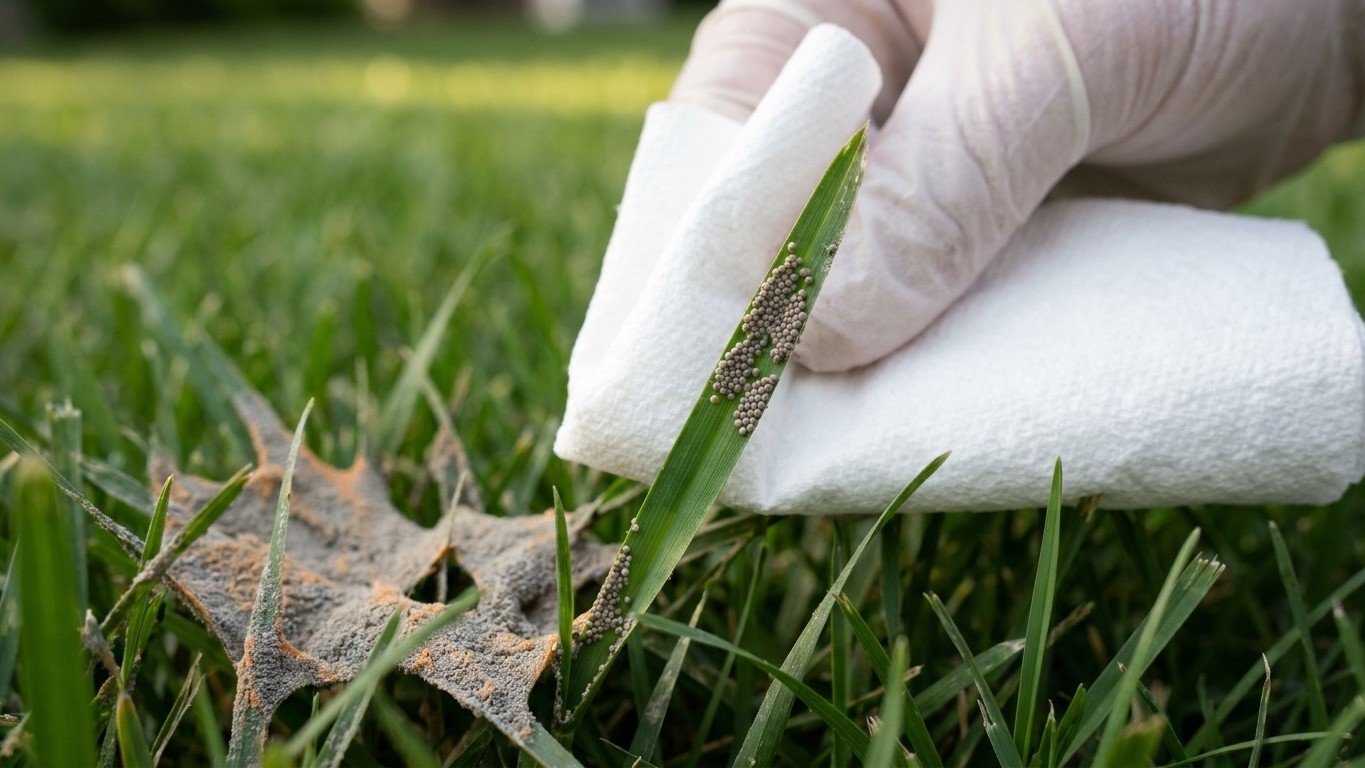

That gray, orange, or yellowish crust spreading across your grass blades overnight looks alarming, but slime mold does not feed on grass at all. It sits on top of the blade, uses the lawn as a surface to reproduce, and disappears within days without leaving a mark on the turf underneath. No fungicide needed, no dead patches left behind.
What you are looking at
Slime mold shows up as small clusters, usually a few inches to a foot or so across, scattered over the lawn in irregular patches. From a distance it can look like the grass was dusted with ash, sprayed with dull paint, or coated in something greasy. The color range runs from pale gray to steel blue, cream, bright yellow, or dull orange-brown, depending on the species and how long the growth has been sitting there.
The detail that actually confirms slime mold, rather than a fungal disease, is what you find on an individual blade. Pick one from inside the patch and look closely. Slime mold coats the outside in tiny round or pinhead-sized structures, almost like fish eggs or ground pepper glued to the surface. Rub it with your finger or a paper towel and the coating wipes off easily, leaving a clean green blade underneath. That is the tell. Fungal lawn diseases, by contrast, damage the blade tissue itself, leaving lesions, discoloration, or rot that does not wipe away because it has replaced part of the leaf rather than sitting on it.
Timing on the ground also helps. Slime mold tends to appear fast, sometimes within a day or two after a stretch of warm, humid weather, and often shows up right after mowing or heavy dew, when moisture on the blades is highest. It clusters most heavily in shaded, low-lying spots where water sits longer.
Texture is the last confirmation. Early growth stages can look wet and slimy, almost like a spill on the grass. As it dries out over a few days, it turns crusty and powdery, and a light breeze or a pass of the mower will scatter it like dust. None of that happens with an actual turf pathogen, which stays put and keeps damaging the blade until conditions change or a treatment interrupts it.
What it is not
The easiest way to rule out slime mold, and disease altogether, is to check whether the coating wipes off. If it does not, and the blade itself looks streaked, spotted, or rotted, you are dealing with something that has actually invaded the plant tissue rather than something sitting on top of it.
A large share of what homeowners report as a lawn disease is not a pathogen at all. Brown patches after a heat wave are often just a cool-season grass going dormant to survive drought stress. Species like Kentucky bluegrass and tall fescue will turn straw-brown during a dry, hot stretch, then green back up within two to three weeks once regular watering resumes. Pulling on the grass is a quick check: dormant grass stays rooted, while grass killed by disease or grubs pulls up loose with little resistance.
Scalping from mowing too short is another common misdiagnosis, leaving a yellow-brown cast across the whole lawn that gets blamed on fungus when it is really a mower deck set too low. Dull mower blades cause a similar problem, shredding the tip of each blade instead of cutting it cleanly, mimicking early disease symptoms from a distance.
Uneven watering shows up as irregular patches that follow the sprinkler pattern rather than the outward spread of a disease outbreak. Dog urine spots, compacted soil, and buried debris can all produce dead patches that have nothing to do with a pathogen. Before assuming disease, or slime mold, check whether the pattern lines up with shade, traffic, water reach, or mowing habits first.
The conditions that bring it on
Slime mold needs two things to appear: moisture and warmth. It thrives when grass blades stay wet for extended periods, whether from heavy dew, overwatering, poor drainage, or humid days. Unlike most lawn diseases, it is not picky about grass type. It grows on the leaf surface itself rather than infecting plant tissue, so it appears just as readily on Warm-Season grasses like Bermuda or zoysia during summer as on cool-season lawns like fescue or bluegrass in spring and fall.
The season it shows up in follows the moisture pattern more than the calendar. Spring rains combined with mild temperatures create ideal conditions in many regions, and a second wave often follows in late summer when overnight humidity climbs even if daytime heat is high. Shaded areas under trees, spots near downspouts, and low corners of the yard where water pools are the first places it turns up.
Grass height and thatch buildup play a role too. A lawn mowed on the shorter side with good airflow dries faster after watering, while a thick, overgrown lawn traps humidity at the soil surface and gives slime mold more time to establish. Piles of grass clippings or leaf litter left sitting through a wet stretch can also hold enough moisture to trigger a patch.
Because slime mold organisms feed on bacteria, decaying organic matter, and other microorganisms in the thatch and soil rather than on the grass plant, it can appear on almost any turf type once moisture and temperature line up. That is different from most true lawn diseases, which are often specific to either cool-season or warm-season grasses and tied to a narrower temperature window. This flexibility is exactly why slime mold can seem to appear out of nowhere on a lawn that otherwise looks perfectly healthy.
What to do now
The honest answer for slime mold is that it needs almost no intervention. It does not feed on the grass, it does not spread through the plant’s root system, and it will dry up and disappear within a few days to two weeks once the weather shifts or dries out. Chasing it with a fungicide is money spent on something the weather is already going to fix on its own.
If the patches bother you visually while waiting for them to clear, a strong spray from the garden hose knocks most of the crusty coating off the blades immediately, or a pass with a rake or the mower breaks it up and scatters it. Neither is strictly necessary since the grass underneath was never damaged in the first place.
Fungicide use should be reserved for cases where you have confirmed an actual pathogen through the wipe-off test described earlier, not for slime mold itself. Products containing chlorothalonil or those labeled for lawn disease control can address true fungal infections, but always read and follow the label directions, since several active ingredients are restricted for homeowner use in certain states. Applying a fungicide for slime mold specifically treats a cosmetic issue as if it were a threat to the lawn’s health, which it is not.
Give the affected spots a few days of drier weather and normal mowing before assuming anything more serious is happening. If the coating keeps returning in the exact same low, shaded spot every time it rains, that points toward a standing water or drainage issue worth addressing at the source.
Preventing it next season
Most prevention against slime mold, and against soggy-lawn problems generally, comes down to timing habits rather than buying a product. Watering early in the morning, ideally before 10 a.m., gives grass blades the entire day to dry out under sun and airflow, instead of sitting wet overnight as they do after an evening watering schedule. That change cuts down the surface moisture window that slime mold, and several actual fungal diseases, depend on to establish.
Mowing height matters more than most homeowners assume. Keeping cool-season grasses like fescue and bluegrass around 3 to 3.5 inches, and warm-season grasses like Bermuda or zoysia at their species-appropriate shorter height, promotes deeper roots and better airflow without letting the canopy get so thick that humidity gets trapped underneath.
Nitrogen timing plays a supporting role. Heavy nitrogen applications during hot, humid stretches push soft, lush growth that holds moisture longer, even if it does not directly affect slime mold. Spacing fertilizer applications to match the grass type’s active growing season keeps growth steadier and less moisture-retentive.
- Rake or blow leaf litter and grass clippings off the lawn regularly, especially in shaded areas.
- Prune overhanging tree branches to let more sunlight and airflow reach chronically damp corners.
- Aerate compacted soil in low spots so water drains instead of pooling on the surface.
- Check gutters and downspouts to make sure they are not draining directly onto a section of lawn.
None of this requires a special product built for slime mold, because none exists that is needed. Better airflow, correct mowing height, morning watering, and clearing debris cover the same ground and pay off against several other lawn issues at the same time.
Common questions
Will slime mold kill my grass if I ignore it?
No. Slime mold feeds on organic matter and microorganisms on the leaf surface, not on the grass plant itself, so it cannot kill the turf underneath even if left Completely untreated.
How long does slime mold stay on a lawn?
Typically a few days up to about two weeks, depending on how quickly the weather dries out. Sun, wind, and a break in humid conditions clear it faster than a stretch of continued rain.
Can I just mow over slime mold?
Yes. Mowing as usual breaks up and scatters the dried coating, and it is one of the fastest ways to make the patches disappear visually without any chemical treatment.
Does slime mold mean my lawn has a drainage problem?
Not necessarily, but if it keeps returning in the same exact spot after every rain, that spot is likely staying wet longer than the rest of the yard, which is worth checking for a low grade or blocked drainage.