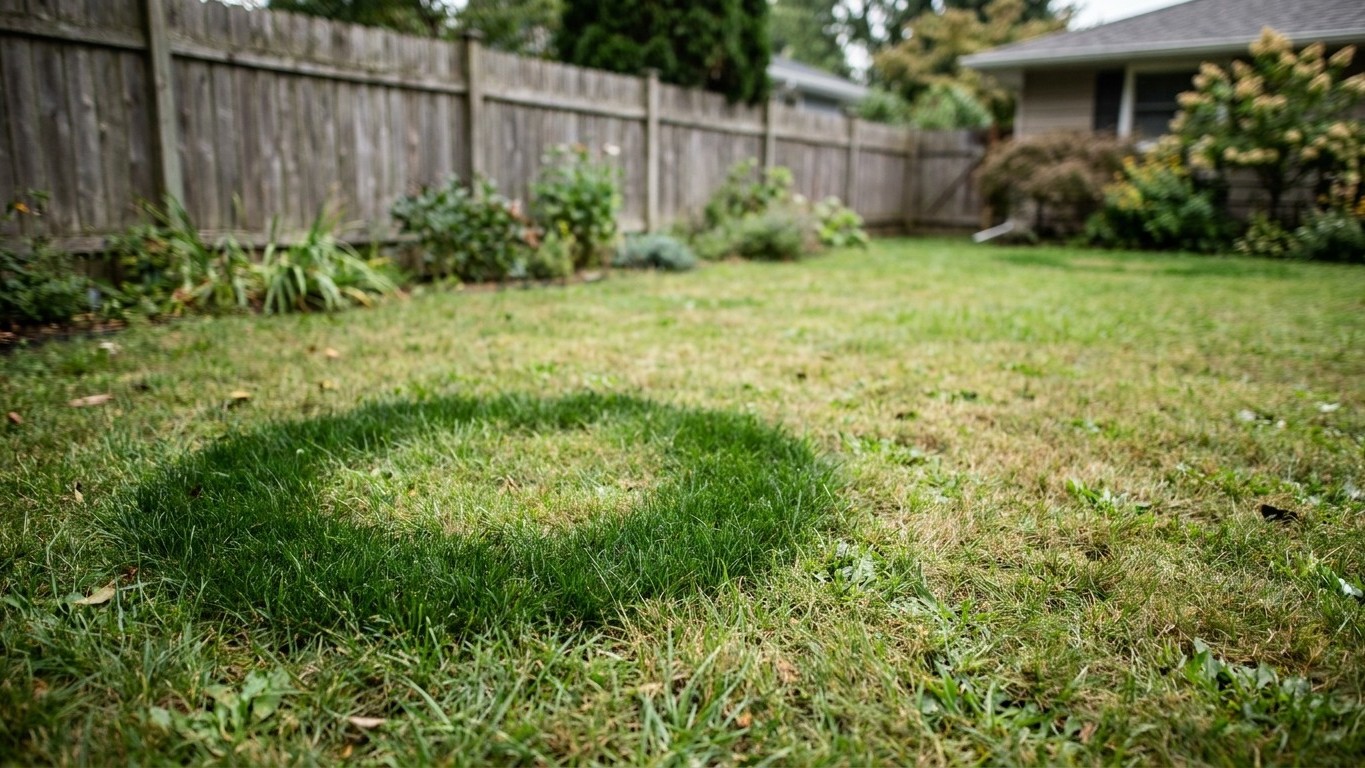

Fairy ring shows up as a ring or arc of grass growing darker green than the lawn around it, sometimes with a band of mushrooms sprouting along the same line after rain. It comes from fungi living underground, feeding on old roots, stumps, or construction lumber buried before the lawn was ever seeded. The single thing to check first: dig a plug at the edge of the ring and look for a white, thread-like fungal mat in the thatch. That confirms fairy ring rather than a watering or mowing problem.
What you are looking at

Fairy ring starts as a ring, a partial arc, or a scatter of rings across the lawn, each one a band of grass growing noticeably darker green than the turf around it. The ring can be a few inches across when it first appears and widen outward year after year as the fungus works through more buried organic matter. Inside the dark green band you sometimes find a second, thinner ring of yellow-brown or dead grass, and outside it the lawn looks ordinary. After rain, mushrooms, puffballs, or small brown toadstools often push up along the ring, then disappear within a day or two once the soil dries.
Unlike Brown Patch or Red Thread, fairy ring does not leave a lesion on the leaf blade itself. The blade looks like ordinary grass, only greener. The confirming sign is underground: pull back the thatch layer at the ring’s edge and look for a white or gray, thread-like fungal mat matted through the thatch and topsoil, sometimes smelling faintly musty. If you find that mat, you have fairy ring. If the blades carry spots, streaks, or a pink threadlike growth instead, you are looking at a different disease entirely.
The dark green color is not the fungus itself. It is a side effect: the fungus breaks down buried wood and roots and releases nitrogen the grass above absorbs, which is why the ring often looks like the healthiest part of the lawn rather than the sickest.
What it is not
A single small, round dead patch with a dark green halo around the rim, usually under a foot across and found where a dog repeatedly stands, is a urine spot, not fairy ring. It will not widen into an arc and it will not sprout mushrooms.
A dark green arc that lines up with the reach of a sprinkler head, or a dry crescent where two heads fail to overlap, is an irrigation pattern, not a fungus. Walk the arc and check whether it matches the geometry of the sprinkler zone before assuming disease.
Grass that greens up in patches after a fertilizer pass, especially near a spot where a bag was spilled or a spreader overlapped, is a fertilizer streak. It fades within a couple of weeks as growth evens out, and it never sprouts a mushroom.
A gray, black, or bright yellow crust coating the grass blades themselves after a wet spell, easily wiped off with a finger, is slime mold, a harmless organism feeding on the thatch surface rather than the grass. It disappears on its own within a week and needs no treatment.
Most of what gardeners report as a lawn disease turns out to be a mowing or watering habit instead, covered more broadly on the Lawn Diseases page. If your dark ring never sprouts a mushroom, never shows a mycelial mat under the thatch, and lines up with something you did, treat the simple explanation first.
The conditions that bring it on
Why the ring appears
Fairy ring is fed by a mass of buried organic matter, an old stump, root system, or construction lumber left under the soil when the lawn was graded, that the fungus is slowly digesting. Because the food source is underground rather than tied to a particular grass species, fairy ring shows up in cool-season lawns and warm-season lawns alike: Kentucky bluegrass, tall fescue, fine fescue, and perennial ryegrass are as susceptible as bermudagrass, zoysiagrass, St. Augustinegrass, or centipedegrass, per Penn State Extension’s Lawn Establishment guidance and Clemson Cooperative Extension HGIC 1214, Selecting a Lawn Grass. The fungus does not care what grass grows above it.
What it does care about is moisture. The underground mycelium survives dry stretches, but it only fruits, meaning it pushes mushrooms above ground, after a soaking rain or a run of humid days. That is why the ring seems to appear overnight after a storm, fade for weeks, then reappear the next time the ground stays wet for several days running. The dark green band itself, unlike the mushrooms, tends to persist through drier weather because the nitrogen released into the soil lingers.
Fairy ring also turns up more often on newly established lawns, particularly ones seeded or sodded over recently cleared woodland or fill dirt, and on older lawns with a thick, spongy thatch layer that gives the fungus an ongoing supply of decaying material once the original buried wood runs out. Sandy, low-fertility soils are especially prone, since they hold less water and fewer nutrients on their own, giving the fungal mat a competitive edge over grass roots for both. A lawn with thin thatch and no buried debris rarely develops it at all.
What to do now
In most cases, do nothing. The dark green ring is the grass responding to extra nitrogen, not damage, and it fades on its own as the buried organic matter is used up or the weather turns dry. Mow, water, and fertilize the rest of the lawn as usual and let the ring blend back in over a season or two.
The exception is a ring where the grass inside has turned thin, yellow, or dead rather than merely dark green. That happens when the fungal mat becomes dense enough to repel water, so the soil underneath stays bone dry even after rain reaches the surrounding lawn. Press a screwdriver into the dead band. If it resists going in while it slides easily into the green turf nearby, the soil there has gone hydrophobic. The fix is mechanical, not chemical: core aerate the ring heavily, breaking up the water-repellent layer, then water the area by hand two or three times a week until the grass roots deeper than the mat.
Fungicides are rarely worth buying for fairy ring. The fungal mat lives several inches down in the thatch and soil, deeper than a homeowner spray reaches, and lawn disease products on the shelf are formulated for leaf and crown infections like brown patch, not for a mycelial mass feeding on buried wood. Spending on a fungicide here is, in most cases, money spent on a problem it cannot reach. Save the budget for the aeration and watering that actually break up the water-repellent layer.
If mushrooms are a concern around pets or small children, mow or rake them off as they appear. This is entirely cosmetic housekeeping. It does not slow the fungus underground, but it keeps curious dogs from sampling toadstools of unknown identity.
Preventing it next season
Water deeply, not daily
Fairy ring’s underground mat thrives on a lawn watered lightly every day, because the thatch surface stays damp for the fungus without the deeper soil ever getting the flush a real rain gives it. Water deeply and less often instead, and give the lawn a chance to dry at the surface between sessions. Watering in the early morning rather than evening also gives grass blades time to dry before nightfall, which matters more for leaf diseases like Brown Patch and Red Thread, but it does no harm here either.
Keep thatch and buried debris in check
If you are establishing a new lawn, clear stumps, root balls, and construction scrap from the site before grading rather than burying them and seeding over the top. On an established lawn, dethatch when the layer gets spongy underfoot, and follow a steady nitrogen program from Clemson Cooperative Extension HGIC 1201, Fertilizing Lawns, rather than a single heavy feeding, since fairy ring shows up more sharply against a lawn that is otherwise starved of nitrogen.
Mow at the right height for your grass
Scalping a lawn stresses the turf and thins the canopy that would otherwise mask a mild ring. Mowing at the correct height for your species, per Clemson Cooperative Extension HGIC 1205, Mowing Lawns, keeps the rest of the lawn dense enough that a faint ring is barely noticeable even if the fungus is still active underground.
| Grass | Mowing height | Drought tolerance |
|---|---|---|
| Kentucky Bluegrass | 2 to 3 in | Fair |
| Tall Fescue | 2.5 to 3.5 in | Fair |
| Bermudagrass | 0.75 to 1.5 in | Excellent |
| Zoysiagrass | 0.75 to 2 in | Good |
| St. Augustinegrass | 2.5 to 4 in | Good |
Cool-season figures come from Penn State Extension’s Lawn Establishment guidance, and warm-season figures come from Clemson Cooperative Extension HGIC 1214, Selecting a Lawn Grass. Mowing at the low end of a species’ range every week, rather than letting it grow tall and scalping it back hard, keeps the canopy even and makes a faint fairy ring far less noticeable across the yard.
Common questions
Can I dig out the ring and replace the soil to get rid of it?
Sometimes, but only for a small, isolated ring tied to a single buried stump you can locate and remove. In most cases the mycelium has already spread past the visible ring, so digging out the soil you can see leaves fungus behind at the edges, and the ring returns the following wet season.
Are the mushrooms that pop up in the ring poisonous?
Treat them as if they could be. Field identification of lawn mushrooms is unreliable even for experienced foragers, and several toxic species look similar to harmless ones at a glance. Rake or mow them off before pets or kids get near them rather than trying to identify them yourself.
If I reseed over a fairy ring, will it come back in the new grass?
Yes, if the buried wood or debris feeding the fungus is still down there. New grass has no effect on what is decomposing underground, so reseeding without removing the source just puts fresh turf over the same problem.
Can fairy ring spread from my lawn to the neighbor’s yard?
Not by direct contact in any fast or obvious way. Each ring is generally tied to its own buried food source, and while spores can travel on wind or equipment, a ring establishing itself somewhere new depends on there being decaying organic matter underground to feed on, not on proximity to an existing ring.