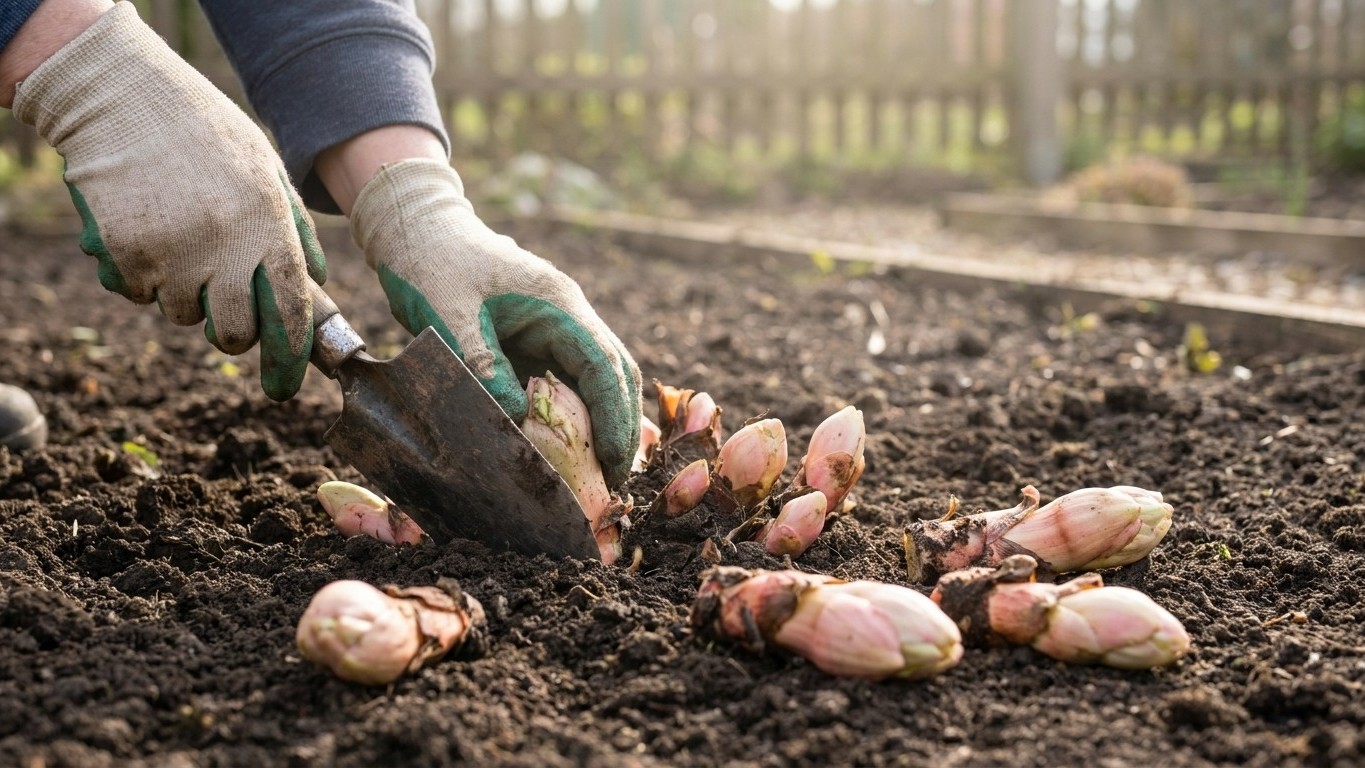

One healthy rhubarb crown, once it’s spent enough seasons in the ground, doesn’t need replacing. It needs cutting apart. Divide it correctly and a single plant becomes five to ten separate plants, each capable of putting up its own stalks the following spring. This isn’t a rescue tactic for a struggling plant, either. Division is how gardeners multiply rhubarb without buying new crowns, and how an aging patch avoids the crowding that quietly shrinks stalk size year after year.
The short answer
According to Utah State University Extension, a healthy, mature rhubarb crown generally produces five to ten new plants when divided correctly. That figure isn’t a marketing round number. It comes directly from how the crown is cut: each section of crown and root needs one large bud, and the number of viable buds on a mature crown is what determines whether you end up closer to five plants or closer to ten.
Timing matters less by the calendar and more by the plant’s own signal. Established plants are divided every 5 to 10 years, depending on the variety and its overall vigor, not on a fixed schedule every gardener follows the same way. The work itself happens in early spring, before new growth begins, when the entire crown is dug up while it’s still dormant enough to handle without damaging emerging shoots.
It’s worth being clear about what rhubarb propagation actually is. Rhubarb isn’t started from seed the way a tomato or a pepper would be. It’s grown from crown cuttings, sometimes called starts, which is exactly what division produces. When you divide a crown, you’re not creating a shortcut version of the plant. You’re creating full, independent plants, each carrying a piece of root tissue and at least one bud capable of pushing up its own leaves and stalks the next season.
Once divided, the sections don’t have to go into the ground the same afternoon. Utah State University Extension notes that if divided crowns aren’t immediately replanted, they can be stored by covering them with moist media such as potting soil, saw dust, peat moss, or vermiculite, kept at temperatures between 32 and 40 F, and replanted before or just as the crown pieces begin to grow. That gives a gardener some flexibility if the weather turns or the new bed isn’t ready yet, without losing the divisions to drying out.
The bigger point is that division isn’t maintenance in the way pruning or weeding is. It’s propagation. One plant, given the right cut and the right timing, turns into a small patch. That’s the mechanism worth understanding before picking up a shovel.
What actually decides it

The headline number, five to ten plants, isn’t fixed. It moves depending on a handful of specific, measurable factors, and each one carries a consequence that’s easy to miss if you’re rushing the job.
The bud count per section
Every section of divided crown needs one large bud. Not a cluster of small buds, not a section that looks big but lacks a visible bud, one large bud attached to its own piece of root and crown tissue. Skip this and the section may sit in the soil doing nothing, because there’s no growing point to push up a stalk. This single detail is what actually caps the plant count. A crown with fewer strong buds yields fewer new plants, even if the root mass looks generous.
Crown age and vigor
The 5 to 10 year window for dividing established plants isn’t arbitrary either. It reflects how long a crown can keep producing strong buds before age and crowding start working against it. A younger, more vigorous crown dividing at the earlier end of that window will likely yield more usable sections with strong buds than an older crown pushed toward the far end, where energy is already being split across more competing growing points underground.
Flowering and its drain on vigor
Rhubarb occasionally sends up flower stalks, and this tendency varies by variety. Flowering reduces plant vigor and cuts into leaf and petiole production, which is exactly the kind of stress that lowers the number of strong buds a crown can support going into a division. Flower stalks should be removed just as they begin to elongate, before they draw down the plant’s energy reserves further.
Storage temperature if replanting is delayed
If divided crowns sit before going back into the ground, the storage window is narrow and specific: 32 to 40 F, wrapped in moist media. Drift outside that range, or let the media dry out, and a bud that would have become a full plant simply fails before it ever reaches soil. A few degrees or a few dry days is the difference between a viable division and a wasted one.
How to do it
- Judge the crown’s age and vigor. Established plants are divided every 5 to 10 years, depending on the variety and how vigorously it’s still producing. A crown that’s clearly slowing down, with smaller stalks than it used to produce, is a candidate even before the upper end of that window.
- Dig up the entire crown in early spring, before new growth begins. The whole root mass needs to come out of the ground intact, while the plant is still dormant, so you can see the full structure of buds and roots before cutting anything.
- Divide the crown so each section carries one large bud. Cut through the crown and root tissue deliberately, checking each section for a single strong bud rather than guessing at even divisions. This step is what determines your final plant count.
- Expect five to ten new plants from a healthy, mature crown. That’s the realistic yield when the crown was vigorous and the buds were clearly identified during cutting.
- Replant the divisions 3 feet apart in a new area of the garden. Spacing them out from the start avoids recreating the crowding that likely triggered the need to divide in the first place.
- If you can’t replant immediately, store the divisions properly. Cover them with moist media such as potting soil, saw dust, peat moss, or vermiculite, and hold them at 32 to 40 F. Replant before, or just as, the crown pieces begin to grow.
- Watch for flower stalks in the seasons that follow. Remove them as soon as they begin to elongate, since flowering reduces vigor and works against the plant recovering fully from being divided.
What Goes Wrong
- Thin stalks after dividing (or before it). This isn’t one problem, it’s a diagnosis with several possible causes: over-harvesting, poor nutrition, inadequate water, temperature stress, and simple crowding as the plant ages. Dividing directly addresses the crowding cause by giving each new plant its own root space, but it won’t fix thin stalks caused by over-harvesting or poor watering. Those need separate remedies alongside the division.
- A crown section that never produces a plant. If a divided section doesn’t include a visible, large bud, it has no growing point and will simply fail in the soil. The remedy is prevention: check each section for a bud before cutting it free, rather than dividing by size or guesswork.
- Reduced vigor from unmanaged flowering. Flower stalks that are left to grow past the elongation stage draw down the plant’s energy, cutting into leaf and petiole production right when a newly divided plant needs that energy to establish. Remove flower stalks as they begin to elongate, every season, not just the year of division.
- Divided crowns that dry out or rot before replanting. Setting divisions aside without covering them, or storing them outside the 32 to 40 F range, damages the buds before they ever get a chance to grow. Cover with moist potting soil, saw dust, peat moss, or vermiculite, hold at the correct temperature, and replant before or just as growth begins.
- Assuming the whole plant is edible once new divisions mature. Rhubarb stalks are safe to eat, but the leaves are not. They contain oxalic acid and can cause sickness, and in serious cases kidney failure, in people and in livestock. When new divisions eventually reach harvest size, only the stalks go in the kitchen. The leaves get discarded, every time.
Common questions
How often should an established rhubarb plant be divided?
Every 5 to 10 years, depending on the variety and how vigorous the plant still is. Older, more crowded crowns tend to fall toward the earlier end of that range.
What happens if flower stalks aren’t removed quickly?
Flowering reduces plant vigor and cuts into leaf and petiole production. Removing flower stalks as they begin to elongate protects the energy the plant needs, which matters even more in the seasons right after a division.
Can rhubarb leaves be eaten along with the stalks?
No. The leaves contain oxalic acid and can cause sickness, including kidney failure in serious cases, and livestock are susceptible too. Only the stalks are safe to eat.
How long can divided crown pieces wait before going back in the ground?
As long as they’re stored correctly: covered in moist media such as potting soil, saw dust, peat moss, or vermiculite, kept between 32 and 40 F, and replanted before or just as the pieces begin to show new growth.