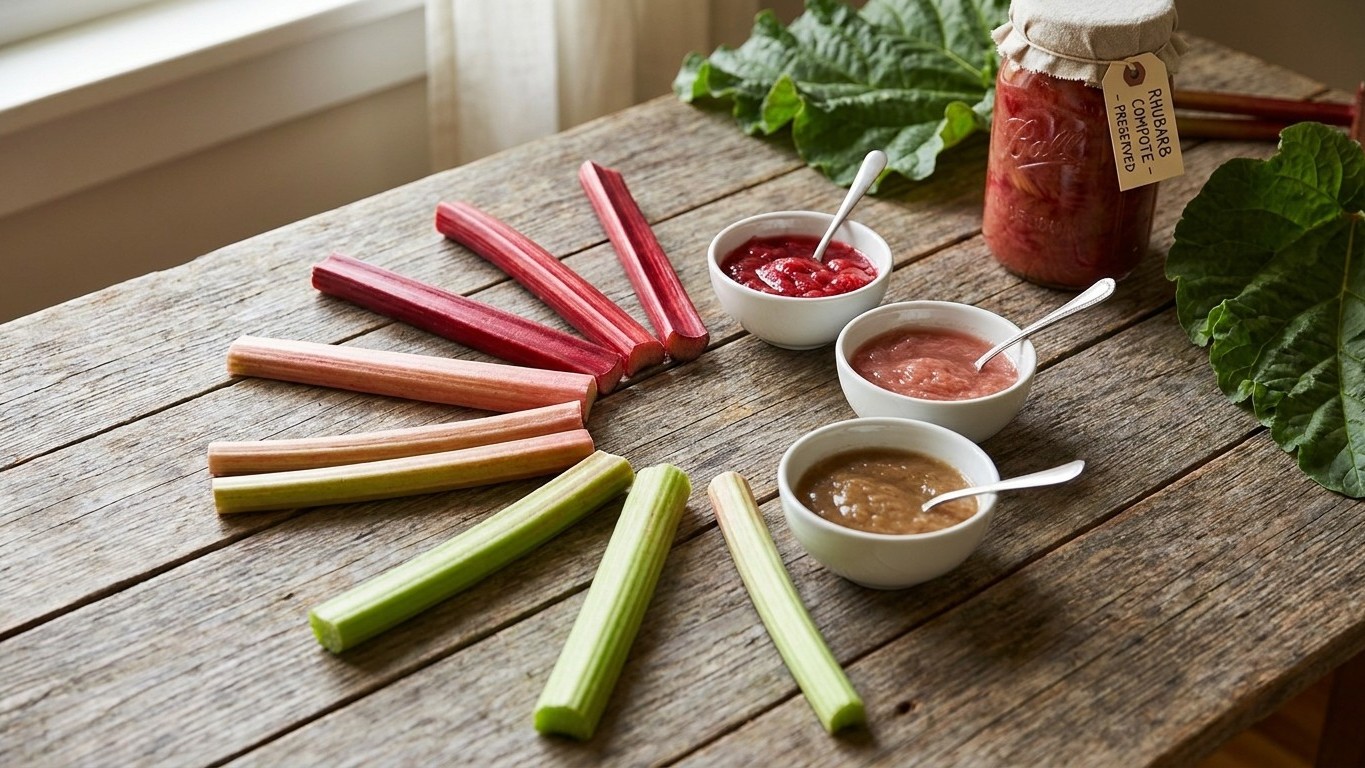

Two of the eight rhubarb varieties Utah State University Extension profiles get a specific nod for holding their red color through cooking and processing: Chipman’s Canada Red and Valentine. Bolting sorts the list differently. Crimson Red and Victoria are flagged as likely to throw flower stalks that need cutting out, while Cherry Wine and Strawberry are described as producing few of them. The other four varieties carry no such note either way.
The short answer
Utah State University Extension’s 2011 guide “Rhubarb in the Garden” runs through eight named varieties, and only two of them come with an explicit statement about color surviving heat: Chipman’s Canada Red, described as “color resists fading when processed,” and Valentine, described the same way, “color resists fading when processed.” Every other variety on the list gets a stalk color and a growing note, but no promise about what happens to that color once it hits a saucepan or a canner.
Bolting, the plant’s tendency to send up a central flower stalk instead of putting its energy into edible stems, splits the same eight varieties into rough groups. Crimson Red is described as “likely to produce flower stalks.” Victoria is “very likely to produce flower stalks that need removal.” On the other side, Cherry Wine and Strawberry are both noted for producing “few flower stalks.” Chipman’s Canada Red, Early Sunshine, MacDonald and, again, Valentine, aren’t given a bolting rating in the source at all.
Here’s the full list as the Extension office describes it, with both traits pulled out side by side.
| Variety | Stalk Color | USU Note | Color Holds When Cooked | Bolting Tendency |
|---|---|---|---|---|
| Chipman’s Canada Red | Moderate red | Multiple uses, high yielding | Resists fading | Not stated |
| Crimson Red | Bright red | Well-balanced flavor, not stringy | Not stated | Likely to bolt |
| Cherry Wine | Bright red | Moderate vigor | Not stated | Few flower stalks |
| Early Sunshine | Intense red | Useful for pie filling, moderate producer | Not stated | Not stated |
| MacDonald | Bright pink to bright red | Common, high yielding, good for pies, freezing, canning | Not stated | Not stated |
| Valentine | Deep red | Historic variety, classic flavor | Resists fading | Not stated |
| Strawberry | Light red | Moderate vigor | Not stated | Few flower stalks |
| Victoria | Mostly pink at base, fades to green at top | Grown widely | Not stated | Very likely to bolt |
No yield figure, no days-to-harvest, no hardiness zone comes attached to any of these eight in the source material. That’s a limitation worth keeping in mind if a nursery listing promises numbers the Extension guide simply doesn’t give.
What actually decides it

Two separate biological switches are at work here, and they don’t run on the same trigger.
Why some varieties bolt and others don’t
Flower stalks form when a rhubarb crown senses it’s time to reproduce, usually pushed along by heat, plant age, or stress during establishment. Victoria’s description makes the consequence plain: those flower stalks “need removal,” because every bit of energy that goes into a flower head is energy the plant isn’t putting into next year’s edible stems. Crimson Red carries the same warning in softer language. Cherry Wine and Strawberry, rated for producing few flower stalks, ask less of the gardener over a season.
A small measurement compounds this. A crown planted with the bud sitting under only about one inch of soil, rather than buried too deep or left exposed, tends to emerge stronger and less stressed, which in practice means less premature flowering in a bolt-prone variety. Skip that detail and a variety already inclined to bolt, like Victoria, will do it more, not less.
Why color holds or fades under heat
The pigment that makes a rhubarb stalk red is anthocyanin, and anthocyanin is not uniformly heat-stable. Some varieties keep it through boiling and canning; others lose the red and settle into green or muddy pink once cooked, even if the raw stalk looked vivid in the garden. That’s the entire reason Chipman’s Canada Red and Valentine get singled out in the Extension guide: the color survives the pot, which the other six varieties aren’t credited with doing.
The same one-third rule that governs bolting energy also governs pigment. Harvesting more than about a third of a plant’s stalks in a season pulls down the leaf area left to photosynthesize, and a stressed crown produces thinner, paler stalks the following year regardless of variety. Stay under that limit and the plant rebuilds the reserves that make next season’s color, red or pink, closer to what the variety is supposed to deliver.
How to do it
- Pick a planting site in full sun with soil that drains well, and work compost or aged manure into it before planting.
- Plant crown divisions, called starts, rather than seed, in early spring before new growth begins, positioning the bud close to the surface, under roughly one inch of soil.
- Skip harvesting entirely through the plant’s first growing season so the crown can establish its root system.
- In the second year, take only a light harvest, leaving the majority of stalks standing.
- From the third year on, harvest by pulling stalks rather than cutting them, never taking more than one third of the stalks from a plant at any one time.
- Watch bolt-prone varieties, Crimson Red and Victoria in particular, and cut out any flower stalk as soon as it appears so the plant’s energy stays in the stems.
- Discard the leaves rather than eating them or feeding them to animals. Rhubarb leaves contain oxalic acid, which can cause sickness and, in serious cases, kidney failure in people and in livestock.
- Divide overcrowded crowns every several years in early spring, before new growth starts, to keep vigor and stalk color from declining.
What goes wrong

- Thin, spindly stalks with several possible causes. An overcrowded crown that hasn’t been divided in years produces weaker stalks; so does taking more than a third of the stalks in a single harvest; so does planting in partial shade instead of full sun. Divide the crown, cut back on how much is harvested, and confirm the bed gets sun for most of the day before assuming the variety itself is the problem.
- Flower stalks draining the plant. Crimson Red and Victoria are both described as likely to bolt, and an unremoved flower stalk pulls energy away from the edible stems all season. Cut the flower stalk out at its base as soon as it’s spotted.
- Bright raw stalks that turn dull after cooking. This is a variety issue more than a technique issue. Only Chipman’s Canada Red and Valentine are described as resisting color fade when processed; the other six carry no such guarantee, so a home canner chasing a red finished product may want to plant one of those two rather than assume any red-stalked variety will hold up in the jar.
- Leaves left in the garden or added to a compost pile animals can reach. The leaves carry oxalic acid and are toxic to people and to livestock. Remove and discard them separately rather than leaving trimmed leaves where pets, kids, or grazing animals can get to them.
- Harvesting the first year after planting. Pulling stalks before the crown has had a full season to establish weakens the plant going forward. Wait until the second year for even a light harvest.
Common questions
Which rhubarb variety keeps its red color best after cooking?
Utah State University Extension names two: Chipman’s Canada Red and Valentine, both described as resisting color fade when processed. The other six varieties in its list don’t carry that note.
Which rhubarb varieties are most likely to bolt?
Victoria is called “very likely” to send up flower stalks that need removal, and Crimson Red is described as “likely” to do the same. Cherry Wine and Strawberry, by contrast, are noted for producing few flower stalks.
Can you eat rhubarb leaves?
No. The leaves contain oxalic acid and can cause sickness or kidney failure. Livestock are susceptible too, so trimmed leaves shouldn’t be left where animals can reach them. Only the stalks are safe to eat.
Does altitude affect canning rhubarb?
Yes, and this is a national rule, not a variety-specific one: process at 20 minutes for altitudes between 1,000 and 6,000 feet, and 25 minutes above 6,000 feet.