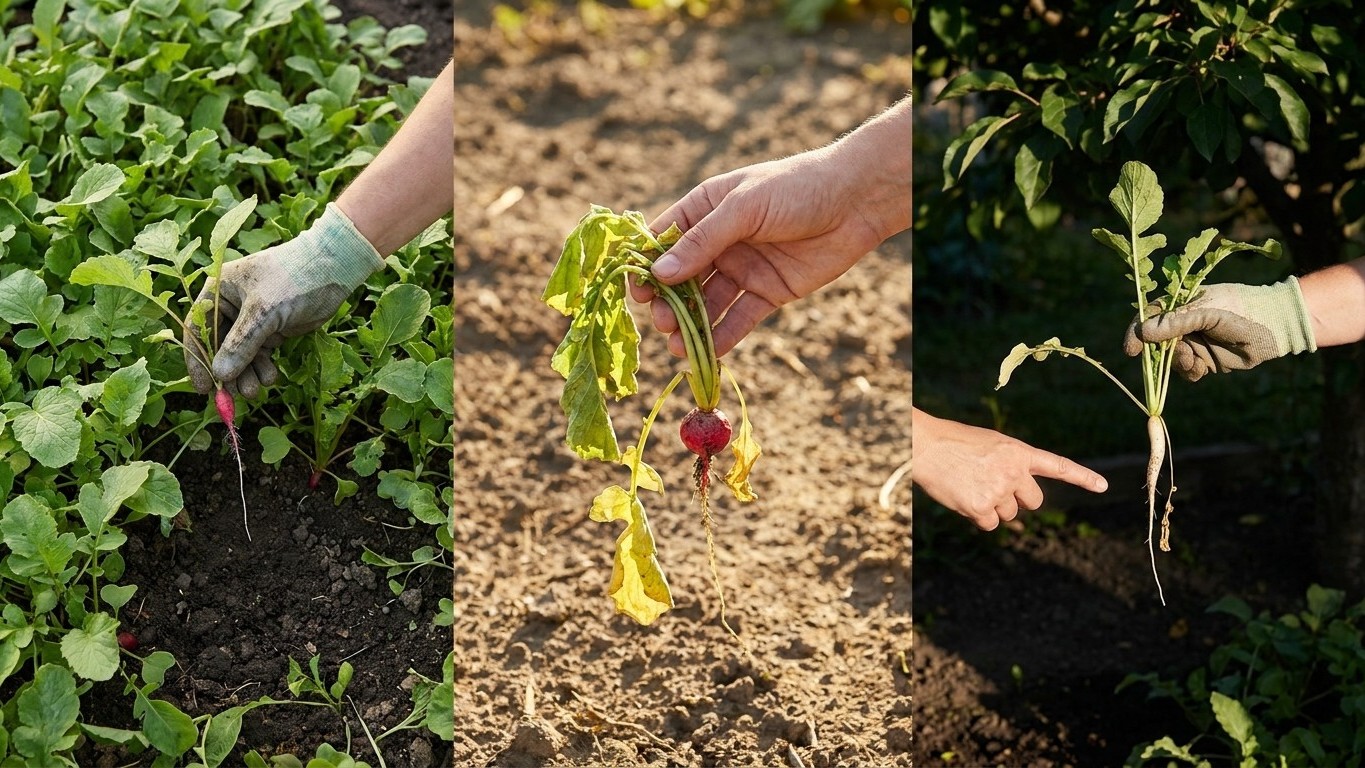

All leaves, no radish comes down to one of three separate problems, according to Utah State University Extension’s fact sheet Radishes in the Garden: seedlings left too thick and never thinned, roots pushed by heat that suppresses bulbing, or plants grown in too much shade to fill out. Each cause gets a different fix: thin, re-time, or relocate.
The short answer
Utah State University Extension names the problem directly and refuses to blame it on a single cause. The fact sheet states that “all tops and no root” shows up “when planted too thickly and not thinned properly,” so the plants never get the room they need to swell a root. It shows up separately “when temperatures are too hot (planted too late or unseasonable weather in spring),” which suppresses bulbing outright rather than starving it. And it shows up a third way “if grown in too much shade,” where the roots simply never fill out completely even if spacing and Temperature are fine.
That’s three distinct mechanisms hiding behind one symptom, and the extension office treats them as three separate diagnoses rather than one generic “radish problem.” Crowding is a spacing failure you can correct with a thinning pass. Heat is a timing failure you correct by adjusting when you sow. Shade is a siting failure you correct by moving the bed, not by changing how you grow the radishes.
The timing piece deserves a number, since radishes are always direct-sown and never started indoors as transplants. The fact sheet’s own rule for avoiding summer heat is to count backward from your area’s first heavy frost: sow the fall crop somewhere between 25 and 45 days before that frost date hits. That window is what keeps young roots out of hot soil and away from the bulbing shutdown described above. It’s a count you can apply anywhere in the country, unlike a calendar month tied to one region’s growing season.
Root maggots, flea beetles, and root rot can also stunt a radish crop, but those are pest and disease problems, not “all leaves, no root” specifically. They get their own remedies further down, separate from the spacing, heat, and shade triangle that Utah State University Extension singles out for this exact symptom.
What actually decides it

A radish is built around one governing idea: speed. It’s bred and grown to sprint from seed to a harvestable root in a short window, and almost every defect the extension fact sheet describes is really just something that slowed that sprint down. Understanding that single principle explains why crowding, heat, and shade all produce the same symptom through different routes.
Crowding steals the resources a fast root needs
When seedlings sit shoulder to shoulder, they compete for the same patch of soil moisture and nutrients at exactly the moment the root should be swelling fastest. Instead of one plant putting everything into a single bulb, several plants split that energy between them, and the visible result is exactly what the fact sheet describes: healthy green tops with barely any root underneath.
Heat suppresses bulbing directly
Heat doesn’t just slow a radish down, it can shut off bulb formation as a response to unseasonable warmth, whether that’s a plant sown too late in spring or an unexpected hot spell hitting young plants. The top growth keeps going because leaves tolerate heat better than the swelling root does, which again produces tops without a proportional root.
Shade starves the root of what it needs to fill out
Too much shade doesn’t stop the plant from growing, it just changes where that growth goes. Leaves reach for whatever light is available while the root, deprived of the full sun a radish wants, never fills out completely even on a well-spaced, well-timed planting.
Uneven moisture drags the whole process down
The same speed principle explains why moisture fluctuations cause root cracking, slow leaf development, and contribute to “hot,” bitter roots. A radish that gets a stop-start supply of water is a radish whose sprint keeps stalling and restarting, and the plant pays for that in texture and flavor even when spacing, heat, and light are all correct.
How to do it
- Choose a full-sun bed, since shade alone is enough to keep roots from filling out regardless of everything else you do right.
- Sow seed directly where the radishes will grow. Radishes don’t transplant, so there’s no starting them indoors and moving them later.
- Sow seed about half an inch deep.
- Space rows 10 to 12 inches apart to give roots room to swell without shading neighboring rows.
- Thin seedlings as soon as they’re identifiable so mature plants stand 1 to 2 inches apart. This step is the direct fix for the crowding cause of all-tops-no-root.
- For a fall crop, count backward from your area’s expected heavy frost date and sow 25 to 45 days ahead of it, keeping the crop out of the hot stretch of the season that suppresses bulbing.
- Water on a frequent and uniform schedule rather than letting the soil swing between dry and soaked, since that fluctuation is what drives cracking and bitter flavor.
- Harvest while roots are still young. Radishes left in the ground too long are the ones most prone to splitting.
What Goes Wrong
- All tops, no root: this single symptom has three separate causes and three separate fixes. If seedlings were never thinned, thin existing rows down to 1 to 2 inches apart so remaining plants can bulb out. If the planting hit unseasonable heat or went in too late, re-time the next sowing using the 25-to-45-day Count Back From frost instead of guessing at a calendar month. If the bed sits in too much shade, the fix isn’t cultural at all, it’s relocation to a full-sun spot.
- Cracking and splitting: old radishes left in the ground too long will generally split on their own, so the remedy is simply harvesting younger. Separately, a heavy application of water after a dry stretch will also crack mature roots, which points to irrigating on a frequent and uniform schedule rather than letting the soil dry out and then soaking it.
- Hot, bitter roots: this comes from the same moisture fluctuations that cause cracking and slow leaf development. Frequent, uniform watering addresses the flavor problem and the cracking problem at the same time.
- Root maggots: these burrow into the root and bulb itself, damaging the harvestable part of the plant directly. Floating row covers that exclude the adult flies from laying eggs near the crop are the practical countermeasure.
- Flea beetles: they chew tiny holes in cotyledons and leaves, which weakens young plants right when they need to be growing fastest. Floating row covers exclude these pests as well.
- Root rots: these take hold in wet, poorly drained soil. Crop rotation and improved soil drainage are the two remedies the extension fact sheet points to, since neither a cover nor a watering adjustment addresses a soil-borne disease.
Common questions
Can I fix all-leaves-no-root radishes once they’re already growing, or do I need to start over?
If crowding is the cause, thinning the remaining plants can still help them bulb out, since the surviving roots gain the space and resources they were missing. If heat or shade caused it, thinning won’t fix a bulb that’s already been suppressed by temperature or starved of light; that planting is better harvested for greens or replaced with a properly timed or properly sited sowing.
Does thinning too late still help?
It helps more the earlier it happens, since the goal is to stop competition before roots start swelling. Thinning as soon as seedlings are identifiable, rather than waiting, gives the remaining plants the full run of soil moisture and nutrients through their whole growth period.
How do I know if shade is the problem versus heat?
Heat-suppressed bulbing tends to follow a specific hot stretch or a planting that went in too late in the season. Shade-related failure shows up consistently in the same bed regardless of timing, since it’s about how much direct sun that spot receives rather than what the weather did on any given week.
Is a cracked radish still safe to eat?
Cracking is a texture and cosmetic issue tied to age or a sudden heavy watering after a dry spell, not a sign of contamination on its own. Trimming around a split and using the radish promptly is the practical response, along with harvesting the next batch younger and watering on a frequent, uniform schedule to prevent the moisture swings that cause it.