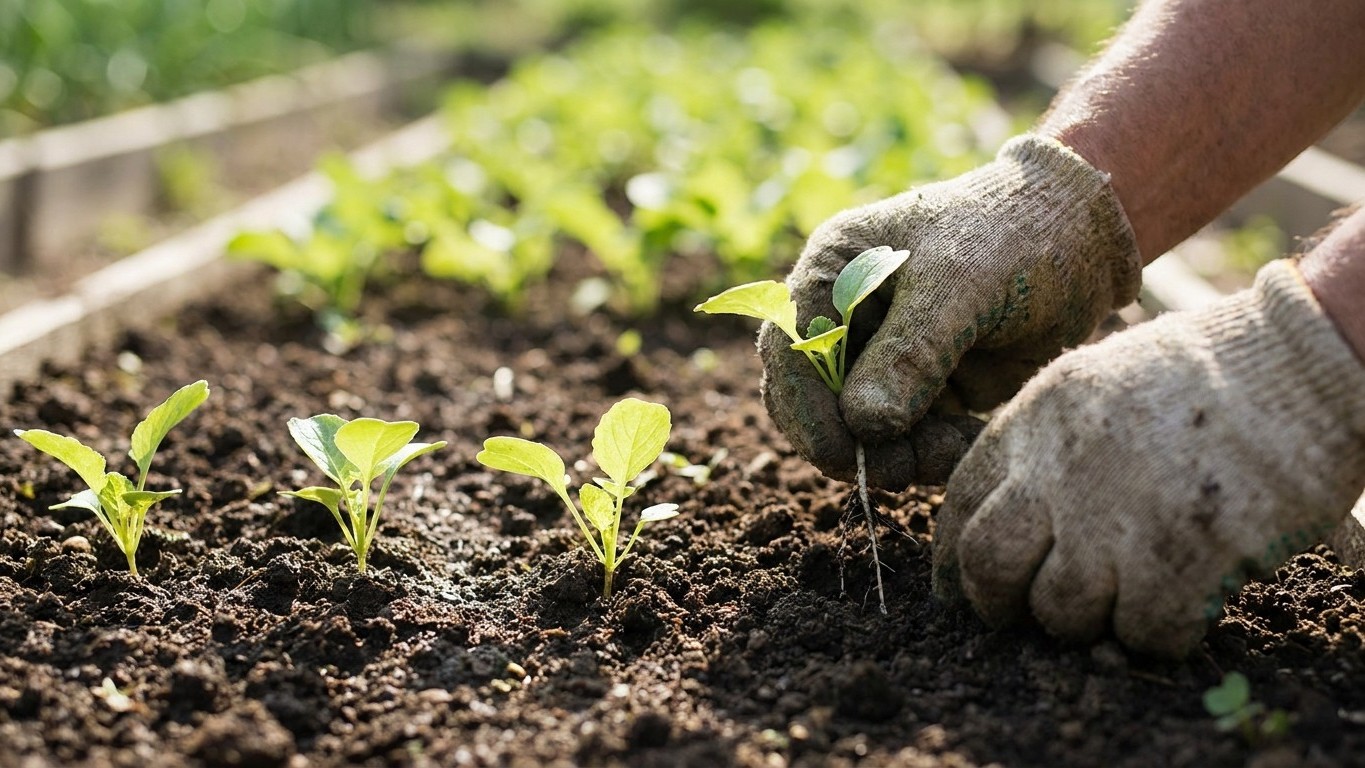

Thinning is what makes a radish a radish. Utah State University Extension puts it plainly: seedlings need to end up 1-2 inches apart in the row, with rows 10-12 inches apart, or the roots never size up. Skip that step and you get a row of leafy tops with nothing worth pulling underneath.
The short answer
Direct-seed radishes, because they are always direct-sown, and thin the row once seedlings show their first true leaves, before crowding starts costing you root size. Utah State University Extension’s fact sheet on radishes is the reference here, and its instructions are specific: thin closely spaced plants to encourage good root size, leaving 1-2 inches between plants in the row and keeping rows 10-12 inches apart. That spacing is not a suggestion for tidiness. It is the number that determines whether a radish swells into something round and crisp or stays a thin white thread attached to a bush of leaves.
Timing matters as much as spacing, but not in the way most garden advice frames it. Radishes are a race against heat, not a calendar date circled in a planner. For a fall crop, the transposable rule from the source is to count backward from your area’s average first heavy frost, sowing early enough to dodge the worst of late-summer heat but late enough that the crop matures in cooler weather, roughly 25 to 45 days before that frost date lands. That window shifts by hundreds of miles depending on where you garden, which is exactly why a fixed month never works as advice. A gardener in coastal Oregon and one in inland Arizona are not looking at the same weekend, but they are looking at the same math.
The thinning itself happens fast, on the scale of days rather than weeks, because radishes are among the fastest root crops in the garden. That speed is the whole story of this crop, for better and for worse. It is why the plant rewards attentive thinning so quickly and punishes neglect just as quickly. A row left uncut for even a week past the point where seedlings touch leaves is already losing root potential, because the plants are spending their energy competing for light and space instead of swelling below ground. There is no do-over once that competition sets in. You can still get a harvest, but you will not get the roots you planted for.
What actually decides it

One thing governs this crop from seed to harvest: speed. Radishes are built to grow fast, mature fast, and fail fast if anything slows them down. Every problem gardeners run into with this vegetable traces back to something interrupting that clock, whether it is crowding, poor soil, weeds, or heat. Understanding that single principle explains nearly every piece of guidance on this crop, including why thinning is treated as non-negotiable rather than optional tidying.
Crowding steals the clock
Seeds sown too thickly germinate into a tangle of seedlings competing for the same patch of soil. According to Utah State University Extension, when radishes are planted too thickly and not thinned properly, the plants fail to grow sizable roots. The energy that should go into swelling a root instead goes into leaf growth, because each seedling is fighting its neighbors for light rather than developing underground. Thinning removes that competition early, before the crop has wasted days it cannot get back.
Soil texture sets the speed limit
Radishes want fertile, well-drained, deep, sandy soil. Heavy, compacted ground physically resists a swelling root, slowing expansion even when spacing and timing are perfect. The fix from the source is direct: heavy soils need to be amended with plenty of compost to allow good root development. Compost loosens the structure enough that the root can push outward at the pace the plant is built for.
Weeds and cultivation cost more time than they seem to
Radishes do not compete well with weeds, and that weakness is worst during germination and early establishment, exactly when the plant’s growth is already slow and vulnerable. Pulling weeds by hand rather than hoeing deep matters too. Deep cultivation around the plants causes root pruning and damage that sets back growth and yield, undoing the head start that careful thinning and good soil provide.
How to do it
- Prepare the bed with sandy, well-drained soil. If the ground is heavy, work in compost before sowing so roots can expand without resistance.
- Direct-sow seeds about half an inch deep. Radishes are never started indoors or transplanted; the seed goes straight into its permanent spot.
- Space rows 10-12 inches apart so each row has room to develop without crowding its neighbor.
- Water gently and consistently to bring seedlings up evenly across the row.
- Thin seedlings to 1-2 inches apart in the row as soon as they are large enough to handle, snipping or pulling extras rather than letting the row stay crowded.
- Weed by hand close to the row instead of hoeing deep, especially in the first weeks after germination when the plants are most vulnerable to competition.
- Apply a nitrogen-based fertilizer, 1/4 cup per 10 feet of row of 21-0-0, 3-4 weeks after emergence to support root development once the crop is established.
- Harvest promptly once roots reach usable size rather than leaving them in the ground, since the same speed that builds the root can also carry it past its best texture.
What Goes Wrong
- All tops, no root, caused by crowding: seeds sown too thickly and never thinned put every seedling in direct competition for light. Fix it by thinning promptly to 1-2 inches apart in the row; there is no later fix once leaves have overtaken the row.
- All tops, no root, caused by heavy soil: even properly spaced plants stall out if the ground is compacted clay rather than the deep, sandy soil radishes need. Fix it by amending the bed with compost before the next sowing so the root has room to expand.
- All tops, no root, caused by weed competition: weeds crowding seedlings during germination pull water and light away at the exact moment growth is already slow. Fix it by weeding by hand through the first few weeks rather than waiting until the row looks overrun.
- Stunted or damaged roots from deep cultivation: hoeing too close and too deep prunes the developing root itself, since deep cultivation around the plants causes damage that affects growth and yield. Fix it by weeding shallow and by hand near the row, saving the hoe for the space between rows.
- Bulbs that never seem to catch up: a row that misses its early nitrogen boost can lag behind. Fix it by applying the 21-0-0 fertilizer at 1/4 cup per 10 feet of row on schedule, 3-4 weeks after emergence, rather than skipping feeding altogether.
Common questions
Can I skip thinning if I space seeds carefully at sowing?
Careful spacing at sowing reduces the work, but germination is never perfectly even, and a few seeds always land closer together than planned. Checking the row once seedlings emerge and adjusting to the 1-2 inch spacing still matters, even if fewer plants need to come out.
Do radishes transplant well if I start them in trays?
No. Radishes are direct-sown; the source is explicit that this crop goes straight into the garden bed as seed rather than being started indoors and moved later. Root crops in general dislike the disturbance of transplanting, and radishes are no exception.
How do I know when to stop thinning and start harvesting?
Thinning happens early, while seedlings are small and before roots have begun to swell. Harvesting comes later, once the crop planted at 1-2 inch spacing has had time to size up. The two are separate jobs on the same timeline, not the same task at different stages.
Which radish variety should I plant?
Utah State University Extension names Champion, Cherry Belle, Daikon Long White, Icicle, and Easter Egg as options, without ranking one over another or attaching maturity numbers to any of them. Variety choice comes down to root shape and color preference more than performance differences documented in the source.