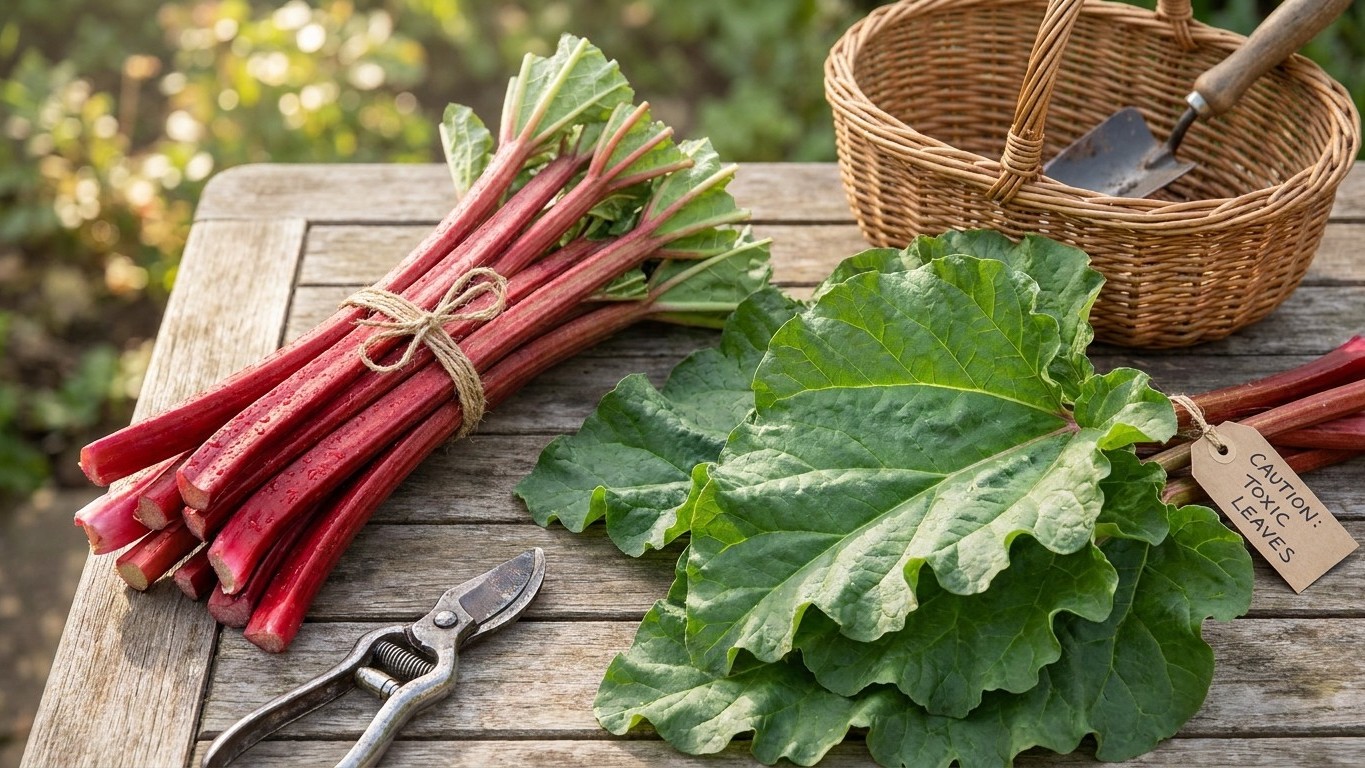

Cook the stalks, compost the leaves. That’s the whole rule with rhubarb, and it’s not a matter of taste or texture, it comes down to a toxic compound the leaf blade carries and the stalk barely contains. A backyard patch produces armfuls of stalks that go straight into pies, sauces, and jars every year, and the only people who get hurt are the ones who mistake the leaf for something edible. Know which part goes in the kitchen and which part goes on the Compost Pile, and rhubarb is nothing to fear.
The short answer
Rhubarb leaves are toxic; rhubarb stalks are not. According to Utah State University Extension’s guide, Rhubarb in the Garden, “rhubarb leaves contain high concentrations of oxalic acid that can make you quite sick and lead to kidney failure. The stalks on the other hand have almost no oxalic acid.” That’s the entire mechanism in one sentence: same plant, two parts, wildly different chemistry.
The extension office doesn’t hedge on what to do with the leaf. Its guidance is direct: “Only the stalks are edible, so all leaves should be removed and discarded.” No partial trim, no cutting off just the tip, no simmering the leaf down to make it safe somehow. The whole leaf blade comes off, and it doesn’t go in a salad, a soup, or anyone’s smoothie experiment.
Livestock owners get the same warning that rural gardeners sometimes overlook. The extension notes plainly, “Animals are also susceptible to this poisoning so leaves should not be fed to livestock.” A chicken coop, a goat pen, a rabbit hutch, none of them are the right destination for a pile of pulled rhubarb leaves, even though those animals happily eat almost anything else pulled from a garden bed.
So where do the leaves go? Utah State University Extension gives two approved paths: “Discard the leaves into the compost pile or leave in the garden as a mulch.” Both options keep the toxic material out of any feed trough or dinner plate while still putting the plant matter to use in the yard.
None of this makes rhubarb a dangerous crop to grow. Gardeners across the country harvest stalks by the armful every spring without incident, and the plant has been a staple of home gardens for generations. The caution applies to one part of the plant only, and once a gardener knows to separate stalk from leaf at harvest, the toxicity question is settled for good.
What actually decides it

The difference between safe to eat and a trip to the emergency room comes down to where the plant stores a single compound.
Where the acid concentrates
Oxalic acid builds up almost entirely in the broad leaf blade, the flat green fan at the top of each stalk. The petiole, the long red or green piece most cooks call rhubarb, carries almost none of it, according to Utah State University Extension. That’s why a dish made entirely from stalks carries no meaningful oxalic acid risk, while a dish made with even a small amount of chopped leaf can concentrate enough of the compound to cause real harm.
This is also why trimming just the worst-looking part of a leaf isn’t sound advice. The extension’s instruction is to remove all leaves, not trim them, because there’s no visibly safe zone within the blade. The whole leaf carries the concentration, so the whole leaf gets discarded, every time, with no exceptions for a leaf that looks smaller or less mature than the rest.
Why animals are at risk too
Oxalic acid poisoning isn’t a human-specific quirk of biology. Utah State University Extension flags that animals are susceptible to the same poisoning, which is why leaves can’t simply be tossed over a fence to chickens, goats, or livestock that would otherwise eat garden scraps without hesitation. A backyard flock that free-ranges near a rhubarb patch can peck at a fallen leaf the same way a person might mistakenly toss one into a stockpot, and the outcome is a comparable one tied to the same compound.
That’s the reasoning behind the two approved disposal routes. Composting or mulching keeps the leaf material in the garden ecosystem, breaking down or covering soil, rather than sitting somewhere an animal or an unwitting cook could reach it directly. Compost piles and mulch layers aren’t feed troughs, and that distinction is the whole point of the extension’s advice.
Put together, the two mechanisms explain the entire rule. The stalk is chemically distinct from the leaf, and the disposal method matters as much as the harvest method, because the toxic compound doesn’t disappear once the leaf comes off the plant.
How to do it
Handling rhubarb safely from harvest to jar takes only a few extra seconds per stalk, and none of it requires guesswork once the leaf-versus-stalk rule is clear.
- Harvest the stalk the way it’s normally picked, pulling or cutting at the base, keeping the leaf attached until the next step.
- Cut the leaf blade off immediately, right where it meets the petiole. Utah State University Extension is direct that “only the stalks are edible, so all leaves should be removed and discarded” before a stalk goes anywhere near a kitchen counter.
- Send the leaves to the compost pile or spread them as mulch in a garden bed, the two disposal methods the extension recommends.
- Keep the discarded leaves away from any animal enclosure while they sit waiting for the compost bin, since “animals are also susceptible to this poisoning.”
- Rinse the trimmed stalks before cooking or storing them to remove garden soil and any leaf residue left at the cut.
- If preserving stalks by canning, process filled jars for 20 minutes at altitudes between 1,000 and 6,000 feet, or 25 minutes above 6,000 feet, a national guideline that applies no matter where the plant was grown.
What goes wrong

- A leaf ends up in the pot by mistake. This usually happens when a stalk is harvested in a hurry and the leaf blade isn’t fully separated before cooking. The fix is procedural: cut the leaf off at harvest, every time, before the stalk goes into a basket with the rest of the produce.
- Discarded leaves get fed to backyard animals. Chickens, rabbits, and goats will eat almost anything handed to them, and a rhubarb leaf looks like any other garden scrap. Utah State University Extension’s warning that “animals are also susceptible to this poisoning” means leaves belong in the compost pile or as mulch, never in a feed bucket or tossed over a coop fence.
- Leaves go in the trash instead of the compost or mulch pile. This isn’t dangerous, but it wastes plant material the extension specifically recommends putting to use in the garden, and it skips the disposal method meant to keep the toxin away from people and animals alike.
- Someone eats rhubarb leaves and starts feeling sick. Because leaves carry high concentrations of oxalic acid capable of causing serious illness and kidney failure, any suspected ingestion is a medical situation, not a wait-and-see one. Contact a medical provider or poison control resource right away.
- Canned rhubarb stalks get processed with a generic timer instead of an altitude-adjusted one. Twenty minutes below 6,000 feet and 25 minutes above it aren’t interchangeable; using the wrong figure for a given elevation undermines the safety of the whole canning process. Check local elevation before setting the timer.
Common questions
Can you eat rhubarb leaves if you cook them long enough?
No. Utah State University Extension doesn’t list any cooking method that neutralizes the oxalic acid concentration in rhubarb leaves; its guidance is to remove and discard all leaves rather than prepare them in any form.
Is it safe to compost rhubarb leaves?
Yes. Utah State University Extension specifically recommends discarding leaves “into the compost pile or leave in the garden as a mulch” as the two approved disposal methods.
Can chickens or other backyard animals eat rhubarb leaves?
No. The extension states that “animals are also susceptible to this poisoning,” meaning leaves shouldn’t be fed to livestock or left where free-ranging animals can reach them.
What should you do if you accidentally ate rhubarb leaf?
Treat it as a medical concern rather than a minor upset. Oxalic acid in rhubarb leaves can cause serious illness and kidney failure, so contacting a medical provider or poison control resource promptly is the right response instead of waiting to see if symptoms appear.