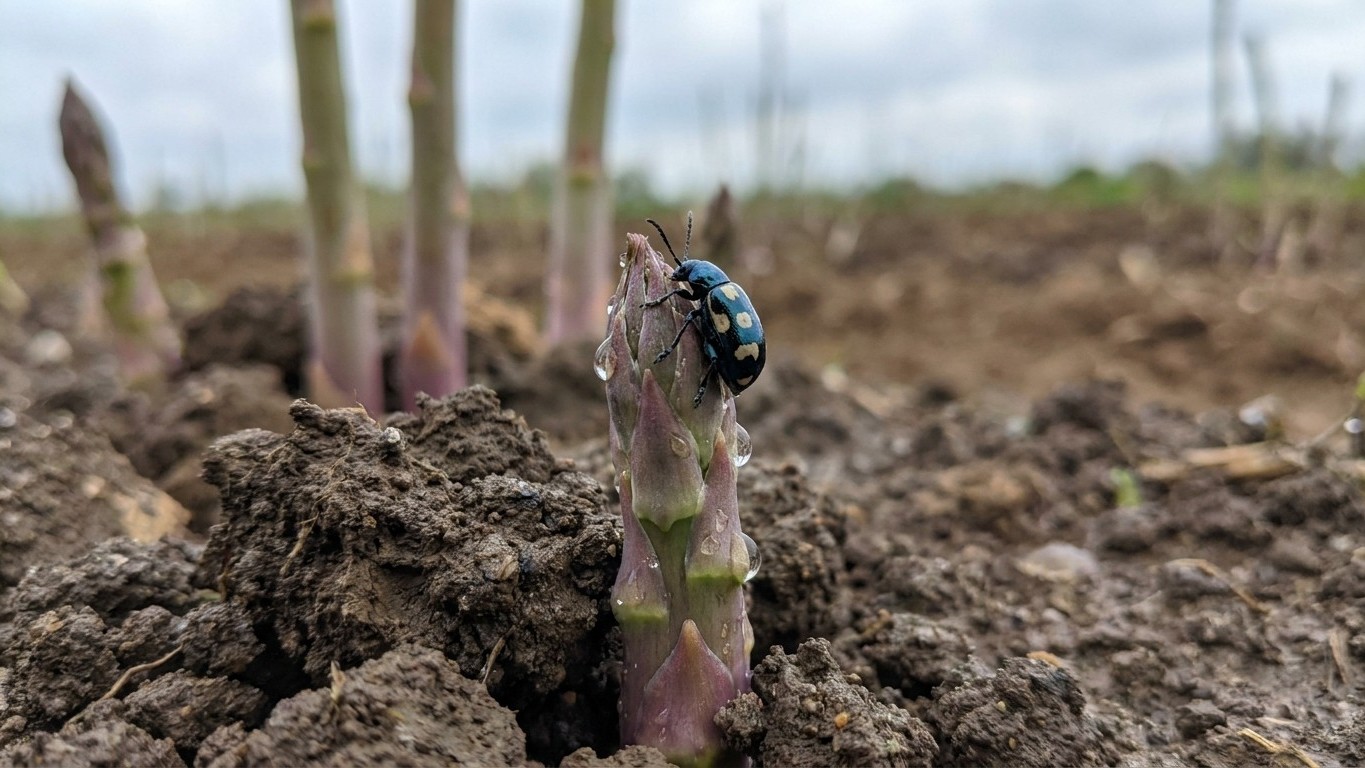

Two insects do most of the feeding damage reported on asparagus in Alberta gardens: grasshoppers and thrips. Three other species that show up on regional pest lists, the brown marmorated stink bug, miller moths and social wasps, are present in the province too, but none of them target asparagus foliage or spears in any documented way. Pest pressure on this crop here is real but narrow, and it concentrates in the driest stretch of summer.
Which pests attack asparagus in Alberta

The most specific documented list available for this part of the northern prairie comes from Montana State University Extension, Urban IPM, a service just across the border that names five insects for gardens in this broader region: Brown marmorated stink bug, Grasshoppers, Miller moths, Social wasps and Thrips. That list covers general urban and garden pests for the area, not asparagus specifically, so it needs sorting before it means anything for a backyard asparagus bed.
Only two of the five documented insects, grasshoppers and thrips, actually feed on asparagus tissue. The other three have a documented presence in the region but nothing to do with this particular crop. The brown marmorated stink bug is a piercing-sucking insect that goes after fruiting crops with fleshy tissue, tomatoes, peppers, tree fruit, not the wiry, needle-like foliage asparagus produces once spears turn to fern. Miller moths are the adult, migratory stage of the army cutworm; the adults feed on flower nectar as they pass through on their way to higher ground, and it’s the larval cutworm stage, not the moth, that chews on plants at soil level, a stage not on this list. Social wasps are predators and scavengers, hunting other insects and scavenging sugary substances, not plant feeders at all, so a wasp working an asparagus bed is there for something else living in it, not the plant itself.
That leaves a short list, and it stays short. Grasshoppers are generalist chewers that will strip foliage from almost anything green when their numbers build, and asparagus’s feathery mature growth is no exception. Thrips are tiny, slender insects that rasp at plant surfaces and feed on the sap that leaks out, and they favor exactly the kind of tender, actively growing foliage asparagus produces through the summer. Neither pest is unique to asparagus, and neither is considered a major regional threat to the crop, but they’re the two worth watching for.
When each one shows up, and what it does first
Timing on this crop starts with the ground thawing and the last frost clearing. Alberta’s average last spring frost falls around May 21 at the Calgary Int’l A reference station, and that date is a mean, not a guarantee: in one year out of two, frost arrives later than that. Crowns go into 8-inch furrows in early spring around that window, and it’s year three before the first spears are ever cut, which means the ferny growth that follows in years one and two is being fed on before it ever reaches a plate.
Thrips tend to turn up first as the season’s ferny growth fills in, working the newest tissue at the tips. What a gardener notices at that stage is a fine, silvery or grayish stippling across the foliage, almost like the plant has been lightly sandpapered, rather than any obvious hole or bite mark. Thrips populations build fastest under hot, dry conditions, and Alberta’s driest summer stretch lands in August, which averages just 57 mm (2.24 inches) of rain, noticeably less than June’s roughly 3.7 inches. That drop-off in moisture through the season is what tends to push thrips activity from a minor early presence to something more visible by late summer.
Grasshoppers arrive on a similar clock, building through the season as surrounding grassland and roadside vegetation dries out and asparagus’s still-green fern stays comparatively attractive. What shows up first is ragged, irregular notching along the edges of the fine branchlets rather than a clean cut, and in a heavy year whole feathery stems can be stripped back to bare stalks. Because both insects peak in the same dry stretch, a bed that looks fine in June can show noticeably more feeding by the time August’s dry weeks set in.
Telling the damage apart from everything else
Asparagus ferns pick up a lot of blame that doesn’t belong to an insect. Moisture stress, sun exposure, nutrient shortfalls and simple mechanical knocks from wind or cultivation can all leave marks that look, at a glance, like something is eating the plant.
| What you see | Possible causes | What tells them apart |
|---|---|---|
| Silvery or grayish stippling on the fern | Thrips feeding, drought stress, dust or sun bleaching | Thrips leave tiny dark fecal specks visible under a hand lens; drought or sun marks don’t |
| Ragged notches along fine branchlets | Grasshoppers, browsing by deer or rabbits | Grasshoppers leave small, irregular bites scattered across many stems; larger animals shear or snap whole stems near the base |
| Wilting or yellowing fern in patches | Insect feeding, drought stress, a soil-borne disease | Insect damage shows visible chew marks or stippling; drought wilt is usually even across the bed; disease often shows discoloration inside the stem when it’s cut open |
| Bent or damaged spears in spring | Insect feeding, mechanical damage from wind or foot traffic | Insect feeding leaves scarring or discoloration at the point of damage; mechanical breaks are clean |
Cut a suspect stem open lengthwise before assuming an insect is the cause: discoloration running inside the tissue points to a disease issue, not feeding damage, and no amount of insect control will fix that. When the cause isn’t obvious from the pattern of damage, that’s the point to bring a sample to a local extension office rather than guess.
What actually works here, and what is a waste of time
Because only two pests on the documented list actually target this crop, the most useful moves are cultural, not chemical. Grasshoppers lay eggs in undisturbed grassy soil, so keeping weedy margins around the bed mowed or cultivated removes some of that egg-laying habitat before numbers build. A floating row cover set over young ferns through the driest weeks of the season gives thrips less exposed, actively growing tissue to work on, and it costs nothing but the timing.
Because asparagus stays in the same ground for 10 to 15 years once it’s planted, the decision made at planting matters more than anything applied afterward. This region’s dominant soil, a Chernozem that runs loam to silt with roughly 42 percent silt content, is generally well drained, which is good news for a crop that needs exactly that. Checking drainage before crowns go in the ground is the one step that can’t be undone later, since a bed that sits wet will struggle regardless of how well pest issues are managed. Watering through August’s driest stretch also keeps ferns less stressed, and stressed plants tend to draw more feeding pressure than vigorous ones.
What tends not to help: treating in June, when rainfall is highest and both documented pests are least active, wastes effort on a window with the lowest actual risk. So does spraying broadly for all five species on the regional list when three of them, stink bugs, miller moths and social wasps, aren’t documented as feeding on this crop at all. Letting the plant keep enough fern to rebuild its root reserves, rather than over-cutting spears, does more for its ability to tolerate feeding pressure than any treatment applied after the fact.
Where to check this for your own county
Montana State University Extension’s Urban IPM program is the most specific documented source available for this part of the northern prairie, but it’s a bordering state’s service, not an Alberta-based one, and a list compiled for one jurisdiction doesn’t guarantee identical pest pressure three hundred miles north or on the other side of a county line. A pest documented at the state or provincial level is not the same as a pest confirmed in one particular garden.
Alberta’s counties and municipal districts maintain their own Agricultural Service Boards, set up specifically to handle local pest, weed and crop questions at the ground level, and that local office is a better first call than any provincial-scale list when something specific turns up on a plant. They deal with the actual conditions of that county’s soil, moisture and pest activity in a given season, which a regional document simply can’t reflect.
Before assuming a fix is needed at all, the useful next step is to bring an affected stem, cut open so any internal discoloration is visible, to that county office or the nearest extension contact, rather than treating based on a symptom alone.
Common questions
Do grasshoppers cause serious damage to established asparagus beds?
Established ferns can tolerate a fair amount of grasshopper feeding without lasting harm, since the plant’s real investment is in its root system underground. Heavy, repeated stripping in a dry year is more of a concern for a young bed still in its first two years, before harvest has even started.
Are thrips visible to the naked eye?
Barely. They’re small, slender insects that are easier to spot by their damage, fine silvery stippling on the fern, than by seeing the insect itself. A hand lens makes the tiny dark fecal specks they leave behind much easier to confirm.
Does Alberta’s dry August make pest problems worse?
It’s the likeliest window for both documented pests to be most active, since August averages just 57 mm (2.24 inches) of rain, the lowest of the summer months. Watering through that stretch keeps plants less stressed and less attractive to feeding insects.
Should I worry about pests during the first two years when I can’t harvest yet?
That’s actually when feeding matters most, since no harvest until year three means every year of fern growth before that is building the reserves the plant will rely on for the next decade or more. Protecting the fern in those first two seasons is worth more attention than most gardeners give it.