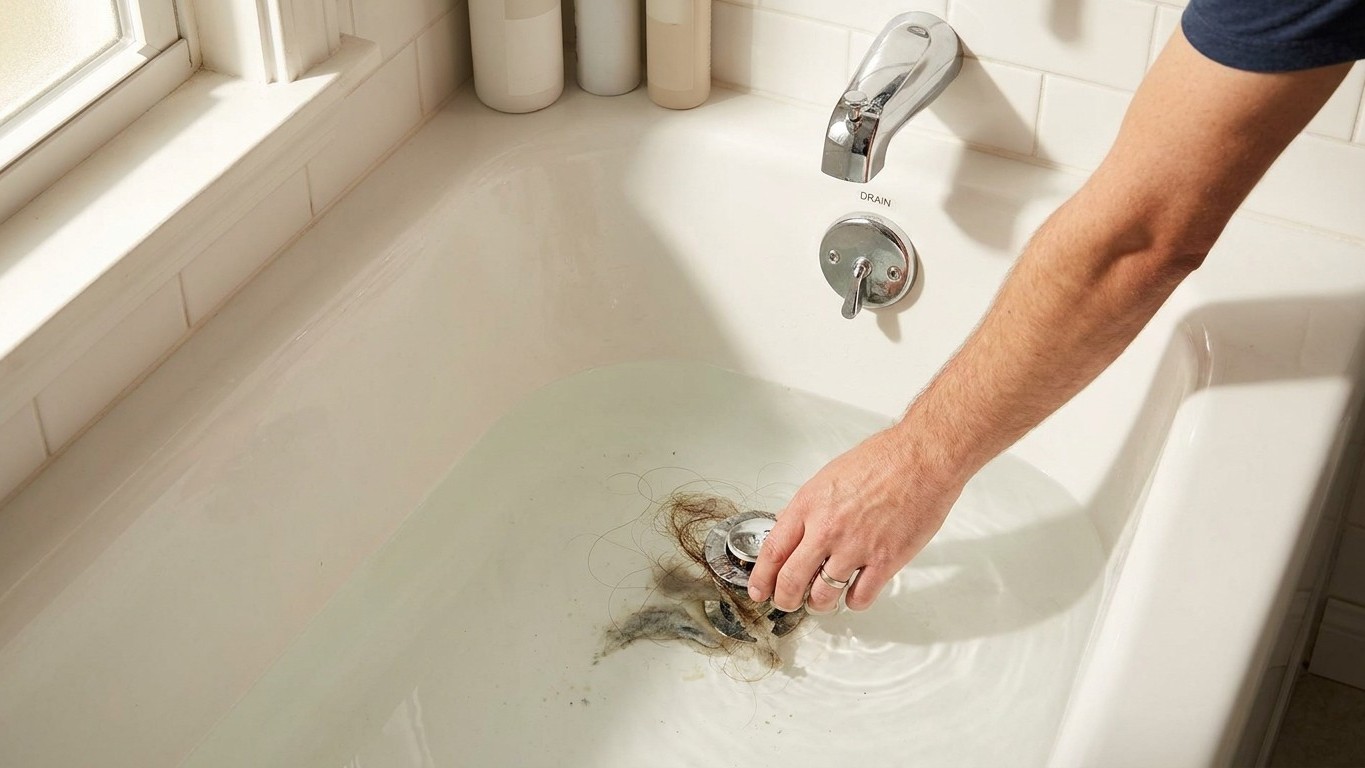

A bathtub that won’t drain almost always comes down to one of two things: a physical clog of hair and soap scum in the trap or waste line, or a stopper mechanism that’s stuck shut and never fully lifting to let water through. The fix usually starts at the stopper itself, not with a bottle from under the sink. Pull it, look at what’s tangled around it, and work backward from there before you assume the pipe itself is blocked.
What is actually happening
A kitchen sink or a bathroom sink drains through a simple trap. A bathtub doesn’t work that way, and that difference is why tub clogs behave so differently from every other drain in the house. Most tubs use what’s called a trip-lever or overflow-linkage stopper: the lever you see near the overflow plate, up by the faucet, connects through a hidden tube behind the tub wall to a plunger or rocker mechanism that sits down in the drain itself. Flip the lever, and a rod inside that tube either drops a plunger to block the drain or pulls a stopper closed at the bottom. Flip it the other way, and the whole assembly is supposed to lift clear so water runs free.
That’s the part no other fixture in the house has, and it’s usually the first place to look when drainage slows or stops. The rod-and-linkage assembly lives inside a vertical tube you can’t see, bolted to the overflow plate with two or three screws. Hair and soap residue collect on the plunger or rocker at the bottom of that mechanism the same way they’d collect on a stopper you can see, except this buildup is hidden, so people blame the pipe when the actual obstruction is sitting on a piece of metal a few inches down.
Why the mechanism jams
Over years of use, the linkage rod can also just get gunked up or slightly bent, so it doesn’t travel far enough to lift the plunger completely even when the lever is in the “open” position. The result looks exactly like a slow drain caused by a clog deep in the pipe, but the pipe is clear. The stopper mechanism is simply not opening all the way, which is why cleaning the visible stopper often does nothing: the real obstruction, or the real jam, is inside the overflow tube itself.
Older tubs sometimes use a simpler pop-up or toe-touch stopper without the trip-lever linkage, and those tend to fail differently, usually from a worn gasket or a stripped adjustment nut rather than a jammed rod. Knowing which type sits in your tub changes what you’re actually diagnosing, and a quick look at the overflow plate tells you which one you have before you open anything up.
What to check, in order
Work from the cheapest and most likely cause toward the more involved ones. Each step below tells you something about the next, so don’t skip ahead.
- Pull the stopper and look at it. If it lifts out (or unscrews, depending on the style) and comes up wrapped in hair and soap film, that buildup was very likely restricting flow on its own. A stopper that comes out clean tells you the problem is farther down, not at the surface.
- Check the overflow plate and lever position. With the plate off (two or three screws, no tools beyond a screwdriver), work the lever by hand and watch how far the linkage travels. If the plunger barely moves, or doesn’t fully retract when the lever is set to “open,” the mechanism itself is the obstruction, not the pipe.
- Pull the linkage assembly out through the overflow tube. This is the part most people never see. Slide it out slowly and look at the bottom for a mat of hair and scum wound around the plunger or rocker arm. If it’s caked, clean it by hand and reinsert it; this alone resolves a large share of “slow tub drain” complaints.
- Run water with the stopper open and mechanism removed. If water now drains normally, the clog was in the stopper or linkage, confirmed. If it still drains slowly or backs up, the obstruction is farther down the waste line, past where the mechanism reaches.
- Check whether other fixtures are affected too. A slow tub alone points to a local clog near the tub. A tub that’s slow and a nearby toilet or sink that’s also gurgling or slow points to a shared line problem farther down, which is a different repair entirely.
Each of these steps is diagnostic as well as corrective: the point where the water starts moving normally again tells you exactly where the problem was, which matters if it comes back and you need to know Where to Look First next time.
What it costs to leave it
A tub that drains slowly rarely gets fixed right away. It’s not urgent the way a leak under the sink is, so it sits for weeks, sometimes longer, while standing water sneaks past a worn stopper seal or seeps around the overflow gasket behind the wall. That slow seepage is exactly the kind of household leak the EPA has spent years trying to get homeowners to take seriously.
The scale is bigger than most people expect. According to the U.S. EPA WaterSense program, “household leaks can waste nearly 1 trillion gallons of water annually nationwide,” and “the average household’s leaks can account for more than 9,300 gallons of water wasted every year.” The agency also notes that “nine percent of homes have leaks that waste 50 gallons or more per day,” which is the category a persistently overflowing or slow-seeping tub mechanism can fall into if the gasket or linkage tube isn’t sealing properly.
These are national aggregates from a conservation campaign, not a prediction about your bathtub specifically. They exist to show scale, not to tell you what your own household is losing. A tub that drains slowly because of a hair clog in the stopper isn’t leaking water at all. It’s just backing up and eventually clearing. But a tub where the overflow gasket has failed, or where the linkage tube itself has a hairline crack, can leak steadily into the wall cavity behind the tub without any visible sign in the room, which is a different and more expensive problem than a slow drain.
The only way to know what’s actually happening in your house is your water meter, not a national number. If you suspect water is escaping somewhere you can’t see, a simple meter check, done with everything else in the house turned off, will tell you more in ten minutes than any average ever will. This site has a dedicated page walking through exactly how to read a meter for a hidden leak, and it’s worth doing before assuming the worst or ignoring the problem entirely.
For context on why this matters financially, WaterSense also states that “fixing easily corrected household water leaks can save homeowners about 10 percent on their water bills,” which is a meaningful number when it’s applied to your actual bill rather than a national average.
When to stop and call a plumber
Most slow-draining tubs are a homeowner-level fix: pull the stopper, clean the linkage, run water, done. But there’s a clear line past which the smart move is to stop and call a licensed plumber, and it’s worth knowing where that line sits before you’re standing in an inch of water deciding what to do next.
If the problem is genuinely behind the wall, meaning you’ve pulled the linkage assembly, cleaned it, reinstalled it, and the tub still won’t drain or still shows signs of water escaping around the overflow plate, that’s a job for someone who can open the wall cavity properly and check the waste line connection without guessing. The same goes for anything involving the main water supply line to the house. That’s not a fixture-level repair, and mistakes there affect every tap in the home, not just the tub.
A gas water heater anywhere near the affected area is its own category of caution. If a slow drain or suspected leak is anywhere close to a gas appliance, or if you smell gas at any point while investigating, stop entirely and call a professional immediately rather than continuing to troubleshoot the plumbing.
Finally, any leak that has already wetted structure, meaning you can see water staining on a ceiling below the bathroom, feel soft or spongy subfloor near the tub, or smell mildew that wasn’t there before, has moved past a plumbing fix and into a repair that likely involves both a plumber and possibly a contractor to address the wood or drywall underneath. Water damage is expensive precisely because it’s quiet. By the time it’s visible, it’s usually been happening for a while, and waiting longer only adds to that cost.
Common questions
Why does my tub drain fine at first and then slow down halfway through?
That pattern usually points to a partial clog in the linkage mechanism or stopper rather than a fully blocked pipe. Water drains normally while the level is high because pressure pushes it past the obstruction, then slows as the water level drops and there’s less pressure behind it.
Is it normal for a tub to drain slower than a shower stall?
Tubs generally do drain a bit slower than a simple shower stall drain because of the added linkage mechanism and the longer path water takes through the overflow assembly. A noticeable difference, where the tub takes several minutes longer to clear, is still worth checking rather than assuming it’s just normal design.
Can I tell if the clog is in the stopper or farther down the pipe without taking anything apart?
Not reliably. The most telling test is pulling the stopper and linkage assembly out and running water with it removed entirely. If the tub drains normally at that point, the clog was in the mechanism, and if it still drains slowly, the obstruction is farther down the line.
Does a slow tub drain waste water the way a dripping faucet does?
Not usually, unless there’s an actual leak involved. A slow drain from a hair clog just delays water leaving the tub. It doesn’t waste it. But a failed gasket or cracked overflow tube behind the wall can leak steadily even when the tub isn’t in use, which is the scenario worth checking with a water meter reading.