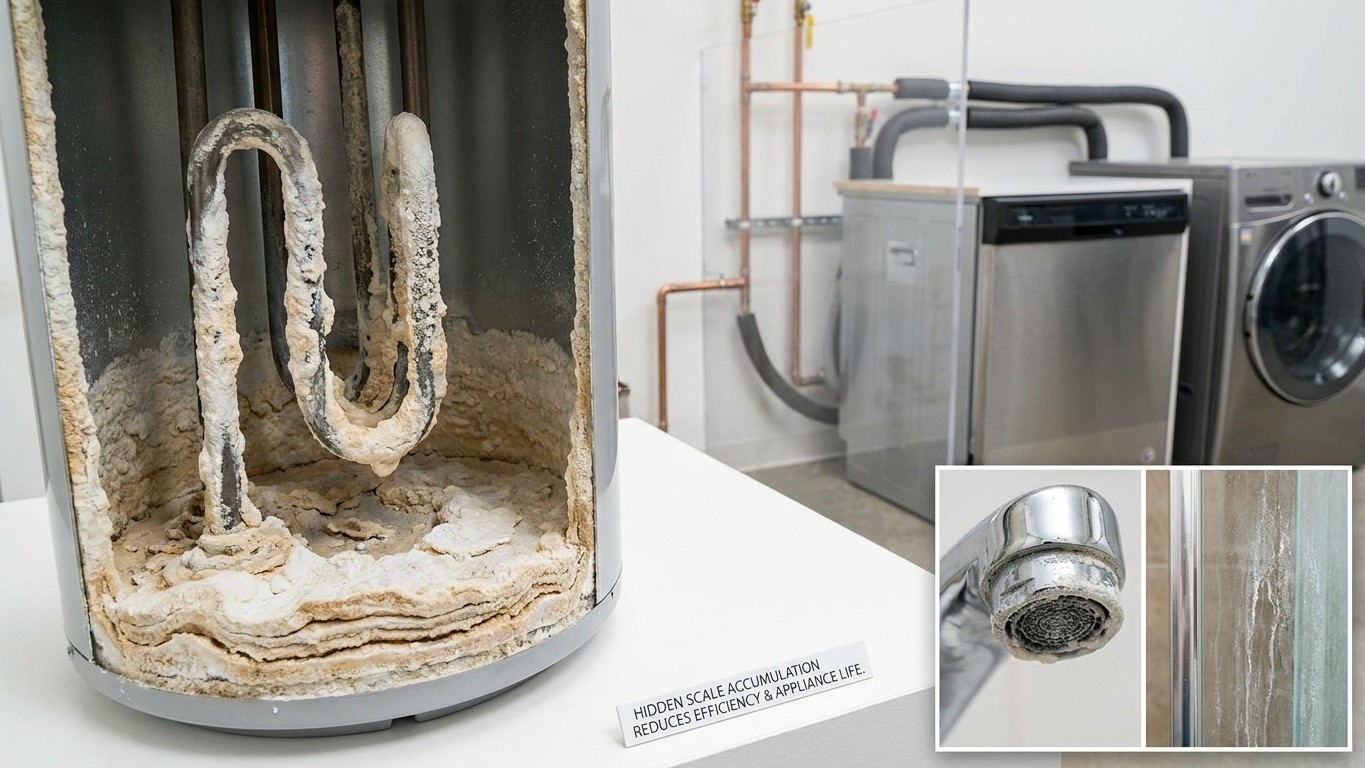

Hard water carries dissolved calcium and magnesium, and every time it’s heated or left to evaporate, those minerals turn solid. That’s the scale you see around a faucet aerator or crusted on a shower door. Inside pipes and appliances, the same process happens out of sight, narrowing water lines, coating heating elements, and forcing water heaters, dishwashers, and washing machines to work harder than they were built to. The fix isn’t usually urgent, but ignoring it quietly costs money and years of appliance life.
What is actually happening
Calcium and magnesium stay dissolved in cold water without causing much trouble. Heat changes that. As water warms inside a tank, a kettle, or a dishwasher’s heating coil, those minerals lose their solubility and come out of solution as solid calcium carbonate. That’s scale. It doesn’t wash away with the next fill. It bonds to whatever surface it forms on, and each heating cycle adds another thin layer.
The reason this matters more than a cosmetic ring around a faucet is where the buildup happens next. Inside a water heater, scale settles on the bottom of the tank and coats the heating element itself, whether gas or electric. That layer acts as insulation, but insulation in the wrong place. The heating element now has to work through a mineral crust to warm the water above it, burning more energy for the same result and, on electric units in particular, running hotter than designed. A heating element that overheats fails sooner. On gas units, sediment at the tank bottom can cause popping or rumbling sounds as trapped water flashes to steam beneath the layer.
The same mechanism plays out at a smaller scale inside dishwashers and washing machines, where internal heating elements and spray arms narrow with mineral deposits over time. Showerheads and faucet aerators are the visible version of this: the small holes that shape the spray fill in gradually, cutting flow long before anyone notices a problem with the fixture itself.
Why it’s invisible until it isn’t
None of this announces itself. A water heater losing efficiency to scale doesn’t trip a breaker or set off an alarm, it just costs a little more on the energy bill each month, a difference too small to notice against normal seasonal swings. The failure shows up later, when the tank develops a leak years earlier than its rated lifespan, or when a heating element burns out on a unit that’s barely past its warranty. By the time the appliance actually fails, the mineral buildup that caused it has been accumulating for years, layer by layer, completely out of view.
Understanding that the damage is gradual and heat-driven changes how a homeowner should think about hard water. It isn’t a single problem to solve once. It’s an ongoing condition that favors periodic maintenance over one-time fixes, and it explains why the appliances that heat water (water heaters, dishwashers, coffee makers, steam irons) show wear long before appliances that only move cold water, like A Washing Machine‘s cold-fill valve.
What to check, in order
- Look at the faucet aerators and showerheads first. Unscrew one and look for a white or greenish-white crust around the mesh screen. If the holes are visibly narrowed or clogged, that’s mineral scale, and reduced flow at that fixture confirms it. This is the cheapest check in the house and takes about a minute.
- Check the water heater’s temperature and pressure relief valve area, and listen to the tank. Popping, rumbling, or crackling sounds when the burner or element runs point to sediment settled at the bottom of the tank. A tank that takes noticeably longer to deliver hot water than it used to is showing the same thing from a different angle.
- Look at kettle, coffee maker, or iron interiors if you have any with a visible reservoir. A chalky white buildup on a heating surface you can see is a reliable stand-in for what’s happening, invisibly, inside larger appliances on the same water line.
- Check dishwasher and washing machine performance over the last year. Glasses coming out cloudy, dishes with a filmy residue, or laundry that feels stiff even with enough detergent all point toward mineral content interfering with how soap rinses away.
- Test the water itself, if you want a number rather than symptoms. Home test strips or a lab test from a local water utility or extension office will state hardness in grains per gallon. This step confirms what the physical checks already suggested, it doesn’t replace them.
Each check tells you something distinct. Fixture-level scale confirms hardness is present and active. Tank noise confirms it’s already affecting the water heater specifically. Appliance symptoms confirm the cost is showing up in daily use, not just in theory. Run them in this order because the first two take minutes and cost nothing, while a lab water test is worth doing only once you already suspect hardness is the cause.
What it costs to leave it
Hard water scale doesn’t cause the dramatic, all-at-once failures that a burst pipe does. It works more like a slow tax on efficiency, and national water-conservation data helps put that kind of slow, cumulative cost into perspective, even though it’s measuring something adjacent: leaks, not scale.
The U.S. EPA’s WaterSense program notes that “household leaks can waste nearly 1 trillion gallons of water annually nationwide,” and that “the average household’s leaks can account for more than 9,300 gallons of water wasted every year.” The agency also found that “nine percent of homes have leaks that waste 50 gallons or more per day.” These are national aggregates from a conservation campaign, not a hardness study, and they measure water lost to leaks rather than water wasted through scale-related inefficiency. But they’re useful for one thing: showing how much can go unnoticed in an ordinary home’s plumbing when nobody’s looking closely, whether the cause is a worn flapper or a scaled-over heating element quietly using more energy than it should.
EPA WaterSense also breaks the leak numbers down to the fixture level: “a leaky faucet that drips at the rate of one drip per second can waste more than 3,000 gallons per year,” while “a showerhead leaking at 10 drips per minute wastes more than 500 gallons per year,” and “an old or worn flapper can cause your toilet to flush on its own or silently leak thousands of gallons a year.” The agency estimates that “fixing easily corrected household water leaks can save homeowners about 10 percent on their water bills.”
None of these figures say anything about what hard water costs a specific household in shortened appliance life or higher energy use, no national number can, because hardness levels, appliance age, and usage patterns vary too much house to house. The only measurement that matters for your own home is your own water meter, checked before and after a period of no water use. If you haven’t done that yet, a page on this site walks through how to check for hidden water leaks using nothing but the meter you already have.
When to stop and call a plumber
Everything above (checking an aerator, listening to a water heater, testing hardness) is something any homeowner can do safely with no tools beyond a wrench and a flashlight. The line moves once the work goes past the fixture and into the structure of the house.
Anything happening inside a wall is past the point of a DIY check. If scale or corrosion is suspected in supply lines you can’t see, or a pipe joint behind drywall is showing signs of a slow leak (a soft spot, a faint water stain, a musty smell), that calls for a plumber, not a patch job. The same goes for anything on the main supply line coming into the house: this is the line every fixture depends on, and a mistake there doesn’t stay contained to one sink.
Gas water heaters deserve their own caution. Sediment buildup at the tank bottom is common and worth knowing about, but flushing a tank, adjusting a gas valve, or working anywhere near the burner assembly is a job for someone licensed to do it, given the combination of gas, water, and an enclosed flame. An electric water heater carries less immediate risk but still involves a 240-volt circuit that deserves the same respect.
And any leak that has already wetted structure (subfloor, drywall, framing, insulation) needs a plumber and likely a moisture assessment, not a repair attempt. Water that’s already soaked into building material can support mold growth within 24 to 48 hours, and by the time it’s visible, it’s usually been there longer than that. Before any of this becomes urgent, it helps to know exactly where your home’s main shut-off valve is and how to use it. That’s covered in detail on this site’s guide to finding and using your main water shut-off valve, and it’s worth reading before you need it, not during an emergency.
Common questions
Does hard water actually shorten a water heater’s lifespan?
Yes, through sediment and scale buildup on the heating element and tank bottom, which forces the unit to work harder and can lead to overheating and earlier tank failure than in homes with softer water.
Can I see hard water damage without a water test?
Often, yes. White or greenish crust on faucet aerators and showerheads, cloudy glassware from the dishwasher, and popping sounds from a water heater are all visible or audible signs that usually mean hardness is the underlying cause.
Is hard water bad for a home’s health, not just its plumbing?
Hard water isn’t considered a health hazard by drinking water standards; the concern with hardness is almost entirely about appliance wear, energy efficiency, and fixture buildup rather than safety.
Will a water softener stop all the damage described here?
A softener addresses the mineral content causing scale, but existing buildup inside a water heater or appliance doesn’t disappear on its own once softened water is introduced. Already-scaled components typically need separate cleaning or eventual replacement.