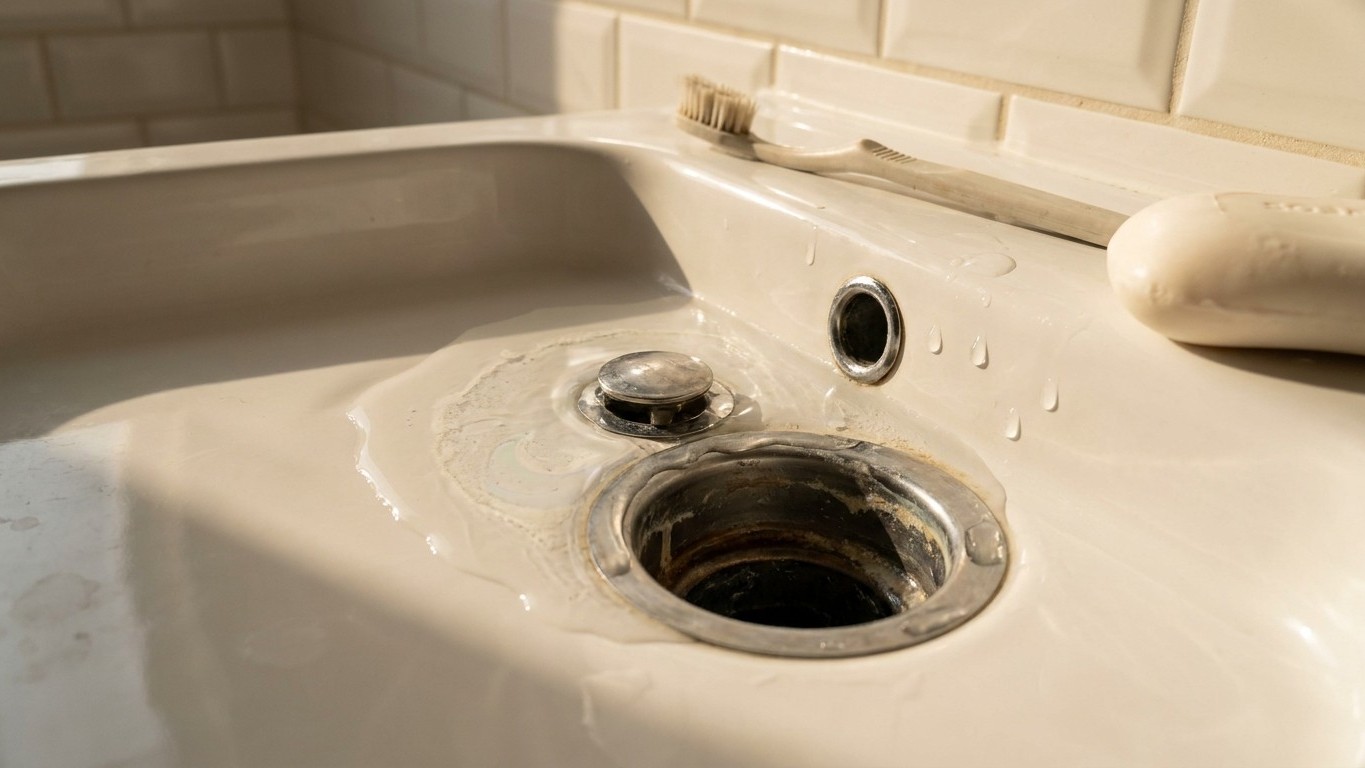

Water still going down means you have time. That’s the entire point of a slow drain: it’s not a clog, it’s a clog forming, and the difference between catching it now and ignoring it is usually the difference between a five-minute fix and a service call. The sluggish sink is the pipe telling you something is narrowing before it closes off completely.
What is actually happening

A drain doesn’t go from perfect to blocked overnight. It narrows. Grease, soap scum, hair, and mineral buildup coat the inside of the pipe the way plaque coats an artery, and each layer shaves a little more off the diameter water has to pass through. At first you won’t notice. Then the sink takes an extra ten seconds to clear. Then thirty. Then you’re standing there watching water pool around the drain while you brush your teeth. That gradual timeline is the mechanism, and it’s why a slow drain is a warning rather than an emergency: the pipe is still open, just smaller than it should be.
The detail that actually matters for figuring out what’s wrong is how many fixtures are affected. A single sink draining slowly points to something local, usually within a few feet of that drain, inside the trap or the branch line feeding it. That’s the easy case. But if the bathroom sink, the tub, and the toilet are all sluggish at the same time, or if a slow sink is paired with gurgling somewhere else in the house, that’s a different problem entirely. Multiple fixtures slowing together usually means the blockage sits further downstream, in a shared line or the main drain that carries wastewater away from the whole house.
That distinction changes what you should even attempt. A local clog in one branch line is squarely a homeowner job: it’s accessible, it’s contained, and clearing it rarely requires special tools. A blockage in a shared or main line is a bigger undertaking, often needing equipment that reaches much further into the pipe than anything sold for home use. So before touching anything, run the other fixtures in the house. Flush the toilet nearby. Run the tub. That five-minute test tells you whether you’re dealing with a nuisance or the early stage of something that will eventually back up into more than one room.
Venting matters too. Drains rely on airflow to let water fall freely; a blocked or undersized vent can make a drain gurgle and empty slowly even with zero buildup inside the pipe itself. It’s less common than a physical clog, but it explains the cases where a sink drains slowly despite the trap and branch line being clean. Worth keeping in mind if the checks below come up empty.
What to check, in order
Work from the cheapest and most likely cause toward the less common ones. Each step below tells you something specific depending on what you find.
- Look at the stopper or strainer first. Pull it out and check what’s wrapped around the base. Hair, soap residue, and toothpaste buildup collect right at the surface in bathroom sinks, and in kitchen sinks it’s usually food particles and grease film. If you find a solid mass here, that’s very likely your entire problem, and clearing it often restores full drainage immediately.
- Check the water level and speed by hand. Fill the sink a few inches and pull the stopper, timing roughly how long it takes to clear. A slow, steady drain with no gurgling points toward a partial clog further down the trap. A drain that gurgles, bubbles, or drains in surges suggests trapped air, which often means the blockage is sitting at a bend or the vent is struggling.
- Inspect the P-trap under the sink. That curved section of pipe is designed to trap debris (and sewer gas) precisely because its shape slows down flow. Placing a bucket underneath and loosening the trap by hand, without tools if possible, lets you see directly what’s built up inside. Thick sludge or a solid clump here confirms a local clog you can physically remove and rinse out.
- Test a second and third fixture. Run the tub, flush the toilet, check another sink. If they drain normally, your problem is isolated to one branch line, which is the easiest scenario. If several fixtures are sluggish or gurgle together, the issue sits downstream in shared piping, and that changes the entire scope of what you’re dealing with.
- Watch for backing up rather than just slowing. A drain that’s merely slow is different from one where water actually rises back up in a different fixture when you run another. That reversal is a strong sign of a blockage in the main line, not a branch, and it’s the clearest signal in this whole list that the problem has grown past the sink itself.
What it costs to leave it
A slow drain by itself doesn’t waste water the way a dripping faucet does. But the habits it creates, and the eventual failure it leads to, sit inside a much bigger picture of household water loss that’s worth understanding for scale. According to U.S. EPA WaterSense, “household leaks can waste nearly 1 trillion gallons of water annually nationwide,” and “the average household’s leaks can account for more than 9,300 gallons of water wasted every year.” WaterSense also notes that “nine percent of homes have leaks that waste 50 gallons or more per day.”
Those numbers describe leaking fixtures, not slow drains, and they’re national aggregates from a conservation campaign, not a prediction for any one house. A slow sink drain doesn’t waste water sitting still. What it does is push people toward workarounds that do waste water: running the tap longer to force debris through, letting the faucet drip to keep the trap “moving,” or ignoring a slow toilet fill because the bowl still eventually clears. WaterSense also points out that “a leaky faucet that drips at the rate of one drip per second can waste more than 3,000 gallons per year,” and that “a showerhead leaking at 10 drips per minute wastes more than 500 gallons per year.” Those are the kinds of secondary leaks that tend to show up in the same households where a slow drain has been left alone for months.
There’s also the flapper angle. WaterSense states that “an old or worn flapper can cause your toilet to flush on its own or silently leak thousands of gallons a year,” which matters here because a toilet that’s slow to drain and a flapper that’s failing often get lumped together as “the toilet’s acting up” when they’re two separate problems needing two separate fixes. And on the financial side, WaterSense notes that “fixing easily corrected household water leaks can save homeowners about 10 percent on their water bills.”
None of these figures tell you what your slow drain is costing you specifically. Your water meter does that. If you suspect a leak is hiding somewhere behind the slow drainage, not just a physical clog, the meter test walks you through confirming it yourself before you assume the two problems are connected.
When to stop and call a plumber
Everything above assumes you can see the problem: a stopper you can pull, a trap you can loosen by hand, a fixture you can watch drain. That’s where a homeowner’s involvement should end. The moment the likely cause is behind a wall, inside a wall-mounted stack, or below a slab, you’re no longer clearing a local clog, you’re opening up plumbing, and that’s a different job requiring different tools and, in most areas, different permissions.
The same boundary applies to anything touching the main water supply line into the house, as opposed to the drain lines carrying water away. Those are pressurized, they’re usually harder to access, and a mistake there causes active flooding rather than a slow nuisance. If you haven’t already located your home’s main shutoff, that’s worth doing before you need it in an emergency, not during one.
Gas water heaters deserve their own line here. If a slow drain is somehow tangled up with a water heater issue, whether it’s drainage from a pan, a relief valve, or anything connected to the unit’s plumbing, and that heater runs on gas, stop. Gas appliances combine water, electricity, and combustible fuel in one box, and diagnosing them without training is a genuinely bad trade for the money saved.
Last boundary: any leak, slow drain, or clog that has already left standing water on drywall, subfloor, cabinetry, or insulation. Wet structure isn’t a plumbing problem anymore, it’s a moisture problem, and mold can start establishing itself within 24 to 48 hours in the right conditions. At that point you’re not just calling a plumber, you may need someone who handles water damage specifically. Catching a slow drain early, back when it was just taking an extra few seconds to clear, is exactly how you avoid ever reaching this stage.
Common questions
Why does my sink drain slowly but the toilet flushes fine?
Toilets and sinks often run through different branch lines before joining a shared drain, so a clog can sit in the sink’s branch specifically without touching the toilet at all. That’s actually a good sign: it usually means the blockage is local and accessible rather than sitting in the main line everything shares.
Can a slow drain fix itself over time?
Almost never. Buildup inside a pipe tends to accumulate rather than dissolve, since whatever caused the narrowing (grease, hair, soap scum) keeps collecting new material as water passes through. A drain that’s slowing down is on a trajectory, and without intervention that trajectory ends in a full blockage.
Is a slow drain in just one sink ever a sign of a bigger sewer problem?
It’s uncommon but possible, especially if the slowness came on suddenly rather than gradually, or if it’s paired with gurgling in other fixtures. Testing other drains in the house, as described above, is the fastest way to rule a main-line issue in or out.
Does hot water help clear a slow drain?
It can help with grease-based buildup by softening it enough to move through, but it won’t clear hair, mineral scale, or solid debris, and it does nothing for a venting problem. It’s worth trying as a first step, but it’s a partial answer, not a diagnosis.