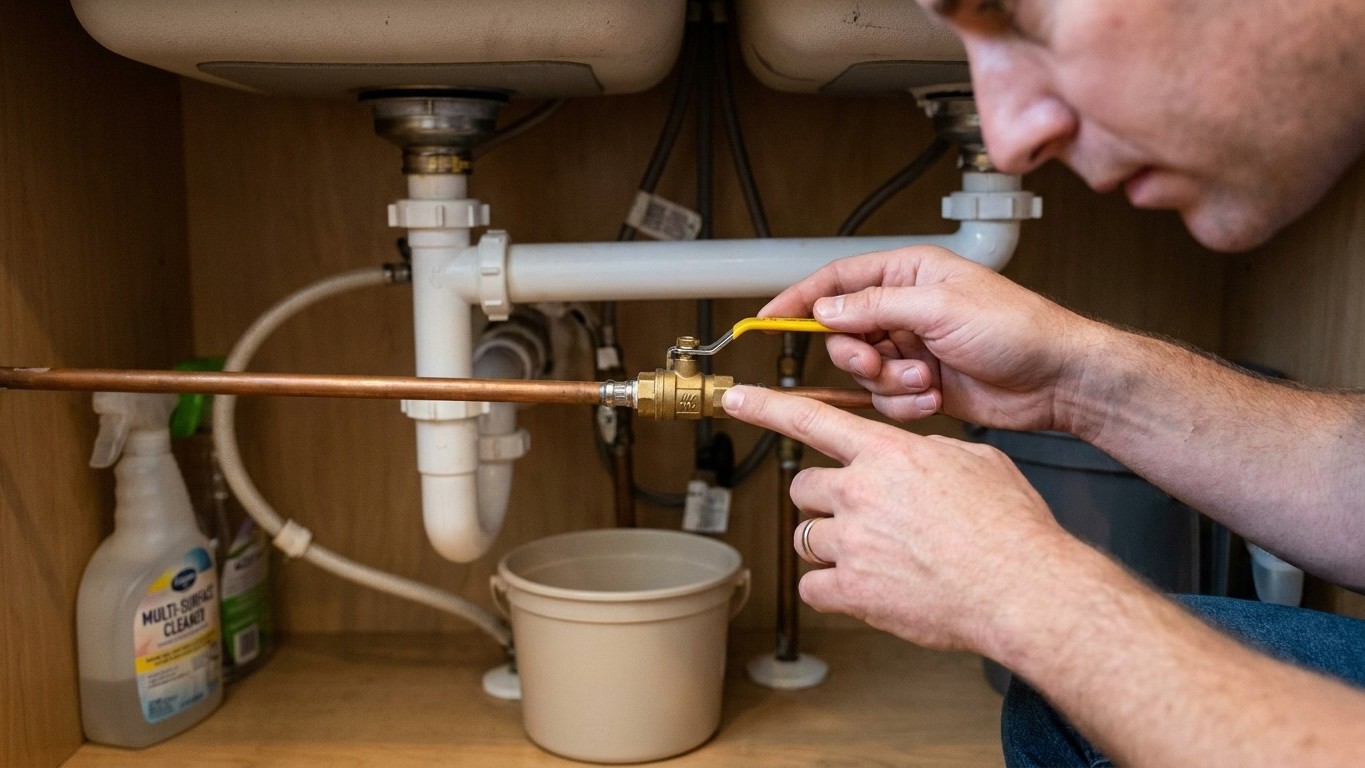

The valve you need is almost always closer than you think: a quarter-turn handle under a sink, behind a toilet, or beside A Washing Machine for a single fixture, and one main valve where the supply line enters the house for everything at once. Finding both before an emergency, not during one, is the difference between a five-second fix and a flooded floor. Most homeowners never look until water is already spreading across the kitchen tile.
What is actually happening
Every home plumbing system is built around a simple branching structure. One line brings water in from the street or a well, and from that single point it splits into dozens of smaller lines feeding sinks, toilets, showers, the water heater, and outdoor spigots. To control that system without draining the whole house every time a washer needs replacing, plumbers install valves at two levels: local shut-offs at each fixture, and one main shut-off that controls the entire supply.
The fixture-level valves are usually small oval or lever handles you can turn with two fingers, mounted directly on the supply line beneath a sink or behind a toilet tank. Turn one a quarter-turn clockwise and that single fixture goes dry while the rest of the house keeps running. These are typically ball valves, which means the handle lines up with the pipe when open and sits crosswise when closed. That visual cue matters: a glance tells you the state of the valve without touching it.
The main shut-off is a different animal. It sits wherever the water line first enters the structure, which in most of the country means a basement wall, a crawlspace, a utility closet near the water heater, or, in warmer regions without basements, an outdoor box near the foundation or the meter itself. This valve is often a gate valve, the kind with a round wheel handle that you spin multiple full rotations rather than a quarter-turn. Gate valves close by lowering a metal wedge into the flow path, which works well but tends to seize up if it hasn’t been touched in years.
Understanding this two-tier structure is what makes the rest of home plumbing manageable. A leaking faucet doesn’t require shutting off the house. A burst supply line to the washing machine doesn’t either. But a cracked main line, a failed water heater tank, or any leak you can’t immediately locate does, and that’s the valve worth knowing on sight rather than searching for while water rises around your ankles.
What to check, in order
When something is leaking or a fixture is behaving oddly, work through these checks in order. Each one costs nothing but a few minutes, and each result narrows down where the actual problem sits.
- Look at the fixture’s local shut-off first. Find the small valve under the sink or behind the toilet and check whether the handle is fully open, partially open, or closed. A valve that’s only partially turned can cause weak flow that mimics a bigger problem. If it turns freely and the leak stops when closed, the issue is downstream of that valve, not upstream.
- Feel around the valve body and the connections above and below it. Dampness, mineral crust, or a faint drip at the compression fitting tells you the valve itself, or the joint feeding it, is the source. A dry valve with a wet supply line above it points further back toward the wall.
- Check whether the leak is warm or cold. Trace which line is dripping. A warm leak means the problem sits on the hot side, which often narrows things to the water heater connections or a hot supply line. This alone can save a lot of guessing.
- Test the main shut-off for resistance. With everything else ruled out, go to the main valve and see how easily it turns. A main valve that’s stiff, corroded, or won’t fully seat is itself a problem waiting to happen, even if it isn’t the current leak’s cause.
- Watch the water meter with everything closed. If every fixture and the main valve are off and the meter’s leak indicator (often a small triangular or star-shaped dial) is still spinning, the leak is between the meter and the house, in a section of pipe you can’t easily see or reach.
Each step either confirms the problem is local and fixable, or pushes it further upstream toward territory that usually needs a professional. That progression is the whole point: cheap checks first, expensive conclusions last.
What it costs to leave it
Small leaks feel unimportant because they’re quiet. The scale of the problem only shows up in aggregate. According to the U.S. EPA WaterSense program, “household leaks can waste nearly 1 trillion gallons of water annually nationwide,” and “the average household’s leaks can account for more than 9,300 gallons of water wasted every year.” The agency also notes that “nine percent of homes have leaks that waste 50 gallons or more per day,” which means a meaningful share of houses are running a slow, invisible drain on their water bill every single day.
Individual fixtures add up faster than most people expect. WaterSense reports that “a leaky faucet that drips at the rate of one drip per second can waste more than 3,000 gallons per year,” and that “a showerhead leaking at 10 drips per minute wastes more than 500 gallons per year.” Toilets are often the biggest offender of all: “an old or worn flapper can cause your toilet to flush on its own or silently leak thousands of gallons a year,” often without any sound or visible puddle to give it away.
These are national totals from a conservation campaign, not a prediction of what any single house is losing. They’re useful for understanding scale, not for estimating your own bill. The only number that actually applies to your home comes from your water meter, checked with everything off, which is exactly the method covered on the hidden-leak page. What WaterSense does confirm with some confidence is the payoff: “fixing easily corrected household water leaks can save homeowners about 10 percent on their water bills,” which for most households is not a trivial amount over a year.
None of this requires guessing. It requires reading your own meter, which takes ten minutes and tells you more than any national average ever could.
When to stop and call a plumber
Some of these checks are safe for anyone to run. Others aren’t, and the line between them is worth stating plainly rather than discovering the hard way. Anything happening behind a wall or under a slab, where you can’t see the pipe or the fitting, is a job for a licensed plumber. Cutting into drywall or flooring to chase a leak without knowing exactly what’s back there tends to turn a small problem into a large repair bill.
The same goes for anything on the main supply line itself, as opposed to a fixture branch. Main lines carry the full pressure and volume of the house’s water supply, and a mistake there doesn’t stay contained to one sink. If the main shut-off won’t close fully, won’t reopen, or is leaking around its own body, that’s not a DIY repair; it’s a call to a plumber before it becomes an emergency instead of a maintenance item.
Gas water heaters deserve their own line of caution. Any leak, smell, or unusual noise involving a gas-fired unit should stop a homeowner immediately, not because the plumbing is complicated but because gas lines and combustion venting are not forgiving of improvised fixes. Shut off the water to the tank if you can do so safely, leave the gas connection alone, and call a professional.
Finally, any leak that has already soaked drywall, subflooring, insulation, or framing has moved past a plumbing problem into a structural one. Water damage spreads through building materials faster than it shows on the surface, and mold can begin developing within 24 to 48 hours in wet conditions. The first move in every one of these situations is the same: find the shut-off, whether local or main, and stop the water before doing anything else. Full instructions for locating and testing yours are on the shut-off valve guide. Everything after that point is a professional’s job, not a weekend project.
Common questions
How often should I test my main shut-off valve?
Once or twice a year is enough for most homes. Turn it fully closed and back open to keep the internal mechanism from seizing, especially on older gate-style valves that haven’t been touched in years.
What if the main shut-off won’t turn at all?
Don’t force it. A frozen or corroded valve can snap under pressure, which turns a controlled shut-off into an uncontrolled leak at the valve itself. This is a clear case for calling a plumber to replace the valve before it’s needed in an emergency.
Is the shut-off near my water meter the same as my main house valve?
Not always. Many properties have a valve at the meter controlled by the utility, and a separate main valve inside or near the house that the homeowner controls. Knowing the location of both matters, since the utility valve typically requires a call to the water company rather than a simple turn of the wrist.
Can I shut off just the hot water without affecting cold?
Yes, if your water heater has its own dedicated shut-off valve on the cold inlet line, which most do. Closing that valve stops water from entering the tank without touching the cold-water supply to the rest of the house.