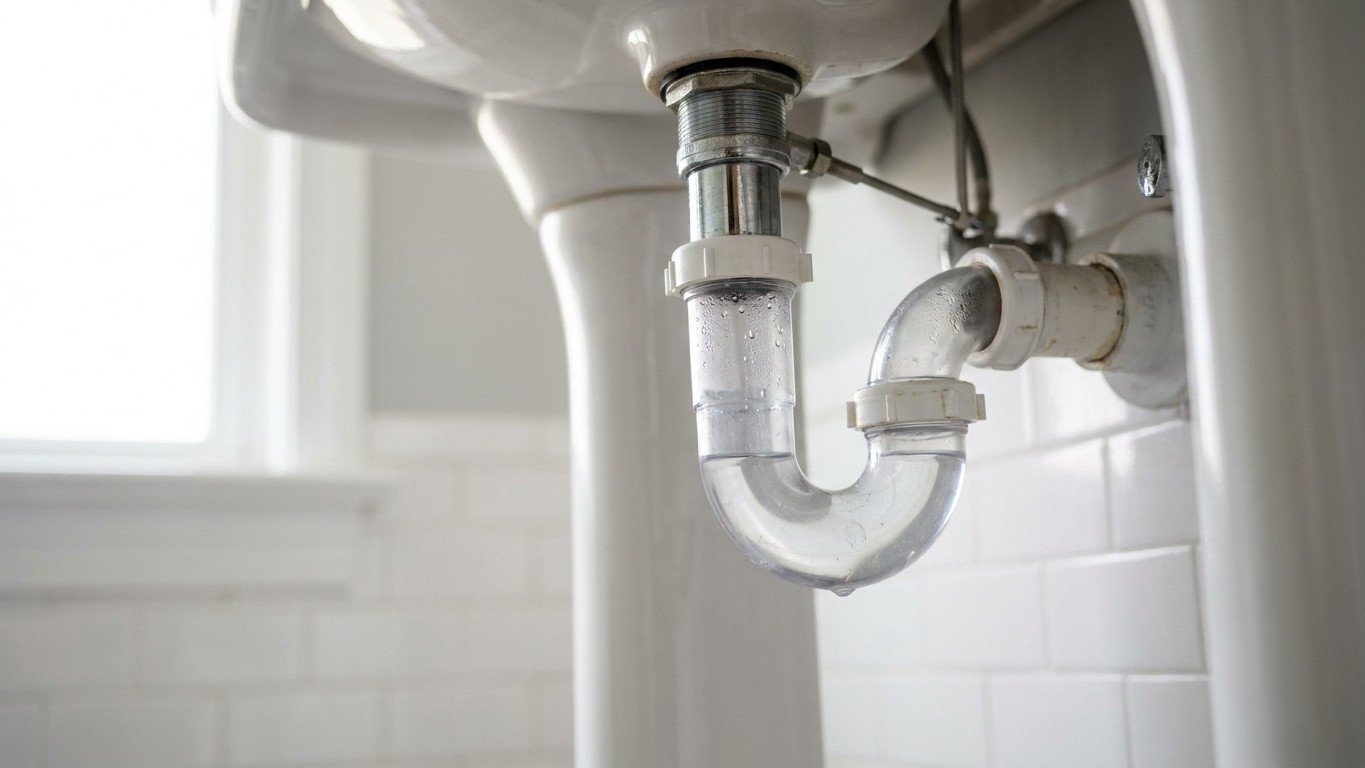

A sewer smell in the house almost always means a water seal has failed somewhere in your drain system, not that sewage is actually backing up. The most common culprits are a dry P-trap under a rarely used sink or floor drain, a worn-out wax ring under a toilet, a blocked vent stack, or a cleanout cap that’s missing or loose. Finding which one it is usually takes fifteen minutes and no tools.
What is actually happening

Every drain in your house, and the sewer line itself, carries gas from decomposing waste. That gas is always there. What normally keeps it out of your living room is a water seal or a physical cap sitting between the pipe and your air. When one of those seals fails, gas finds the path of least resistance, which is usually straight up through the nearest open fixture.
The water seal you don’t think about
Under every sink, tub, and floor drain sits a P-trap, that curved section of pipe shaped like the letter it’s named for. Water sits in the curve permanently, and that standing water is the seal. Drains you use daily stay full without effort. But a guest bathroom sink, a basement floor drain, or a laundry tub that only gets used a few times a month can dry out through plain evaporation, especially in a dry climate or after a few weeks away from home. A floor drain is particularly vulnerable because it has a wide, flat surface exposed to room air, so it evaporates faster than a narrow sink trap.
A toilet works on the same principle, except the wax ring under its base does double duty: it seals the connection to the drain pipe and keeps gas from seeping around the base. That ring is a compressed wax gasket, and it degrades with age, typically over ten to twenty years. It also fails early if the toilet rocks on an uneven floor or if the mounting bolts have loosened, because movement breaks the seal even when the wax itself is still intact.
The vent stack and the cleanout
The pipe that runs up through your roof isn’t just there to vent smell outside. It lets air into the drain system so water can flow without siphoning traps dry as it goes. When that vent gets blocked, by debris, a bird’s nest, or ice in a cold climate, gas has nowhere to go but back down into the house, and other fixtures may start gurgling as they lose their water seal to siphoning.
A cleanout is the capped access port plumbers use to snake a line. If that cap is missing, cracked, or was never seated tight after the last repair, sewer gas has a direct, unobstructed path into your basement or crawlspace air.
What to check, in order
Work through these from cheapest to most involved. Each result tells you something specific, so don’t skip ahead.
- Run water in every drain you rarely use. Guest bathroom sink, basement floor drain, laundry tub, unused shower: let each run for thirty seconds. If the smell disappears afterward, you found a dry trap. Keep it filled by running water through it every couple of weeks, or leave a small amount of cooking oil on top of the water to slow evaporation between uses.
- Wiggle the toilet at the base. Any rocking, a cracked caulk line, or discoloration on the floor around it points to a failed wax ring or a loose mounting. This one needs the toilet pulled and reseated, which is a job most homeowners can do but should plan for, not rush.
- Listen for gurgling when you run other fixtures. If the toilet gurgles when the washing machine drains, or a sink burps air when the tub empties, your vent stack likely has a blockage. That’s a sign air isn’t getting in where it should.
- Find your cleanout and check the cap. It’s usually a screw-in plug near where the sewer line exits the house, in a basement, or in a crawlspace. If the cap is missing, cracked, or was left finger-tight, smell will be strongest right at that spot.
- Look under sinks for loose slip nuts or a disconnected trap arm. A trap arm that’s slipped out of its fitting won’t hold a seal at all, no matter how much water sits in the bend, and the smell will be localized to that one cabinet.
What it costs to leave it
A dry trap or a bad vent doesn’t waste a drop of water, it just lets gas through, so there’s no dollar figure attached to ignoring it beyond the discomfort of living with the smell. But a few of the same failures that cause sewer odor also happen to leak water, and those add up in ways worth knowing.
A rocking toilet with a compromised wax ring can leak water at the base with every flush, not just gas. A loose slip nut under a sink does the same. According to U.S. EPA WaterSense, “an old or worn flapper can cause your toilet to flush on its own or silently leak thousands of gallons a year,” and a toilet with a bad seal is often a toilet with more than one worn part. On a national scale, EPA WaterSense reports that “household leaks can waste nearly 1 trillion gallons of water annually nationwide,” and that “the average household’s leaks can account for more than 9,300 gallons of water wasted every year.” The agency also notes that “nine percent of homes have leaks that waste 50 gallons or more per day.”
None of those numbers tell you what your own house is losing. They’re national aggregates from a water-conservation campaign, useful for scale, not for a personal estimate. Your water meter is the only instrument that measures your own leak, and this site’s guide to checking your meter for a hidden leak walks through how to read it before and after you shut off every fixture in the house. EPA WaterSense also points out that “fixing easily corrected household water leaks can save homeowners about 10 percent on their water bills,” which is a reasonable incentive to check the meter even if the sewer smell itself turns out to be a dry trap with no water loss at all.
When to stop and call a plumber
Every check above involves something you can see, reach, and fix with your hands. That’s the boundary. The moment a repair requires opening a wall, touching the main water supply, working on a gas water heater, or dealing with a leak that has already soaked framing or subfloor, stop and call a licensed plumber.
Water damage behind drywall is expensive precisely because it’s quiet. A slow leak from a cracked vent pipe or a failed cleanout fitting inside a wall cavity can soak framing for weeks before a stain or a soft spot in the floor gives it away, and by then you’re paying for mold remediation and drywall on top of the plumbing repair. If you smell sewer gas but can’t trace it to any accessible trap, toilet, or cleanout, that’s a strong signal the source is hidden in a wall or under a slab, and that’s a job for someone with a camera scope, not a flashlight.
Anything touching the main supply line carries its own risk, since a mistake there doesn’t just cause a smell, it floods a house fast. Before you touch any valve near the main line, know where your shut-off is and how it works. This site’s guide to locating and testing your main water shut-off is worth reading before you start, not after something goes wrong. The same caution applies to a gas water heater: venting issues on a gas appliance can involve combustion byproducts, not just sewer gas, and that’s not a smell to troubleshoot yourself under any circumstance. If you’ve already found wet Insulation, a soft spot in flooring, or a stain spreading across a ceiling, the leak has moved past the checklist stage. Call a plumber, and mention what you’ve already ruled out so the visit is faster.
Common questions
Does a sewer smell mean my sewer line is backed up?
Not usually. A backup typically comes with slow-draining fixtures across the house and gurgling in multiple drains at once. A smell with no drainage problems almost always points to a failed seal, not a blockage in the main line.
Why does the smell only show up sometimes?
Intermittent odor often traces to evaporation in a rarely used trap, or to negative air pressure inside the house (from a running exhaust fan or a furnace) pulling gas past a weak seal that would otherwise hold. Both point to the same fixtures worth checking first.
Can I just pour water down every drain and call it fixed?
It solves a dry trap, but only temporarily if the drain sits unused again. If the smell returns within a week or two, treat that fixture’s trap as consistently vulnerable and either use it more often or check for a slow leak that’s draining the trap faster than evaporation alone would.
Is sewer gas dangerous to breathe?
In the small amounts typical of a household seal failure, it’s unpleasant more than hazardous, but prolonged exposure in an enclosed space isn’t something to dismiss either. If the smell is strong and persistent despite checking every trap, toilet, and cleanout, that’s another reason to bring in a plumber rather than keep guessing.