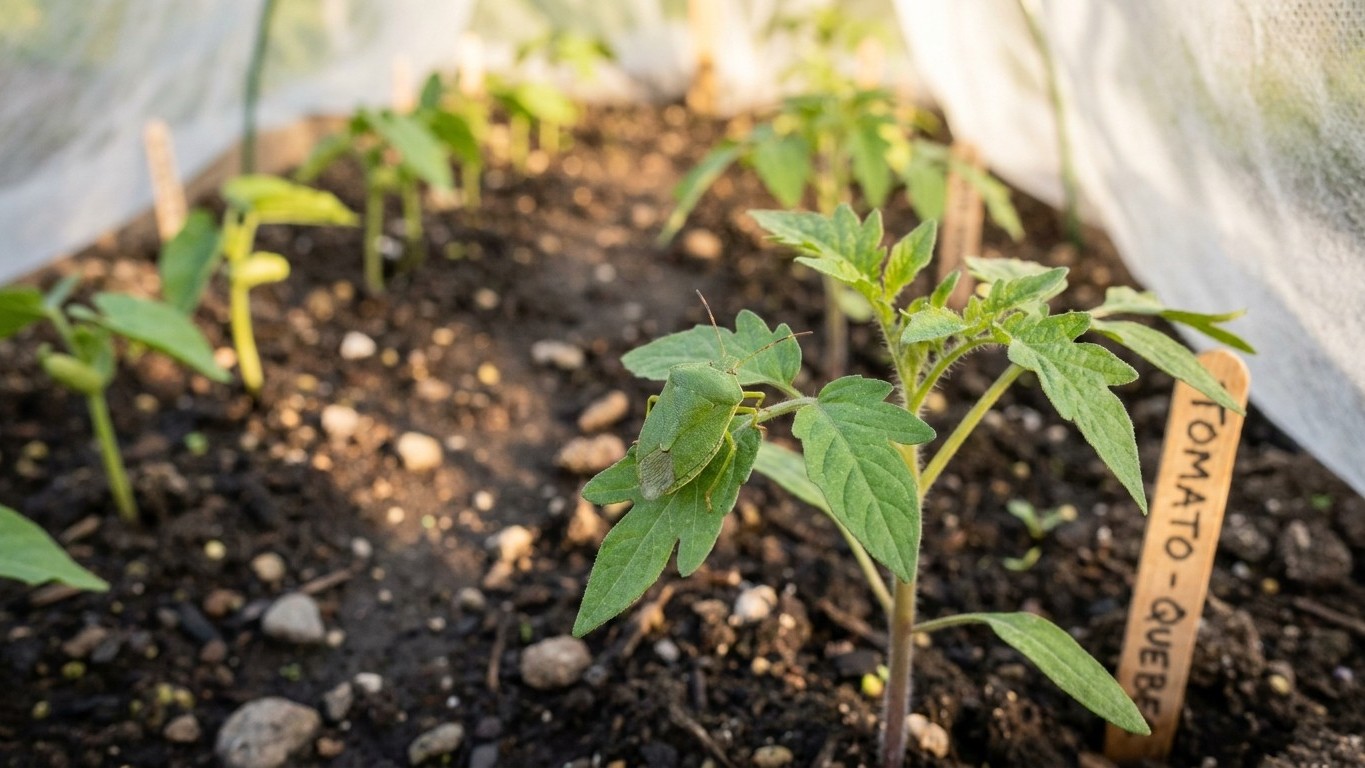

Green stink bugs turn up in South Carolina gardens as early as spring, but the feeding pressure that actually damages crops runs from July through early October, according to Clemson Cooperative Extension. Row covers, hand-picking, and cleared garden debris are the tools a home gardener actually controls, since these bugs fly in from nearby vegetation no matter how a plot is laid out.
The weeks to watch
South Carolina’s stink bug population, which includes the green stink bug, peaks from July through early October, per Clemson’s Home and Garden Information Center. That’s the window listed alongside two other common garden pests tracked on the same fact sheets: tomato fruitworm, active from early May with four to five generations, and leaffooted bug, most common from May through fall. Clemson doesn’t break the green stink bug out into a separate generation count the way it does for tomato fruitworm, so the safest read of the data is the general stink bug pattern rather than a species-specific schedule.
Spring emergence
Overwintered adults move out of leaf litter and wooded edges as temperatures climb in spring, showing up on early weeds and ornamentals before garden crops are even in the ground. Numbers stay low at this stage. It’s a scouting period, not yet a treatment one.
Peak feeding, July through early October
This is the stretch Clemson flags as the real pressure window. Generations overlap through late summer, and this is when tomatoes, peppers, beans, and other fruiting crops take the bulk of their damage. A gardener checking plants weekly through this stretch will catch problems long before a full-blown infestation sets in.
Reading the calendar from your last frost
South Carolina’s last spring frost falls between February 28 and March 17, based on NOAA’s 30-year climate normals for the coastal station near Charleston. That date is a normal, not a guarantee, and it shifts by region: peninsular Charleston tends to run milder than the airport station used for that data, while Upstate South Carolina’s frost window sits several weeks tighter at both ends.
Stink bugs don’t answer to a printed date. They respond to rising temperatures and to when host plants, first weeds, then transplants, leaf out enough to feed on. An early spring pulls their activity forward; a late one pushes it back. The arithmetic works like this:
- Start from your local last frost date, February 28 to March 17 near the coast, earlier still further inland or upstate.
- Add roughly 15 to 18 weeks to reach Clemson’s July starting point for peak stink bug activity, which gives a rough sense of how much lead time sits between frost risk clearing and feeding pressure building.
That gap matters for row covers. They should go on at transplanting, right after frost risk passes, to shield young seedlings from early-season bugs. They need to come off by flowering, since tomatoes, peppers, and cucurbits all need pollinators, and by that point stink bug numbers are usually still climbing toward the July peak rather than already at it.
What it attacks, and what the damage looks like
Most gardeners notice the damage before they ever spot the bug. On tomatoes, it shows up as cloudy or discolored blotches just under the skin, or a puckered, scarred patch near the blossom end called catfacing. On beans, pods come in deformed or pitted. On sweet corn, kernels turn discolored where feeding punctures interrupted development. Peaches and other soft fruit can show sunken, dimpled spots at the same puncture sites.
Both nymphs and adults cause this damage, since green stink bugs feed with piercing, sucking mouthparts rather than chewing tissue the way caterpillars do. That distinction matters for treatment: there’s no single vulnerable larval stage to wait out. Any life stage found on the plant is capable of causing the puncture-and-inject feeding that scars fruit, so control has to target whatever stage is actually present rather than timing around a hatch.
Crops most commonly affected in South Carolina gardens include:
- Tomato
- Pepper
- Bean
- Okra
- Sweet corn
- Peach and other soft fruit
- Cole crops such as cabbage and broccoli
How South Carolina sits in this pest’s range
Clemson’s published material doesn’t rank South Carolina against other states for green stink bug pressure, and no state-by-state count is part of the sourced data here. What the fact sheets do show is a species treated as part of a regional stink bug complex active statewide, alongside tomato fruitworm and leaffooted bug on the same crops. That points to a widespread pest rather than one confined to a corner of the state.
Where South Carolina does show real variation is timing, and it shows up within the state itself. The coastal frost data used for calendar planning comes from a station near Charleston, and the NOAA notes attached to it flag that peninsular Charleston runs milder than that airport reading, while Upstate South Carolina’s frost window sits several weeks tighter at both ends. That difference likely shifts when stink bug activity gets underway in a Lowcountry garden versus one in the Piedmont or foothills, even though the pest itself is present across both regions. Presence isn’t the variable here. Timing is.
What actually works against it
None of these stop working once a bug is standing on a leaf, since green stink bugs feed externally rather than boring into stems or roots. That means every measure below still has value throughout the season, not just early on. In order of effort:
- Plant to dodge the July peak. Early varieties or an early transplant date can get fruit past its most vulnerable young stage before feeding pressure builds toward midsummer.
- Hand-pick adults, nymphs, and egg clusters. Nymphs cluster on leaf undersides and move slowly, making them easy to knock into soapy water. This gets harder once adults disperse and start flying between plants, so early and often beats waiting.
- Clear garden debris and mow weedy borders after harvest. This removes overwintering sites for adults that would otherwise re-emerge nearby the following spring. It does nothing, though, against bugs flying in from a neighbor’s yard or a hedgerow.
- Use row covers on seedlings and young transplants. A physical barrier keeps bugs off soft new growth, but it has to come off before flowering for pollination, and once it’s off, protection ends there.
- Rotate crops. Standard practice against many soil-dwelling pests, but its effect on stink bugs is limited, since adults are strong fliers rather than soil-bound insects that a rotation can outmaneuver.
- Plant a trap crop, such as sorghum or sunflower, along a border. Many gardeners use this to draw bugs away from the main planting. Clemson’s material doesn’t quantify how much protection it adds in a home garden setting.
Common questions
Do green stink bugs bite people?
No. They don’t have mouthparts built for biting skin. When handled or crushed, they release a strong odor from glands on the thorax, which is their main defense against predators, not against people.
What does green stink bug damage look like on tomatoes?
Cloudy, discolored spots just beneath the skin, and a puckered scarring near the blossom end called catfacing, both caused by repeated piercing while the fruit was still developing.
Do green stink bugs disappear in fall?
Feeding pressure fades after early October, based on Clemson’s seasonal timeline, as adults move into leaf litter, bark crevices, and structures to overwinter, then reappear the following spring as temperatures rise again.