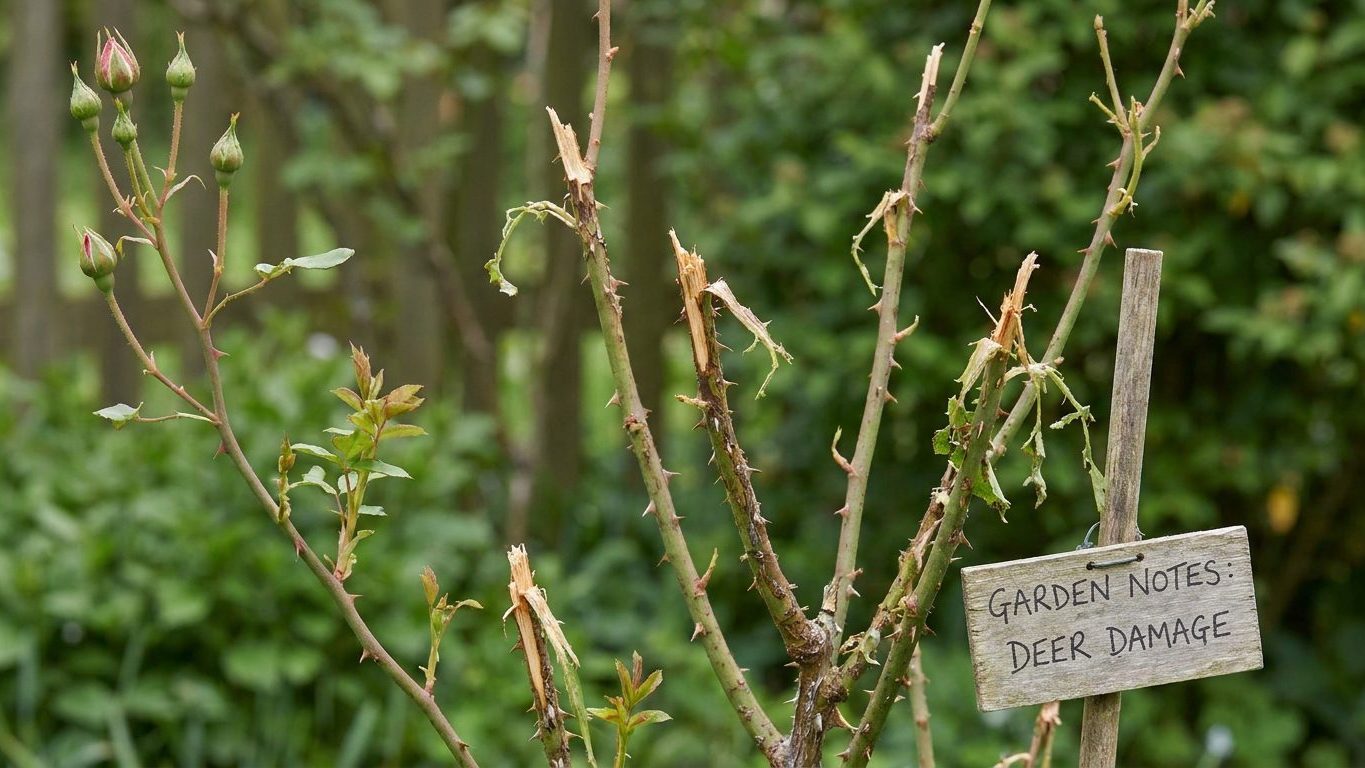

Deer damage on roses shows up as torn, ragged stems and stripped buds, usually overnight, and it rarely kills an established bush. The real question isn’t whether deer are responsible (the torn-stem look is a giveaway) but whether the damage is cosmetic or a threat to the plant’s survival, and that depends almost entirely on the rose’s age and how much foliage is left after the browsing.
What the damage looks like
The single detail that separates deer from every other rose problem is the tear. Deer have no upper incisors, only a hard dental pad, so they can’t bite cleanly through a stem the way a rabbit or a pair of pruners does. Instead they grip and yank, leaving a stem end that’s shredded and frayed, sometimes with bark peeled back an inch or two below the break. Run a finger over a fresh wound and it feels rough, almost splintery, compared to the flat, angled cut a rodent leaves behind.
Height is the second clue, and it’s often more useful than the tear itself. Deer browse from roughly 2 feet up to as high as they can reach standing on hind legs, which on a mature whitetail can mean 6 feet off the ground. Damage that starts at knee height and climbs into the upper canopy points straight at deer. Damage confined to the bottom foot or two of the plant is more likely a rabbit or a groundhog working close to the soil.
Buds and new growth take the worst of it. Deer target the softest, most nutritious tissue first, which on a rose means the swelling flower buds and the tender terminal growth at the tip of each cane. A bush can lose every bud it set for the season in a single night, with the rest of the plant left standing but bare of blooms. Leaves get stripped too, though less selectively, whole clusters torn away rather than nibbled at the edges.
What you generally won’t see is defoliation from the inside out, or skeletonized leaves with the veins left behind in a lace pattern. That kind of damage belongs to chewing insects, not browsing mammals, and it’s worth ruling out before assuming deer are the sole cause, since a stressed rose sometimes carries more than one problem at once.
On an established, multi-year rose with a full root system, this kind of browsing is almost always cosmetic. The plant loses a season’s flowers, not its life, and it typically pushes new growth within a few weeks. On a rose planted within the last year, especially a bare-root or first-year grafted plant still building its root mass, repeated browsing can strip enough leaf tissue that the plant can’t photosynthesize its way through the following season. That’s the case where deer damage genuinely threatens survival rather than just appearance.
Making sure it is this and not something else
Torn stems and missing buds have a short list of look-alikes, and each one has a tell that settles the question in under a minute.
Rabbits
Rabbits also chew through rose canes overnight, and to an anxious gardener the missing growth can look identical to deer work at first glance. The test is the cut itself and its height. Rabbits have both upper and lower incisors, so they leave a clean, angled cut, almost like a scissor snip, usually at a sharp diagonal. That cut sits low, within about 2 to 3 feet of the ground, because rabbits can’t reach higher without a snow drift or a step-up. Deer damage climbs well above that and shows the ragged, torn edge instead of a clean angle.
Groundhogs and other rodents
Groundhogs favor foliage close to the base and can strip a young rose down to bare canes in a single visit, but they rarely touch material more than a foot or so off the ground and they leave gnaw marks rather than tears. Bark stripped in patches near the soil line, combined with a burrow entrance nearby, points to a groundhog rather than deer.
Japanese beetles and rose slugs
These are insect feeders, and their damage is confined to leaf tissue, not stems or buds. Japanese beetles skeletonize leaves, leaving the veins intact in a lace-like pattern, while rose slug larvae scrape the leaf surface, leaving translucent, papery patches. Neither one tears a cane or removes a bud whole, which is the giveaway that separates them from deer even when the overall look of a “chewed” rose seems similar from across the yard.
When it shows up
Deer browsing tracks the rose’s own growth cycle more than any date on a calendar. The heaviest hits land during the spring flush, when the plant is pushing tender new canes and swelling flower buds, both of which are softer and more palatable than mature, hardened growth. A rose that’s fully leafed out and blooming steadily is less attractive than the same plant a few weeks earlier, when everything on it is new and tender.
The second high-risk window comes when natural forage is scarce, typically during dormancy or right after a hard freeze has knocked back the wild plants deer normally browse. At that point a rose bed, especially one near a woodland edge or an unfenced yard bordering open land, becomes one of the few green, palatable options left standing, and deer will strip bark and buds off dormant canes that they’d otherwise ignore.
Drought plays a role too, though indirectly. When natural browse dries up or goes dormant early, deer range wider looking for food and water, and an irrigated rose bed stands out as reliably green. Gardeners in dry years often report browsing on plants that had gone untouched for seasons, not because the deer population changed but because the alternatives disappeared.
New transplants are at risk essentially any time they’re in the ground, regardless of season, simply because their tender, unestablished growth is more attractive and their smaller size puts every bud within easy reach. A first-year rose deserves protection from the day it’s planted, not just during the traditional high-pressure stretches.
What to do now
- Assess before acting. If the plant is established and multi-year, missing buds are a lost season of flowers, not a survival threat, and that changes how much effort is worth spending. A first-year transplant with more than a quarter of its foliage stripped needs intervention now, not next week.
- Try scent and taste deterrents first. Bars of strongly scented soap, hung from lower branches in mesh bags, or human hair scattered around the base, cost almost nothing and work for a few weeks at a time by making the area smell like an active threat zone. Effectiveness fades with rain, so these need refreshing after every heavy storm.
- Move up to commercial repellent sprays. Products based on putrescent egg solids or capsaicin are widely available at garden centers and registered for home use; they work by taste and smell rather than by killing anything, so they don’t harm bees, ladybugs, or other beneficial insects working the same bed. Reapply after rain and rotate between two different active ingredients, since deer in a given area can grow accustomed to a single scent over a season.
- Rotate repellents by mode of action, not just brand. Alternating a taste-based product with an odor-based one keeps deer from adapting the way they will to repeated exposure to the same formula.
- Add physical barriers for high-value or newly planted roses. A cylinder of welded wire fencing, staked around an individual bush and standing at least 5 feet tall, blocks browsing outright and costs a fraction of what fencing an entire bed would run. For a young transplant, this is the most reliable option available to a home gardener and the one least dependent on weather or reapplication.
- Consider motion-activated deterrents for repeat offenders. Motion-triggered sprinklers or lights startle deer without any chemical involved, and they tend to work well specifically because deer are creatures of habit and dislike surprise.
- Reserve full perimeter fencing for chronic, severe pressure. An 8-foot fence, or two shorter offset fences deer can’t judge the depth of, is the only near-total solution, but it’s a significant investment and usually only justified where browsing has been a recurring, season-after-season problem across the whole property rather than one or two plants.
Stopping it coming back
- Choose rose varieties reputed to be less palatable when replacing losses; deer preference varies by region, so a local extension office or nursery can point to what’s actually working nearby rather than relying on a national list.
- Plant the most vulnerable roses, especially first-year transplants, closer to the house or in a fenced side yard rather than at the open edge of the property where deer travel.
- Keep a rotation of at least two repellent types on hand and switch them through the season rather than waiting until damage appears to buy a product for the first time.
- Install low-cost cylinder fencing around new plantings at the time of planting, not after the first bite, since a transplant’s tender first-season growth is the highest-risk period it will ever face.
- Avoid broad, unscented plantings of favorite deer forage (hostas, tulips, arborvitae) directly adjacent to the rose bed, since a mixed planting that includes deer-preferred species will draw browsing traffic straight past the roses.
- Walk the bed after any hard rain during the spring growth flush, since that’s when repellent coverage breaks down fastest and new tender growth is most exposed.
Common questions
Will deer damage kill an established rose bush?
Rarely. A mature rose with a developed root system typically loses a season of blooms and some cane growth but pushes new shoots within weeks. The exception is repeated, severe browsing across multiple seasons that never lets the plant rebuild its energy reserves.
Do deer prefer certain rose colors or types?
Deer select mainly by tenderness and scent rather than color, which is why new transplants and tender spring growth take the worst damage regardless of the rose’s flower color or class.
Are deer repellent sprays safe around bees and other pollinators?
Repellents based on taste or odor, such as egg-solid or capsaicin formulas, work by deterring browsing rather than killing anything, so they don’t carry the same risk to bees and beneficial insects that a broad-spectrum insecticide would. Always check the product label for any application timing restrictions around open blooms.
How tall does a fence need to be to keep deer out?
A single fence needs to be at least 8 feet tall, since deer can clear lower barriers easily. Two shorter fences set a few feet apart, which disrupt a deer’s ability to judge the jump, can substitute for one tall fence where a full 8-foot structure isn’t practical.