
No single answer covers the whole state. Arizona’s 15 counties fall across four IECC climate zones, and the 2021 International Residential Code ties the vapor-retarder requirement directly to that zone. In the state’s driest, hottest counties, no interior vapor retarder is required. In its cooler counties, one is. The dividing line is the county line, not a statewide rule.
What the code asks for in Arizona

Arizona has no single answer to the vapor-barrier question, and that’s the honest starting point. The 2021 IRC, Section R702.7, sets the baseline rule for the whole country: a vapor retarder of a class named in Table R702.7(2) “shall be provided on the interior side of frame walls.” That’s the default. But the same section carries an exception that changes everything for a hot, dry state: “A vapor retarder shall not be required in Climate Zones 1, 2 and 3.”
Arizona’s 15 counties split across four zones. Five counties sit in Zone 3B, five more in Zone 2B, two in Zone 4B, and three in Zone 5B. That means ten of the state’s fifteen counties, those in 2B and 3B, fall squarely under the exception. In those counties, the code does not require an interior vapor retarder on above-grade frame walls. The remaining five counties, split between 4B and 5B, sit outside the exception. In those counties the base rule applies, and a vapor retarder of the class specified in the code’s table is called for.
That word “not required” deserves a second look, because it gets misread constantly. The exception removes an obligation. It does not prohibit anything. A builder in a 2B or 3B county is not breaking any rule by installing a vapor retarder anyway, though as the next section explains, doing so with the wrong material class can cause real damage. The exception simply means the county building department will not fail an inspection over its absence.
Why this split exists at all
The zone boundaries aren’t arbitrary lines on a map. They track how water vapor behaves in a given climate, and Arizona happens to straddle a sharp break in that behavior. A county in 2B (think low desert, Sun Belt heat, minimal humidity) handles moisture in almost the opposite way from a county in 5B (higher elevation, colder winters, a longer heating season). The code writers built that difference into the table rather than pretending one rule fits every wall from Yuma to Flagstaff.
This is exactly why the model code cannot be treated as a single national answer. It’s a set of rules keyed to zone, and Arizona is one of the clearer examples of a state where the zone map matters more than the state line. A homeowner in a 4B or 5B county who assumes the “no vapor barrier needed in Arizona” rule of thumb applies to their wall could be building against the actual adopted code in their jurisdiction. The only way to know which side of that line a given property falls on is to check with the local building department, since the code in force is the one the county or city has adopted, not a generic statewide assumption.
Why the answer is the opposite in a warm climate
The reason the code splits by zone comes down to which direction the moisture is traveling, and that direction reverses between a cold state and a hot one. In a cold climate, the warm, damp air lives inside the house. An interior vapor retarder stops that indoor moisture from migrating out through the wall cavity and hitting the cold sheathing, where it would condense. That’s the classic, textbook case, and it’s the picture most people have in their heads when they hear “vapor barrier.”
Flip the climate, and the moisture source flips too. In a warm, humid climate the damp air is arriving from outside, pushing inward through the wall assembly during the hottest, most humid stretches of the year. If that wall has an impermeable layer on the interior side of the insulation, that layer becomes the coolest, least permeable surface the vapor reaches, exactly the spot where it condenses. The U.S. Department of Energy’s Building America program spells out what happens next in plain terms: “If the wall contains a vapor retarder on the interior side of the insulation, the water vapor will condense on this cool, impermeable surface.” The consequence, in the DOE’s own words, is “ruined insulation, mold, and structural rot of framing members.”
That single sentence is the entire reason the code doesn’t hand out one rule nationwide. It isn’t bureaucratic caution or a compliance checkbox. It’s a direct response to which way the water is moving through the wall at any given time of year. A wall assembly that protects a house in Flagstaff’s winters can actively damage a house in Yuma’s summers, because the same impermeable sheet that blocks vapor in one direction traps it in the other.
This is also why “vapor barrier” as a catch-all term causes so much confusion. The material itself isn’t good or bad. Its performance depends entirely on which side of the insulation it sits on, and which direction the seasonal moisture load is traveling in that particular climate zone. A Class I retarder that’s a smart move in a 5B county could be the exact mechanism that rots framing in a 2B one. Arizona, spanning both extremes within its own borders, is a useful reminder that the “right” wall assembly is a local question, not a regional guess.
The three classes, and why the word matters
“Vapor barrier” gets used loosely, but the code doesn’t work in absolutes. It works in permeance, measured in perms, and it sorts materials into three classes. Polyethylene sheeting is not “a vapor barrier” in code language; it’s a Class I vapor retarder, and that distinction is the whole basis of the disagreement between a builder in a 4B county and one in a 2B county. Nobody is arguing about whether to have a retarder. They’re arguing about which class belongs on that particular wall.
| Class | Example materials | Permeance |
|---|---|---|
| Class I | Sheet polyethylene, nonperforated aluminum foil | 0.1 perm or less |
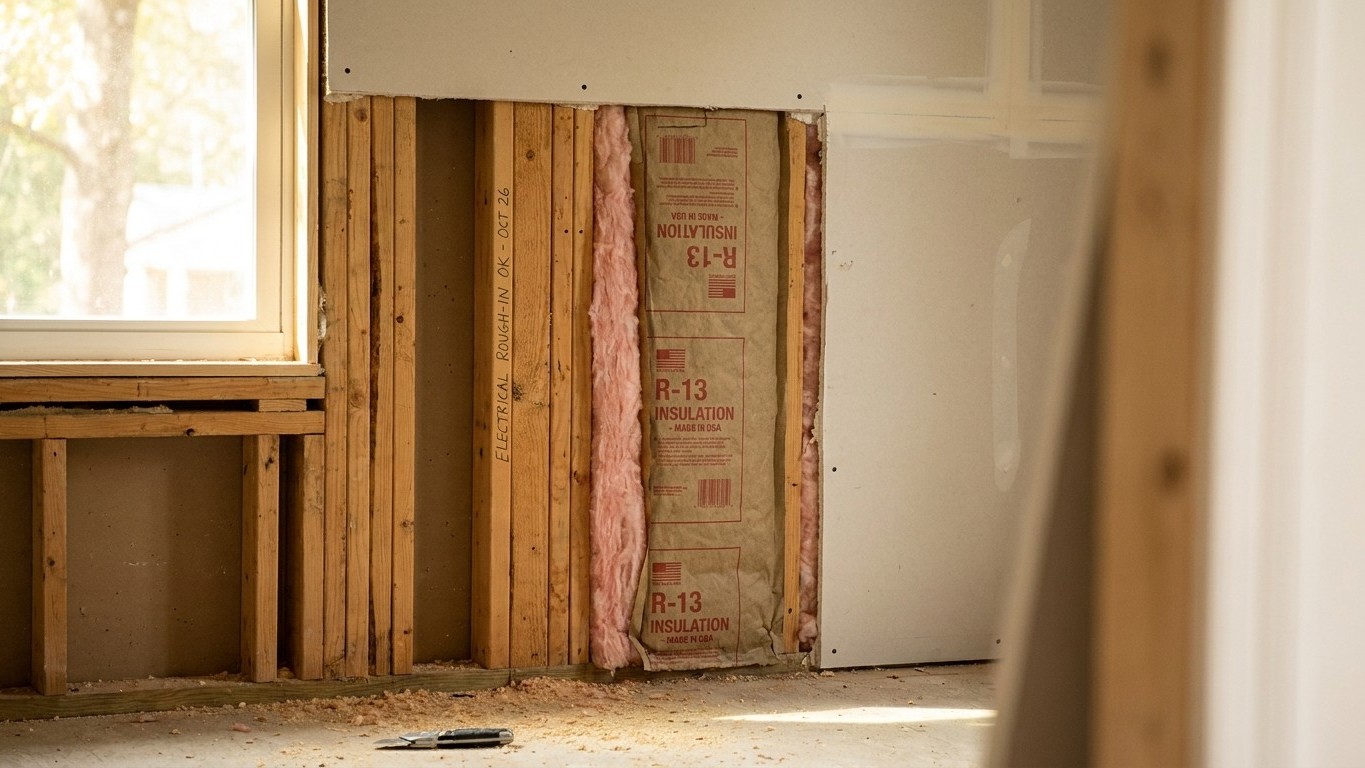
| Class II | Kraft-faced fiberglass batts, vapor retarder paint | Above 0.1 up to 1.0 perm |
| Class III | Latex or enamel paint | Above 1.0 up to 10.0 perm |
The retarder most homeowners already own
Here’s a detail that surprises a lot of people: ordinary latex or enamel wall paint qualifies as a Class III vapor retarder. Nearly every finished interior wall in the country already carries one, whether the homeowner ever thought about it or not. That’s a meaningfully different product than sheet polyethylene, both in how much vapor it lets pass and in how it behaves in a wall assembly. Class III retarders are permeable enough to let a wall dry in more than one direction, which is often exactly what a hot, humid climate needs and what a Class I sheet would prevent.
One more distinction worth keeping straight: a vapor retarder is not an air barrier. They solve different problems. A vapor retarder slows the diffusion of water vapor through a material. An air barrier stops bulk air movement, which carries far more moisture, far faster, through gaps and cracks than diffusion ever could. Some products are built to do both jobs at once, but the code addresses them as separate requirements, and conflating the two is a common source of confusion at the design stage.
Where the rule stops
Even where the base rule applies, the 2021 IRC carves out situations where an interior vapor retarder isn’t called for at all, separate from the climate-zone exception already covered above. Three of them show up regularly in real houses:
- Basement walls
- The below-grade portion of any wall
- Construction where accumulation, condensation, or freezing of moisture will not damage the materials involved
The basement exception is the one most homeowners actually run into, and it’s worth understanding rather than just noting. A poured concrete or block foundation wall behaves nothing like a stud-and-sheathing wall above grade. Concrete holds moisture from the soil around it and releases it slowly, over years, not seasons. That assembly needs to be able to dry toward the interior, because drying outward through the soil-facing side isn’t realistic. Add an impermeable sheet on the interior face of a basement wall, and that moisture has nowhere to go. It stays in the wall assembly, which is precisely the setup that leads to trapped water, deteriorating insulation, and long-term damage to framing members that never gets noticed until something is opened up.
Below-grade wall sections generally follow the same logic, even outside a full basement, since the soil contact and the drying path behave the same way regardless of what’s happening above the grade line. For a fuller look at how that specific assembly should be handled, this site’s guide to basement wall vapor control walks through the detail this article only has room to summarize.
Who actually decides, in Arizona
None of this matters at the level of an individual wall until the local building department weighs in, and that’s not a formality here. Model codes like the 2021 IRC get adopted state by state, and often amended along the way. Some jurisdictions adopt the newest edition quickly; others run years behind, or adjust specific sections like R702.7 to fit local conditions. The code that actually governs a given wall in Arizona is whatever edition and amendment set the county or city has formally adopted, not the model code text on its own.
Degree days help explain why this question carries real weight in some Arizona counties and almost none in others. At Phoenix Sky Harbor, the reference station for the state’s low desert, the annual normal runs about 874 heating degree days against roughly 4,765 cooling degree days. That’s a measure of heating demand, not a temperature reading, and it shows a climate where the heating season barely registers next to the cooling load. A county up in elevation, in 4B or 5B territory, carries a very different degree-day profile, and a correspondingly different reason to take the base vapor-retarder rule seriously.
None of that adds up to a single instruction for any one house. This page lays out what the rule says, what it depends on, and why the dependency exists. It does not tell an individual reader what belongs in their own wall, because that answer sits with the local building department and the specific code edition their jurisdiction has adopted. A wall built with the wrong vapor control doesn’t announce the mistake at the time. It shows up years later, in rot and mold nobody sees coming until the wall is opened up.