
Social wasps in Saskatchewan follow a tight seasonal window: queens emerge from hibernation in late April or May, colonies build through summer, and the whole thing collapses after the first hard frost, usually between mid-September and early October depending on the region. Nothing “stops” a wasp colony mid-summer except direct nest removal or professional treatment. Cold is the only natural reset button, and it comes late enough that most Saskatchewan households deal with peak wasp activity right through Labour Day and into early fall.
Which social wasps actually live in Saskatchewan

Three groups dominate the province, and telling them apart matters because the control approach differs for each.
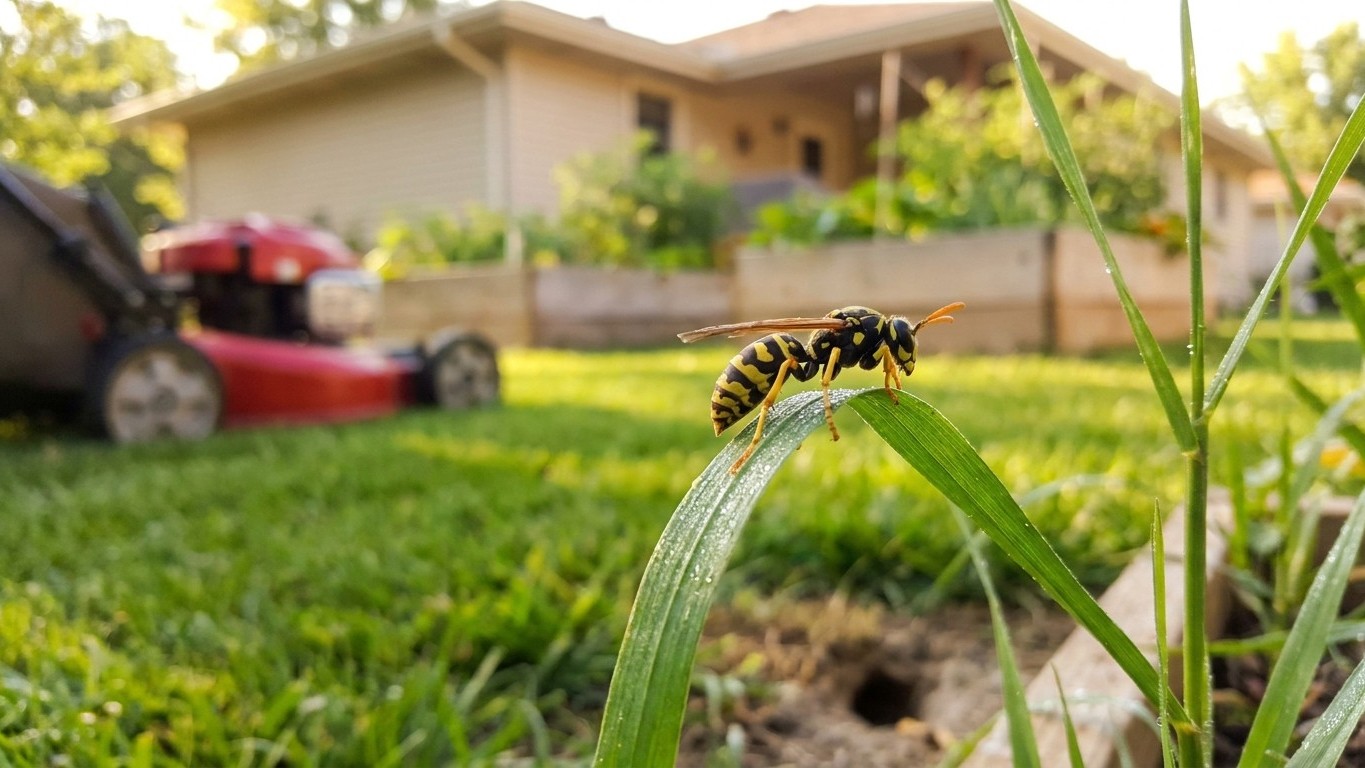
Yellowjackets (genus Vespula) are the ones responsible for most sting complaints across the Prairies. They’re compact, boldly striped in black and yellow, and they nest underground or inside wall voids, old rodent burrows, and rock piles. A mature colony can hold several thousand workers by late summer, and because the nest is hidden, people often don’t know one exists until they’re mowing the lawn and step too close to the entrance.
Bald-faced hornets (Dolichovespula maculata) aren’t true hornets despite the name. They’re bigger than yellowjackets, mostly black with white facial markings, and they build the large, gray, papery nests you see hanging in trees, under eaves, or on shed walls. These nests are aerial and obvious, which sounds worse but actually makes them easier to spot and avoid before someone gets stung.
Paper wasps (Polistes species) are the slimmer, more slender-bodied wasps that build small, open, umbrella-shaped combs under porch eaves, deck railings, and window frames. Colonies stay smaller, often just a few dozen to a couple hundred individuals, and they’re generally less aggressive unless the nest itself is disturbed.
Saskatchewan doesn’t have true hornets (the European hornet, Vespa crabro, hasn’t established here) and it’s outside the confirmed range of invasive species like the northern giant hornet that have made headlines elsewhere in North America. What residents encounter is native wasp activity, not an invasive threat.
The Saskatchewan wasp calendar: when it shows up and why
Every social wasp colony in the province runs on the same annual clock, tied directly to temperature.
Spring: the lone queen phase
Fertilized queens are the only wasps that survive winter, tucked into leaf litter, woodpiles, wall cavities, or loose bark. As soon as daytime temperatures hold consistently above roughly 50°F, usually late April through May in southern Saskatchewan and a couple weeks later farther north, queens emerge and start building a small starter nest alone. At this stage there’s no swarm, no aggression, just one insect laying the first batch of eggs.
Early to mid-summer: colony growth
By June and July, the first generation of workers has hatched and taken over foraging and nest-building, freeing the queen to focus on laying eggs. This is when nests go from grape-sized to fist-sized without most people noticing, because early-season wasps are mostly hunting insects and aren’t yet drawn to human food.
Late summer into fall: peak conflict season
August and September are when Saskatchewan wasp complaints spike. Colonies hit their maximum population right as their diet shifts. Workers stop needing as much protein for larvae and start chasing sugar instead, which is why picnics, patios, and outdoor barbecues turn into wasp magnets exactly during harvest season and the last warm weekends of summer. A single mature yellowjacket colony can produce several hundred new reproductive wasps in this window, some of which become next year’s overwintering queens.
What actually stops the colony
Frost, not effort, ends the cycle. Once nighttime temperatures drop into the low 20s°F for a sustained stretch (typically achieved by the first widespread hard frost), workers die off rapidly and the nest is abandoned within days. Only the newly mated queens have any chance of surviving into the next year, and they don’t reuse the old nest. Every social wasp nest in Saskatchewan is a single-season structure. That’s worth knowing before paying someone to remove an inactive nest in November: by then, it’s already empty.
Why Saskatchewan’s climate shapes wasp behavior differently than milder provinces
The short, intense Prairie summer compresses the wasp life cycle into a narrower window than what’s typical in, say, coastal British Columbia. Colonies here have less time to grow, but the payoff is a sharper, more concentrated peak. Saskatchewan Agriculture and provincial extension resources note that Prairie wasp populations track closely with summer heat units. A hot, dry July and August (common in southern Saskatchewan) tends to produce larger colonies and a more aggressive foraging pattern than a cool, wet summer, because warmer conditions accelerate brood development and give workers more active foraging days.
Drought years carry a secondary effect worth watching: fewer natural water sources push wasps toward hummingbird feeders, pet water bowls, and even swimming pools, which increases stinging incidents around backyards that wouldn’t normally see much wasp traffic.
What stops wasps around a Saskatchewan property (short of frost)
Homeowners can’t out-wait the season, but they can reduce risk and, in many cases, remove an active nest safely before it grows into a real hazard.
- Seal entry points early. Gaps around siding, soffits, and foundation vents are prime real estate for a founding queen in May. Closing these before colonies establish is far easier than removing a mature nest in August.
- Check known hotspots weekly through summer. Shed eaves, deck undersides, compost bin lids, and abandoned rodent burrows in the yard are the most common nest sites in this province. A quick visual check, done from a safe distance, catches nests while they’re still small enough to handle.
- Manage food and scent triggers in late summer. Covered garbage bins, cleaned-up barbecue grills, and picked-up fallen fruit cut down the sugar sources that draw foraging wasps in August and September specifically.
- Treat ground nests at dusk or dawn. Underground yellowjacket colonies are the riskiest to handle because the entrance is easy to miss until it’s stepped on. If a nest is confirmed, treatment (or professional removal) works best in low light when wasps are least active, and only with appropriate protective clothing.
- Leave large aerial nests to professionals once they exceed about softball size. A bald-faced hornet nest that started small in June can house a defensive colony of several hundred workers by late summer, and DIY removal at that stage carries real sting risk.
Stings, allergic reactions, and when to get help
A single sting from a yellowjacket, hornet, or paper wasp typically causes localized pain, swelling, and redness that fades within a day or two. Unlike honeybees, social wasps don’t lose their stinger and can sting repeatedly in one encounter, which is part of why disturbed nests are so dangerous, a defending colony can deliver dozens of stings in seconds.
According to the National Institute for Occupational Safety and Health, roughly 3% of adults develop a systemic allergic reaction to insect stings over their lifetime, and repeated stings from a swarm raise the risk of a severe reaction even in people without a known allergy. Anyone experiencing difficulty breathing, swelling of the face or throat, dizziness, or hives spreading beyond the sting site after a wasp encounter should seek emergency medical care immediately rather than waiting to see if symptoms pass.
Nest identification recap for Saskatchewan yards
Quick visual cues save a lot of guesswork before deciding how to respond:
- Underground entrance with steady wasp traffic in and out: yellowjackets, treat as high-risk.
- Large gray papery nest hanging from a tree or eave, fully enclosed: bald-faced hornet.
- Small open comb, exposed cells visible, tucked under a porch rail or window frame: paper wasp, usually lower risk if left undisturbed.
None of these nests get reused the following spring, which means removing an old, inactive nest in October or November is mostly a cosmetic decision rather than a safety one. The real window for action runs from the first warm days of May, when a single queen is still vulnerable, through the population surge of August, when the same nest might be defended by hundreds of workers.