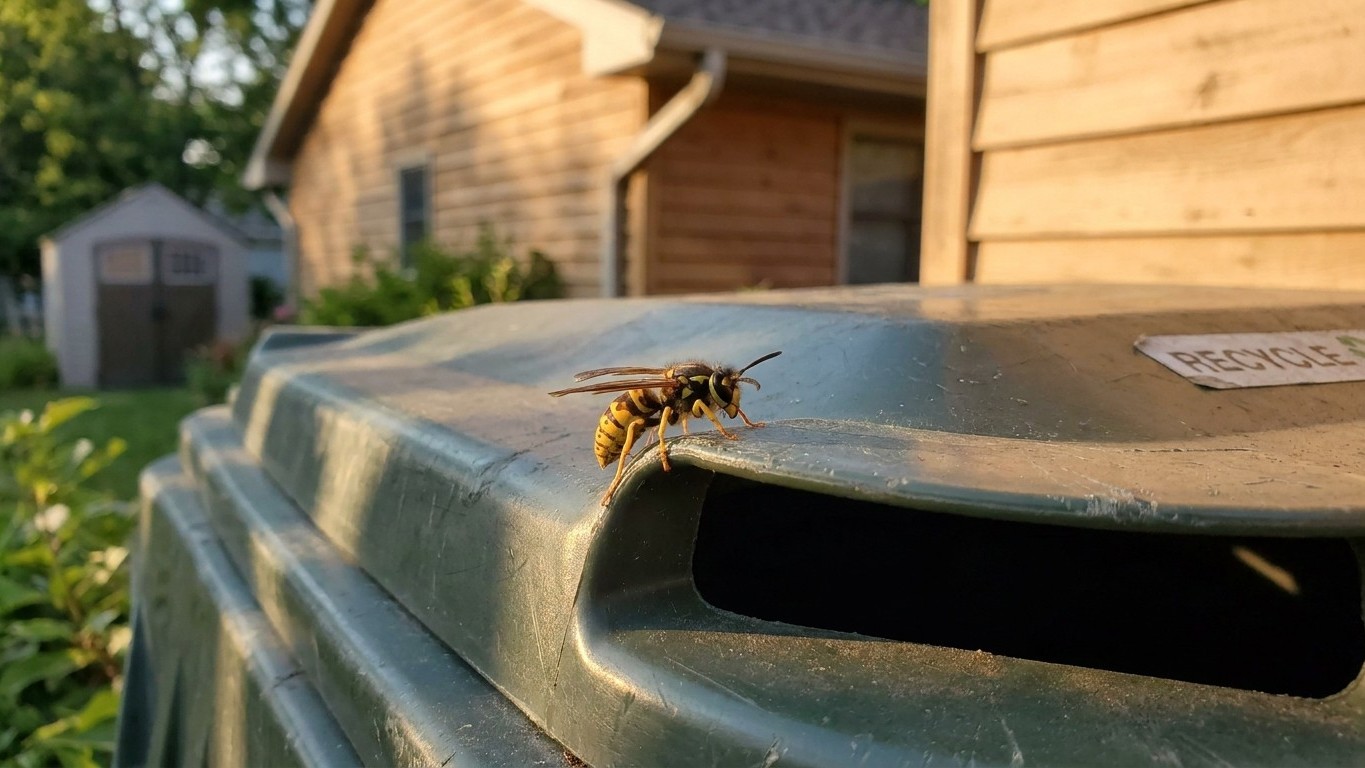

Social wasps show up in Alberta in three predictable waves: solitary queens searching for nest sites in April and May, worker colonies expanding through July, and aggressive, food-seeking swarms peaking from late August through September. What stops them is a combination of early nest removal, tight garbage and pet-food management, and sealing the small gaps around siding, eaves, and sheds where queens like to start over each spring.
Which Wasps Count as “Social” in Alberta

Not every stinging insect in the province lives in a colony. Social wasps are the ones that build a shared nest with a queen, workers, and a defined colony structure that grows through the season. In Alberta, that group is dominated by three players.
Yellowjackets (genus Vespula) are the ones most homeowners actually deal with. They’re the short, stocky, bright yellow-and-black wasps that show up at backyard barbecues and garbage cans. They nest underground, in wall voids, or inside rock piles and old rodent burrows, and a single colony can hold several thousand workers by late summer.
Bald-faced hornets (Dolichovespula maculata) are actually a large yellowjacket relative despite the common name. They’re black and white rather than black and yellow, and they build the classic gray, football-shaped paper nests hanging from tree branches, eaves, or fence lines. Colonies are smaller than yellowjacket nests, usually a few hundred workers, but the wasps are defensive if the nest is disturbed.
Paper wasps (genus Polistes) build the open, umbrella-shaped combs you’ll find tucked under deck railings, window frames, or porch ceilings. They’re slimmer and more reddish-brown than yellowjackets, and colonies stay small, often under a hundred individuals. They’re generally less aggressive unless someone gets close to the nest itself.
Alberta doesn’t have a true native hornet problem the way parts of Europe or Asia do. What people call “hornets” locally almost always refers to the bald-faced hornet, not an invasive giant hornet species.
The Alberta Wasp Calendar
Wasp activity in Alberta tracks the growing season closely, and knowing the stages helps explain why a nest that seemed harmless in June turns into a real problem by Labor Day.
Spring: Queen Emergence
Overwintered queens leave their hiding spots (leaf litter, woodpiles, wall cavities) once daytime temperatures hold consistently above roughly 50°F, which in most of Alberta lands sometime in April. Each queen searches alone for a nest site and starts building a small starter comb by herself. This is the single best window for control, because removing a queen or her tiny early nest eliminates an entire colony before it produces a single worker.
Early to Mid Summer: Colony Build-Up
By June and July, the first generation of workers has taken over foraging and nest expansion while the queen stays inside laying eggs. Colonies are focused on protein at this stage, meaning workers actively hunt caterpillars, flies, and other insects. This is actually the most beneficial phase of the wasp life cycle, since a single colony can remove a meaningful number of garden pests during peak building.
Late Summer: Peak Aggression
Late August through September is when calls to pest control companies spike across the province. Colonies have reached maximum size, new queens and males are being raised, and the diet shifts hard toward sugar. Worker wasps that spent June hunting caterpillars are suddenly swarming around soda cans, fruit trees, and open garbage bins. This shift, combined with colony sizes now in the thousands for yellowjackets, is why late-summer encounters feel far more aggressive than anything seen in June.
Fall: Colony Collapse
The first hard frost, usually landing somewhere between late September and mid-October depending on the region, kills off the workers and the old queen. Only newly mated queens survive, tucking themselves into bark crevices, soil, or man-made structures until spring. A wasp nest never survives the winter and reuses the same structure the following year, which matters for anyone deciding whether an inactive nest needs to be removed at all.
Where Nests Actually Turn Up
Location is one of the fastest ways to guess which species is involved before getting close enough to confirm it visually.
- Underground and wall-void nests almost always belong to yellowjackets. Look for a small, steady stream of wasps entering and exiting a single hole in the lawn, near a foundation crack, or around a dryer vent.
- Hanging gray paper nests in trees, on fence posts, or under eaves are the calling card of bald-faced hornets. These nests can reach the size of a basketball by late summer.
- Open, upside-down umbrella combs tucked under railings, gutters, or window ledges point to paper wasps. The individual larval cells are visible from below, unlike the enclosed hornet and yellowjacket nests.
- Compost bins, garbage areas, and fruit trees aren’t nest sites, but they’re where foraging wasps concentrate from August onward regardless of species.
Sheds, attic vents, and unused mailboxes are also common yellowjacket entry points, especially on properties bordering fields or wooded lots where queens have plenty of undisturbed ground to search in spring.
What Actually Stops Social Wasps
Effective control in Alberta comes down to timing and denying colonies the two things they need to grow: an undisturbed nest site and easy access to food.
Act in Spring, Not Late Summer
The most reliable long-term strategy is inspecting the property in April and May for lone queens or small starter nests, roughly the size of a golf ball, tucked into eaves, sheds, or wall gaps. Removing a nest at this stage takes out the entire future colony before it produces workers. By August, the same nest might hold thousands of defensive wasps, and removal becomes a job for a licensed pest control operator rather than a DIY project.
Seal Entry Points
Queens favor the same spots year after year: gaps around soffits, unscreened vents, loose siding, and holes left by old utility lines. Caulking these openings in early spring, before queens start searching, removes a huge share of potential nest sites without touching a single wasp.
Manage Food Sources
Late-summer wasp problems are almost always food-driven. Tight-fitting lids on garbage and recycling bins, quick cleanup of dropped fruit under crabapple or plum trees, and keeping pet food bowls empty when not in use all reduce the sugar and protein sources that pull foraging wasps toward a yard in the first place. Outdoor drink cans and food left uncovered at gatherings are a common trigger for the sudden “swarm” people report at late-summer barbecues.
Know When to Call a Professional
Underground yellowjacket nests and large hanging hornet nests are not good DIY targets once colonies reach full size. Both species can mount a coordinated defense involving dozens of wasps within seconds of a nest being disturbed, and multiple stings raise real risk for anyone with an insect sting allergy. Provincial health guidance treats multiple wasp stings and any sign of a systemic allergic reaction, such as swelling away from the sting site, difficulty breathing, or dizziness, as reasons to seek medical attention rather than wait it out. For nests near doors, play areas, or building foundations, a licensed operator with proper protective equipment and the right insecticide formulation is the safer route once the colony has grown past the early-spring stage.
A nest that’s inactive by late October, even if it’s still hanging in a tree or visible in a wall gap, doesn’t need to be treated. Since colonies don’t reuse old nests, removing it in fall or over winter (when no wasps remain inside) is far simpler and safer than attempting removal during an active summer.