
Social wasps become active across Montana as soon as daytime temperatures hold steady above 50°F, which typically means late April in the lower valleys around Missoula and Billings, and closer to mid-May at higher elevations near Bozeman or in the Flathead Valley. Colonies build through summer, peak in August, and collapse with the first hard frost. Everything that stops them, from sealing gaps in siding to trapping queens in early spring, works best when timed to that cycle rather than applied randomly once you spot a nest.
The Montana Wasp Calendar: Why Timing Beats Panic

A single overwintered queen starts every colony. She emerges from a wood pile, a rock crevice, or the wall void of an outbuilding once soil temperatures warm enough to trigger activity, usually within a couple weeks of the last hard freeze. She builds a small starter nest alone, lays the first batch of eggs, and feeds those larvae herself until the first workers hatch. That takes three to four weeks in most of Montana’s lowland valleys.
From there, growth accelerates fast. By July, a yellowjacket colony that started with one queen can hold several hundred workers. By late August, in a mild year, some ground nests near Great Falls or Kalispell have been documented with populations in the low thousands. This is also the point where wasps shift diet. Spring and early summer colonies need protein to feed larvae, so workers hunt insects aggressively, which is genuinely useful for gardeners battling aphids and caterpillars. Late summer colonies stop producing larvae and switch to scavenging sugar, which is why wasps suddenly seem obsessed with your soda can or the ripe plums falling off a backyard tree in September.
The entire colony dies at the first hard frost, generally between late September in the Bitterroot Valley and early October in warmer pockets of eastern Montana along the Yellowstone River corridor. Only newly mated queens survive winter, tucked into bark crevices, attic insulation, or leaf litter. Nothing you do to a nest in October matters for next year’s population, because the workers are already finished. What matters is finding and disrupting queens before they establish nests the following spring, which is the single highest-leverage window for control.
Which Social Wasps Actually Live in Montana
Not every stinging insect buzzing around a Montana deck is the same species, and the differences matter for both nest location and treatment approach.
Western Yellowjackets
This is the wasp responsible for most late-summer nuisance calls statewide, from Ravalli County ranches to Missoula backyards. Western yellowjackets nest almost exclusively underground, often reusing rodent burrows, and colonies can spread wider underground than the visible entrance hole suggests. They’re the ones raiding picnic tables and garbage cans in August and September.
German Yellowjackets
An introduced species now established in parts of western Montana, German yellowjackets nest in wall voids, attics, and other enclosed cavities rather than in the ground. They’re more likely to show up as a buzzing sound inside a wall than a hole in the lawn, and their colonies tend to persist a bit longer into fall in sheltered structures.
Paper Wasps
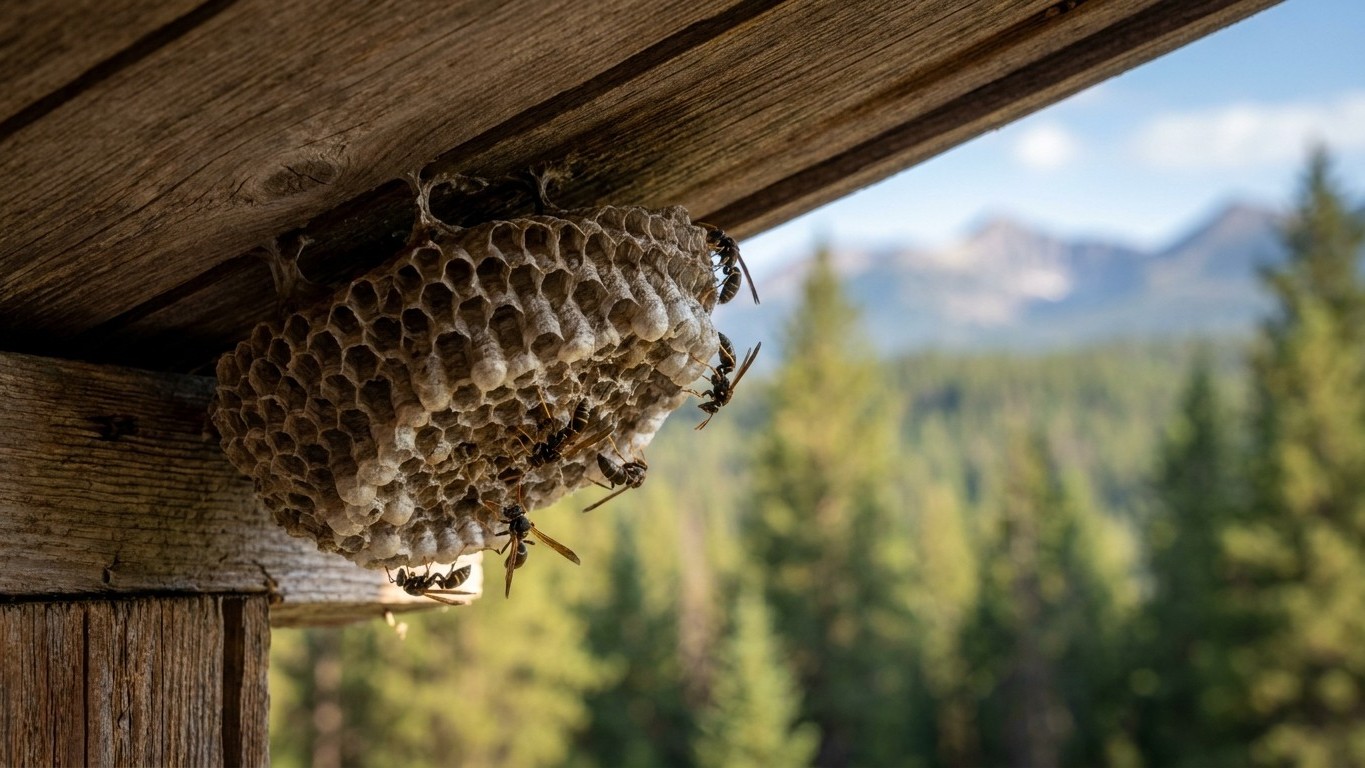
Polistes species build the open, umbrella-shaped combs found under eaves, deck railings, and porch ceilings across the state. Paper wasp colonies stay smaller (often under 100 workers) and the insects are generally less defensive unless the nest itself is disturbed directly. They’re common on ranch outbuildings and hay sheds throughout the Golden Triangle wheat country.
Bald-Faced Hornets
Technically a large yellowjacket relative, not a true hornet, this species builds the football-shaped aerial nests seen hanging in trees or under overhangs, sometimes reaching basketball size by late summer in forested areas around Kalispell and the Swan Valley. They’re aggressive if the nest is bumped, but rarely a problem unless the nest sits along a walkway or near a doorway.
What Actually Stops Social Wasps in Montana
Control that works splits into two categories: preventing queens from establishing nests in spring, and managing established colonies once they’re found. Confusing the two wastes effort.
Spring Queen Trapping
Baited traps hung outdoors in April and early May target overwintered queens before they lay a single egg. One captured queen in April prevents an entire colony that would otherwise reach hundreds of workers by August. This is the most underused tactic among Montana homeowners, who tend to wait until the nuisance stage in July or August, when the colony is already large and defensive.
Sealing Entry Points
German yellowjackets and paper wasps both exploit gaps around siding, soffits, and utility penetrations. Caulking obvious cracks in April, before wasps are actively scouting nest sites, closes off a huge share of potential indoor and wall-void nests. Check where dryer vents, electrical conduits, and cable lines pass through exterior walls, since these are common entry points on older Montana farmhouses and cabins.
Ground Nest Identification
Because western yellowjackets nest underground, mowing patterns matter more than most people realize. A nest entrance often looks like nothing more than a quarter-sized hole with light traffic of wasps flying low and direct, unlike the looping flight of bees. Spotting these early, before mid-July when populations spike, makes removal far safer and simpler.
Direct Nest Treatment
Once a colony is established, treatment happens at dusk or dawn when wasps are least active and most are inside the nest. Ground nests and enclosed wall-void nests generally call for a different approach than open aerial nests, and the number of active entrances on a ground nest is easy to underestimate. This is the stage where professional removal makes the most sense for hornet or yellowjacket colonies near doorways, decks, or areas where kids and pets pass daily, since disturbed colonies can send workers after anyone within twenty or thirty feet.
Sanitation Between May and September
Uncovered garbage cans, unrinsed recycling, fallen fruit under backyard apple and plum trees, and open compost piles all draw foraging workers from a wide radius. Tightening up outdoor food sources doesn’t eliminate a nest, but it reduces the number of wasps showing up at human activity zones, which is usually the actual complaint behind most calls about wasps.
Elevation and Region Change the Math
Montana’s range in elevation, from roughly 1,800 feet near the Idaho border to well over 6,000 feet in mountain valleys around West Yellowstone, shifts the wasp calendar by several weeks depending on where a property sits. Lower valleys along the Yellowstone and Clark Fork rivers see queen emergence and colony collapse earlier and later, respectively, than high-elevation towns. A property near Big Sky or Red Lodge might see wasp activity compressed into a shorter window, from late May through early September, while Billings or Missoula stretch that window on both ends.
Drought years also change nest density. Underground yellowjacket colonies rely on soil moisture for nest stability, and unusually dry summers in eastern Montana have been associated with wasps relocating nest sites closer to irrigated lawns, garden beds, and landscaped areas where soil stays workable. That’s part of why nests seem to cluster near sprinkler zones and garden hoses more than untouched pasture during dry stretches.
When a Nest Needs More Than a DIY Approach
Small paper wasp nests under a single eave, spotted early in the season with fewer than a dozen visible workers, are usually manageable without outside help. Underground yellowjacket colonies discovered in July or August, aerial hornet nests larger than a soccer ball, or any nest inside a wall void near living space, are a different situation. Colony size, defensive behavior, and the risk of multiple stings for anyone with an allergy all tilt toward calling a licensed pest control operator, particularly in a state where the nearest emergency room can be an hour or more away from rural properties.
One detail that surprises a lot of Montana homeowners: killing the visible wasps around a ground nest entrance doesn’t touch the underground chambers, which can extend several feet from the entry hole and house workers that simply weren’t out foraging at the time. Treating the visible symptom while leaving the colony’s core intact is the most common reason a “solved” wasp problem reappears within a week.