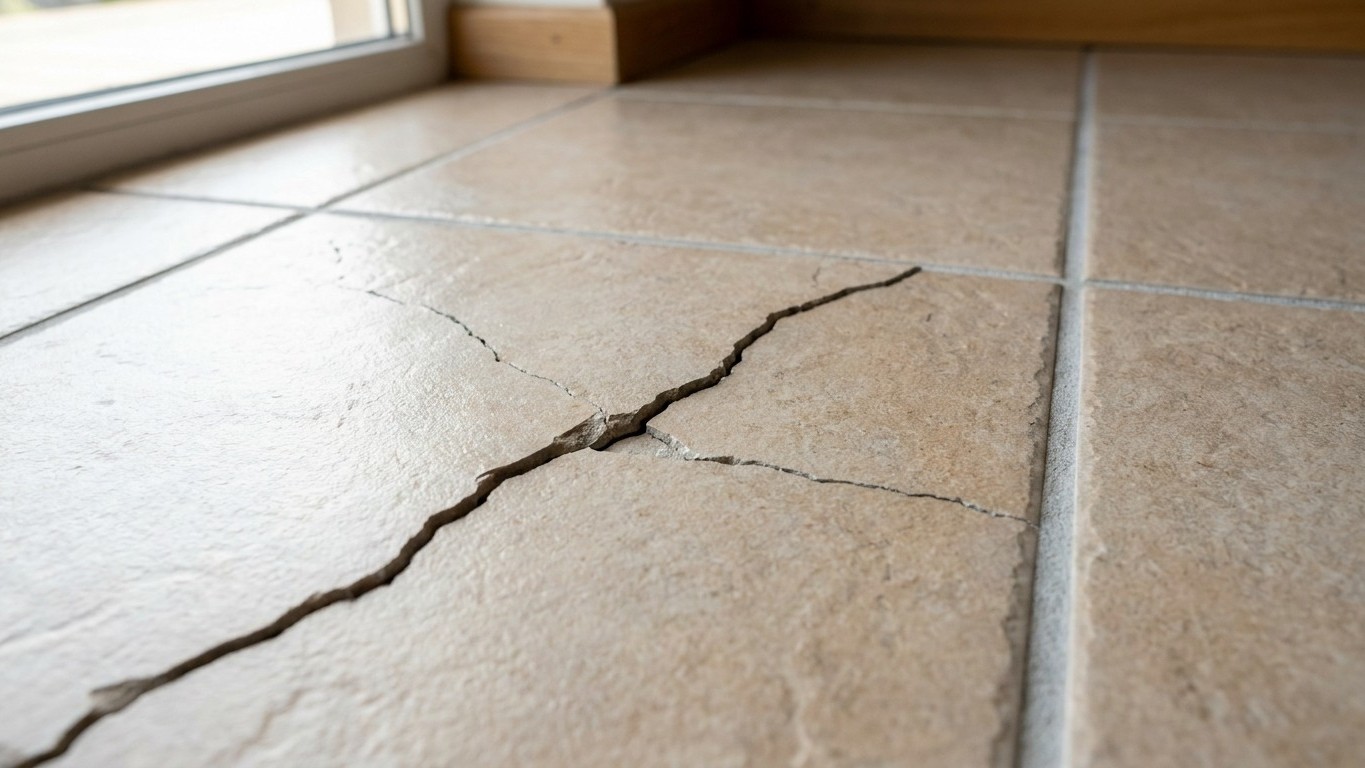

A cracked tile is almost never a manufacturing flaw or a warranty complaint. In the vast majority of cases, the tile did exactly what a rigid material does when the surface beneath it moves: it broke. Finding out why means looking down, not at the tile.
What is actually happening
Tile is hard and inflexible by design. That’s the whole point of the material. The substrate underneath it, whether that’s plywood, a concrete slab, or an older mortar bed, is not perfectly rigid. It flexes under weight, expands and contracts with temperature and humidity, and occasionally settles as a house ages. Tile has almost no capacity to absorb that movement. So when the layer below shifts even a fraction of an inch, the stress has to go somewhere. It goes into the tile, and specifically into whichever tile is weakest at that spot, whether that’s the one with a slightly thin bed of thinset behind it or the one sitting over a seam in the plywood.
Why one tile fails and not its neighbor
Grout lines are supposed to act as tiny expansion joints, giving the field a little room to breathe. When they’re doing their job, movement gets spread across dozens of joints and nothing cracks. When one tile takes the full load instead, it’s usually because the tiles around it are better supported and it isn’t. A void behind that single tile, a spot where the thinset didn’t make full contact during installation, is one of the most common reasons a lone tile fails while everything around it stays perfect for years.
Where the movement comes from
On a wood-framed floor, the movement often traces back to the joists and the subfloor panels resting on them. Spans that are a little long for their load, panels that weren’t fully fastened, or a seam that lands in the wrong place can all create a soft spot that flexes every time someone walks across it. On a concrete slab, the story is different: slabs crack along their own internal stress lines, often near control joints, doorways, or plumbing runs underneath, and if the tile was installed directly over that stress line without an isolation layer, the crack telegraphs straight up through the grout and into the tile. In both cases, a professional can check moisture in the substrate with a meter to rule out water as the reason the material is behaving unpredictably, but that reading is a diagnostic tool, not something a homeowner needs to interpret on their own.
The covering, or what is under it
The single most useful thing to establish before doing anything else is whether this is a problem with the tile installation itself or a problem with the structure underneath it. Those are two completely different repairs, and mixing them up means redoing work.
| What you see | What it usually means | Which layer is responsible |
|---|---|---|
| One tile cracked, isolated, no pattern | Impact damage, or a void left behind the tile during installation | The covering (the tile and its thinset bed) |
| A straight line of cracked tiles, following one direction | Movement along a joint, seam, or stress line beneath the floor | What’s under it (subfloor seam or slab control joint) |
| Cracks radiating outward from a corner or doorway | Deflection concentrated at a structural transition point | What’s under it (framing or slab geometry) |
| Several tiles cracked in a cluster near a wall with plumbing | Possible settling or softening tied to moisture | What’s under it (subfloor or slab condition) |
| Hollow sound under one tile, no visible crack yet | Existing void, not yet enough movement to fracture the tile | The covering, for now, but worth monitoring |
Reading the pattern before touching anything
A single cracked tile with no pattern around it is usually the covering’s problem. Something local, either an impact from a dropped object or a manufacturing or installation gap that left the tile unsupported in one spot, caused a failure that has nothing to do with the rest of the floor. That’s a contained repair.
A line of tiles, on the other hand, is the floor telling you it’s moving as a system. That’s not a tile problem wearing a disguise. It’s a subfloor, joist, or slab issue that happens to be visible through the tile because tile has zero tolerance for flex. Repairing the tile without addressing what’s underneath means the replacement will crack again, often within the first year, because nothing about the actual cause changed.
What to check, in order
Before any tile comes up, there’s a sequence of checks that costs nothing but time and rules things in or out without opening the floor.
- Look at the pattern. One tile or several in a line? A single isolated crack points toward the covering. A line or cluster points toward the structure. This alone rules out or confirms the first branch of the problem.
- Tap the tiles around the crack. A hollow, drum-like sound under a tile that hasn’t cracked yet suggests a void behind it, meaning it’s likely to be next. A solid sound rules out a void at that spot and shifts suspicion toward the subfloor further out.
- Check the location against the house’s layout. Cracks that line up with a wall above, a plumbing wall, a beam, or the center of a long joist span suggest the framing or slab geometry is involved. Cracks with no relationship to any of those suggest something local, like an old repair or a spot where the substrate wasn’t leveled properly.
- Note the timing. A crack that appeared within the first year of a new build often points to normal settling as lumber and framing dry out and adjust, a process that tends to slow down on its own. A crack that shows up on a floor that’s been stable for a decade points toward something that changed recently, like a leak or a new load.
- Bring in a professional for a bounce and deflection check. Walking the floor and feeling for give at the suspect spot, combined with a substrate moisture check with a meter, tells a flooring contractor whether the subfloor itself is sound. This is the last step before anything gets lifted, and it’s where a homeowner’s own inspection should stop.
Everything up to that last step can be done without removing a single tile. Past that point, confirming the cause means lifting the cracked tile and looking at what’s directly beneath it, and that’s a job for whoever ends up doing the repair, not a preliminary step to do alone.
When this stops being a flooring job
Three situations move this problem out of flooring territory entirely, and recognizing them early saves a homeowner from paying for a tile repair that was never going to hold.
The first is anything structural. If the check above shows real deflection, a joist that feels soft underfoot, or cracking that follows a beam line, that’s a load-bearing issue, not a surface one. A flooring installer can replace the tile, but only a structural engineer or a licensed contractor qualified to evaluate framing can determine whether a joist needs sistering, a beam needs support, or a post has settled. Tiling over a structural problem just guarantees a repeat crack.
The second is active water. A subfloor that’s damp because of a current leak isn’t a flooring diagnosis, it’s a plumbing one. No amount of tile repair addresses water still finding its way into the structure. That call goes to a plumber, and the flooring work waits until the source is fixed and the area has had time to dry, which a professional confirms rather than guesses at. For water tracing back to supply lines or fixtures, the plumbing guides in this collection cover how to trace and stop that kind of leak at the source.
The third is anything that’s been wet long enough to smell. That smell means organic growth has had time to establish itself in the subfloor material, and at that point the job is remediation before it’s ever a flooring job again. That’s a specialized call, not a weekend project, and it often starts with finding out where the water actually came from, whether that’s a roof, flashing, or gutter issue letting water into the structure from above. The roofing guides in this collection are the right next stop for tracking that kind of intrusion back to its source, because no floor repair holds up against water that keeps coming back.