
Yes, insulation matters in Alaska, but not for the reason it does in Phoenix or Houston. At the Anchorage reference station, the average number of days a year reaching 90°F or hotter is zero. That single fact reshapes the whole question: insulation here earns its keep mostly by holding heat in, not out, and any summer comfort it delivers is a side benefit riding along on winter-grade material.
The short answer for Alaska

Yes, insulation helps a home in Alaska, and the honest answer is that summer is a small fraction of why. NOAA’s 1991-2020 climate normals put the mean count of 90°F-or-hotter days at Anchorage at 0.0 a year. That is not a rounded-down small number, it is the recorded average: essentially no days of true summer heat load at the state’s largest population center. Compare that to a Gulf Coast station running 60 or 80 such days, and it is clear which side of the country’s climate divide this state sits on. Alaska is a heating-dominated state, full stop, and the same International Energy Conservation Code that hands other states a cooling-heavy zone number puts Alaska’s counties in some of the coldest zones the code defines.
The state spans four IECC climate zones across its 27 counties, and the spread itself tells the story. Eleven counties sit in zone 7, eight in zone 8 (the code’s coldest classification, reserved for places like interior Alaska), five in zone 6A, and three in zone 5C. Zone 8 exists specifically because ordinary cold-climate rules were not severe enough for parts of this state.
| IECC Climate Zone | Number of counties |
|---|---|
| Zone 7 | 11 |
| Zone 8 | 8 |
| Zone 6A | 5 |
| Zone 5C | 3 |
None of that means insulation is irrelevant to summer comfort in a house here. Even a handful of warm afternoons can turn an under-insulated attic into an oven that radiates heat down into living space for hours after sunset. But when the reference station logs zero 90°F days in an average year, the honest framing is that insulation in this state is a winter investment first. The payoff shows up in fuel bills through eight or nine months of heating season, with any summer benefit arriving as a bonus on the handful of genuinely warm days, not as the main reason to do the work.
What happens above the ceiling
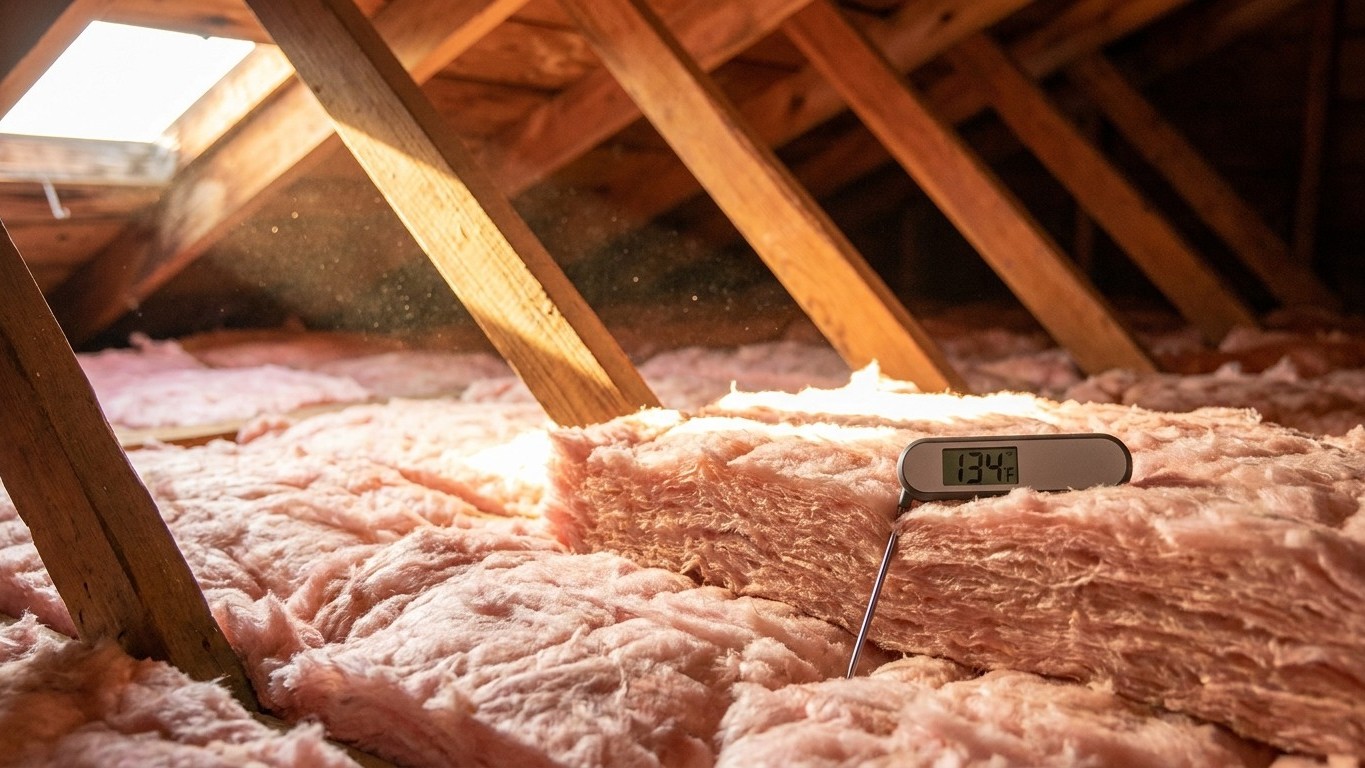
The mechanism is the same physics whether the house sits in Fairbanks or Phoenix, and it is worth walking through because it explains why the same material does two jobs. A roof deck under direct sun absorbs radiant energy and heats up well beyond the outdoor air temperature, sometimes by 40°F or more over the shingles or metal above it. That heat conducts downward into the attic space, and the attic air in turn sits directly above the ceiling of every room below, above the ductwork if any runs through there, and above anything stored in that space. On a genuinely hot afternoon, an attic can become the hottest place in the entire building envelope.
Insulation laid across that ceiling plane does not know or care which direction the heat is trying to travel. It resists heat flow in both directions equally: it slows heat escaping upward in January and slows heat pushing downward in July. That is the single most useful fact in this whole discussion. Attic insulation is not a winter product that happens to have a side effect in summer. It is a resistance layer, and resistance to heat flow works whichever way the flow is currently running.
What ENERGY STAR recommends for these zones
ENERGY STAR publishes retrofit insulation levels for existing wood-framed buildings by climate zone, based on the 2021 IECC. These are recommendations for adding insulation to a house that already exists, not requirements for new construction, and they group zones in the same bands the state’s counties actually fall into.
| Zone | Attic if currently uninsulated | Attic if you already have 3-4 inches | Floor |
|---|---|---|---|
| Zones 6, 5 and 4C | R60 | R49 | R30 |
| Zones 7 and 8 | R60 | R49 | R38 |
Both rows apply somewhere in this state, since its counties sit in zones 7, 8, 6A and 5C. Neither this page nor ENERGY STAR’s published county list will tell an individual reader which zone their own address falls into; that assignment comes from ENERGY STAR’s own zone map, and it is worth checking before buying material. What both rows share is the headline number: R60 in an uninsulated attic, across every zone this state touches. That is the one upgrade that pays in both directions, all year, regardless of which of the four zones a given house sits in.
What homes in Alaska cool with
The U.S. Energy Information Administration’s 2020 Residential Energy Consumption Survey gives a clear picture of how Alaska households actually handle warm weather, and the numbers are modest across the board. Seven percent of homes surveyed use air-conditioning equipment of any kind. Six percent use an individual unit, meaning a ductless mini-split, a window or wall unit, or a portable. The share running a central air-conditioning system was not published, the estimate was suppressed because the sample was too small to report reliably, which is not the same thing as zero. Ceiling fans, by contrast, show up in 46% of homes, by far the most common cooling strategy in the state.
Those figures are shares of households surveyed, not shares of houses standing, and the gap between the 7% running any air conditioning and the 6% running individual units leaves very little room for central systems in this state, whatever that suppressed number actually is.
The connection to insulation depends entirely on which of those setups a given house has. Where central air does exist and its ductwork runs through the attic, as it often does in warmer states, those ducts sit inside the hottest space in the building on a warm afternoon, and ceiling insulation laid over the attic floor does nothing to protect them: sealing and insulating the ducts themselves is a separate job, covered in duct insulation guides on this site. Where cooling is a window unit, a wall unit, or a mini-split, as it is for the 6% of households reporting individual equipment, there is no attic ductwork to worry about at all; the room’s own walls, windows and ceiling are what determine how hard that unit has to work, a subject covered in the room air conditioner guides here. Given how rarely genuine cooling equipment shows up in this state’s homes at all, the far more common summer strategy, judging by that 46% ceiling-fan figure, is moving air rather than conditioning it.
What the heat asks for that the cold does not
Two additions belong specifically to hot climates, and neither one is the right call for a house in a state where the reference station logs zero days above 90°F a year.
A radiant barrier is a reflective layer, usually foil-faced, installed to bounce radiant heat back before it enters the attic space. It carries no R-value and is not insulation in the conventional sense; it does a completely different job, reflecting radiant energy rather than resisting conducted heat flow. It earns its place under a roof deck that spends long summer afternoons baking in direct sun, which is exactly the condition this state’s climate does not produce with any regularity. For a house in a zone 7 or zone 8 county, a radiant barrier is not the tool the situation calls for. The money is better spent getting the attic to R60.
Vapor movement is the second hot-climate consideration, and it runs backward from how most people learn to think about it. In a warm, humid climate, the moisture-laden air is typically outside the wall, pushing inward, which is exactly why the model code does not require an interior vapor retarder in the country’s warmest, most humid zones. In a cold state like this one, the usual direction is reversed: interior humidity tends to push outward through the wall assembly for most of the year, which is a different problem with a different answer. Getting that assembly right, in either direction, is specific enough to deserve its own answer rather than a summary here. The territory’s vapor barrier page is the place to work through it in detail.
What the work is worth
ENERGY STAR’s own methodology page puts a number on the combined payoff of this kind of work: “EPA estimates that homeowners can save an average of 15% on heating and cooling costs (or an average of 11% on total energy costs) by air sealing their homes and adding insulation in attics, floors over crawl spaces, and accessible basement rim joists.”
Both percentages matter, and they are not interchangeable. The 15% figure applies specifically to heating and cooling costs together, not to the total utility bill. The 11% figure is the broader number, covering total energy costs across the household. That the estimate covers heating and cooling as one combined figure is exactly why this page exists rather than treating summer and winter as separate questions: in a heating-dominated state like this one, the vast majority of that 15% saving comes from the winter side of the ledger, with whatever summer benefit exists riding along on the same insulation.
Two limits are worth keeping in mind before treating that number as a promise. It comes from energy modeling of a “typical” existing U.S. home, an average across a wide range of house ages, sizes and starting insulation levels, not a guarantee for any specific address. And the figure names exactly where the modeled work happened: attics, floors over crawl spaces, and accessible basement rim joists. It says nothing about walls, windows or doors, and stretching it to cover those upgrades would be misreading the source. For a state with counties in four different climate zones, the honest way to use this number is as a general sense of scale, worth confirming against the specific R-value targets and zone assignment for the house in question rather than treated as a fixed outcome.