
Yes, Insulation keeps a New Mexico home cooler, and the state’s climate normals show why it matters for a real stretch of the year rather than a handful of scorching afternoons. The reference station in Albuquerque logs an average of 42.5 days a year at 90°F or hotter, a summer load real enough to justify the work but far from the year-round furnace some other territories deal with.
The short answer for New Mexico

Forty-two and a half days above 90°F is a meaningful summer, not a marginal one. That’s roughly six weeks scattered across June through August where a poorly insulated ceiling turns an attic into a radiator sitting directly over living space. But New Mexico isn’t a single climate, and the state’s own county-by-county zoning tells the real story: 13 counties sit in IECC zone 4B, 12 in zone 5B, and 8 in zone 3B. That’s a 33-county spread across three zones, with no single answer that fits all of them.
Zone 3B counties, generally the lower-elevation, hotter parts of the state, lean toward the cooling side of the ledger. Zone 5B counties, higher and cooler, lean the other way, where winter heating losses through an under-insulated ceiling likely cost a household more across the year than summer heat gain does. Zone 4B counties sit in between, with both seasons pulling real weight on the energy bill.
What that means in practice: a homeowner in one of the 8 zone 3B counties is looking at a longer, harder summer than the state average number above suggests, since Albuquerque itself sits in zone 4B. A homeowner in a zone 5B county should expect the 42.5-day figure to overstate their own heat load somewhat, given the elevation gain that typically comes with that zone. Neither reader should assume the other’s answer. What’s constant across all three zones is this: Insulation resists heat flow in both directions, so the same attic work that blunts a January heating bill is also what keeps a July ceiling from radiating heat into the rooms below. The question isn’t whether insulation counts for something here. It’s how much of that count comes from summer versus winter, and that split changes by county, not by state.
What happens above the ceiling
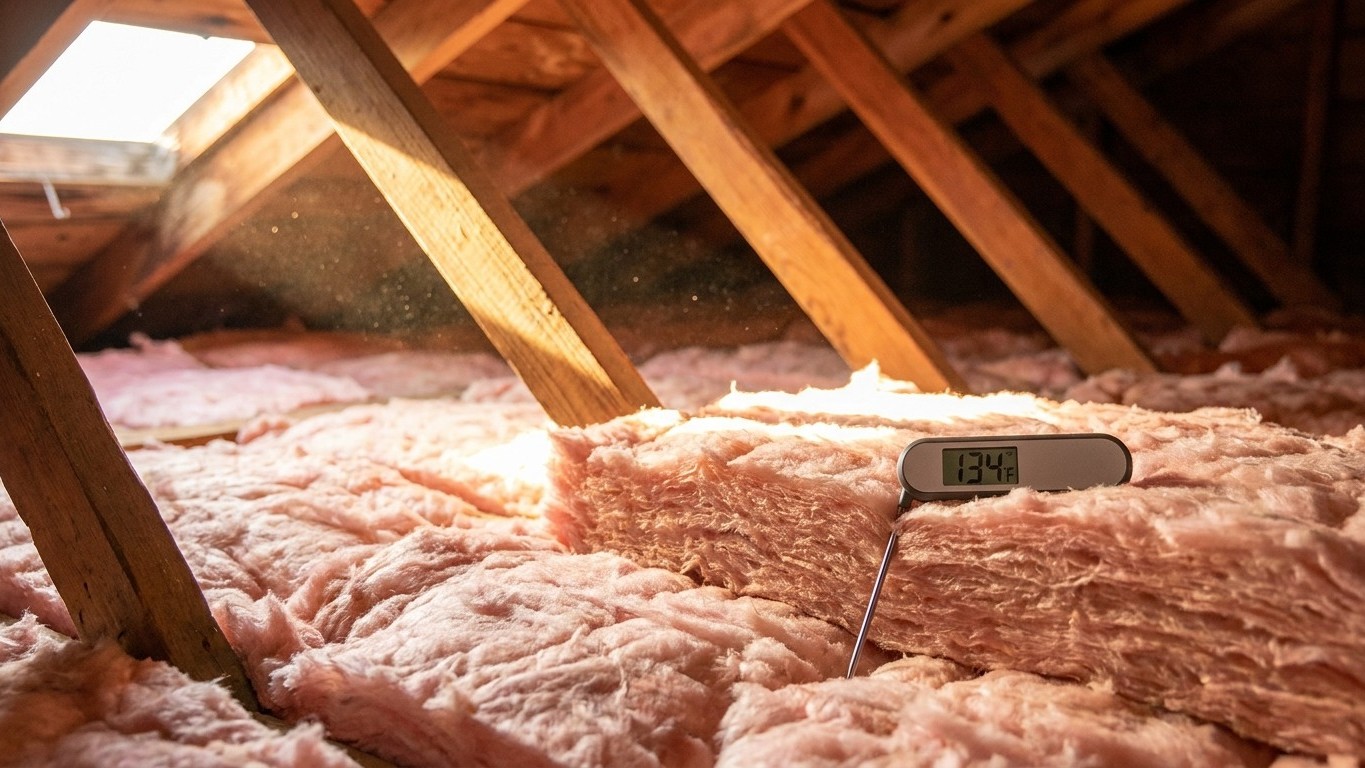
A roof deck under a New Mexico sun in July can run 50 to 60 degrees hotter than the outdoor air, and that heat has nowhere to go but down, into the attic, and then into whatever sits below it: the ceiling drywall, the ductwork, the boxes stored up there, and eventually the living space itself. An uninsulated or thinly insulated attic doesn’t just let a little heat through. It becomes the hottest room in the house and stays that way for hours after sunset, since insulation-starved framing and drywall hold onto that heat and release it slowly overnight.
The point worth repeating is that attic insulation isn’t a seasonal product. It’s a resistance value that works exactly the same way regardless of which direction the heat is trying to move. In winter, warm indoor air rises and tries to escape through the ceiling into a cold attic. In summer, the flow reverses: a superheated attic pushes heat down into the conditioned space. The same fiberglass, cellulose, or spray foam that slows the January leak is what slows the July gain. There’s no separate “summer insulation” to buy.
What ENERGY STAR recommends, by zone
ENERGY STAR’s retrofit guidance for existing wood-framed homes gives three figures per climate zone: how much attic insulation to add if the attic is currently bare, how much to add if there’s already 3 to 4 inches up there, and a separate floor figure for over crawl spaces. Since New Mexico’s counties span three IECC zones, here are the rows that apply somewhere in the state:
| Climate zone | Attic if uninsulated | Attic if 3-4 inches already present | Floor |
|---|---|---|---|
| Zone 3 | R49 | R38 | R19 |
| Zones 4A and 4B | R60 | R49 | R19 |
| Zones 6, 5, and 4C | R60 | R49 | R30 |
These are retrofit levels for existing homes, not new-construction code minimums, and ENERGY STAR does not publish a state or county list of which zone applies where. Its zone map assigns that, and it’s worth checking directly rather than guessing from a county name.
What homes in New Mexico cool with
Federal survey data on New Mexico households shows 85% of homes use air-conditioning equipment of some kind, and 53% run it through a central system. A separate 14% cool with an individual unit, a window box, a wall unit, a ductless mini-split, or a portable. Ceiling fans show up in 75% of homes, doing supplemental work rather than replacing mechanical cooling. Those figures are shares of households surveyed, not of every house standing in the state, and the gap between the 85% overall figure and the 53% central-only figure is where the story lives: a meaningful slice of New Mexico homes are cooling one or two rooms at a time rather than the whole house at once.
That split changes what insulation is actually doing for a given household. In a home with central air and ductwork routed through the attic, those ducts sit in the hottest part of the building all summer long. Ceiling insulation slows heat moving into the attic from outside, but it does nothing to stop a duct sitting in that same superheated space from picking up heat and losing cooled air before it ever reaches a vent. That’s a separate problem with a separate fix, and it’s worth working through the site’s duct insulation and sealing guide if central air with attic ductwork describes the setup.
In a home cooling with a window unit or a mini-split, the calculation is different. There’s no attic duct run to worry about, and the room’s own envelation, walls, windows, the ceiling directly overhead, is what determines how hard that single unit has to work. The site’s room air conditioner guide covers sizing and placement for that setup specifically. Either way, the equipment already installed in a home says a lot about which fix actually moves the needle.
What the heat asks for that the cold does not
Two tools belong specifically to hot climates and don’t do much of anything in a cold one. The first is a radiant barrier: a reflective layer, usually foil-faced, installed under the roof deck or across the rafters, that bounces radiant heat back before it ever reaches the attic floor. It carries no R-value and isn’t insulation in the traditional sense. Where it earns its place is under a sun-loaded roof deck, which describes a real slice of New Mexico’s summer, particularly the lower-elevation zone 3B counties in the state’s southern reaches. It’s a legitimate add for those homes. It’s not the priority fix for a higher-elevation zone 5B home where winter heating losses likely outweigh summer radiant gain, and adding a radiant barrier there wouldn’t be the first dollar well spent.
The second is a matter of direction rather than a product: water vapor moves the opposite way in summer compared to winter. In a warm, humid climate, the moisture sits outside and pushes inward, which is exactly why the model building code doesn’t require an interior vapor retarder in its warmest, most humid zones. New Mexico’s counties are classified with a “B” moisture designation, dry rather than warm-humid, which changes how that vapor question plays out here compared to a Gulf Coast state. That’s a distinct enough topic that it deserves its own answer rather than a partial one folded into an attic discussion. The site’s vapor barrier guide for this territory works through it properly.
What the work is worth
ENERGY STAR’s published estimate puts a number on all of this: “EPA estimates that homeowners can save an average of 15% on heating and cooling costs (or an average of 11% on total energy costs) by air sealing their homes and adding insulation in attics, floors over crawl spaces, and accessible basement rim joists.” Both figures matter together. Fifteen percent is measured against heating and cooling costs specifically, while 11% is measured against total energy costs, a wider bucket that includes water heating, lighting, and appliances alongside space conditioning.
That the estimate covers heating and cooling as a single combined figure is the reason this whole discussion holds together. It isn’t a winter number that happens to apply in summer as an afterthought. It’s a year-round figure built from modeling both seasons at once, which lines up with everything above: the same attic fix that blunts a January bill is doing real work in July too.
Two limits worth keeping in mind. This is an average from energy modeling of a typical existing U.S. home, not a guarantee for any specific house in Albuquerque, Las Cruces, or a rural county in between. And the figure covers attics, floors over crawl spaces, and accessible basement rim joists specifically, not walls, windows, or doors, which are separate projects with their own separate math.