
Yes, but the honest version of that answer for British Columbia looks different than it does for Texas or Arizona. At the reference station in Vancouver, the average number of days a year that reach 90°F or higher is zero. Insulation still matters here, but the payoff is overwhelmingly a winter story that happens to carry a small summer bonus, not the other way around.
The short answer for British Columbia

Vancouver’s climate normal for days above 90°F sits at 0.0, according to Environment and Climate Change Canada’s 1981-2010 normals. That number is not a rounding error or an average masking a few scorchers. It means the coastal reference station essentially never sees the kind of heat load that drives attic temperatures into triple digits for weeks at a stretch, the way it does across much of the American South and Southwest.
That single fact reframes the whole question. Where a summer runs long and brutal, Insulation becomes half the year’s energy math, holding conditioned air inside against relentless outdoor heat. Where the summer barely registers, as it does at this station, the calculation flips. Vancouver International sits in Natural Resources Canada’s climate zone 4, the mildest of the country’s residential zones, defined by roughly 2,818 heating degree days below 18°C. Zone 4 tops out under 3,000 HDD; zones 5 through 8 climb from there, with zone 8 running past 7,000. A station this far on the mild end of the national scale spends its energy budget fighting damp, cool winters far more than it fights heat.
None of that means Insulation is wasted here in July. A well-insulated ceiling still slows heat gain on the handful of genuinely warm afternoons the coast does get, and it still protects an attic full of ductwork or stored belongings from baking. But if you’re weighing where Insulation dollars do the most work in this part of the province, the case for it rests on the long, wet winter, not on a summer that a climate normal describes as functionally absent. Readers further inland or up the province, where summers run hotter and winters colder, are working from a different zone entirely, and should check their own municipality’s degree-day figures before assuming this number applies to their roof.
What happens above the ceiling
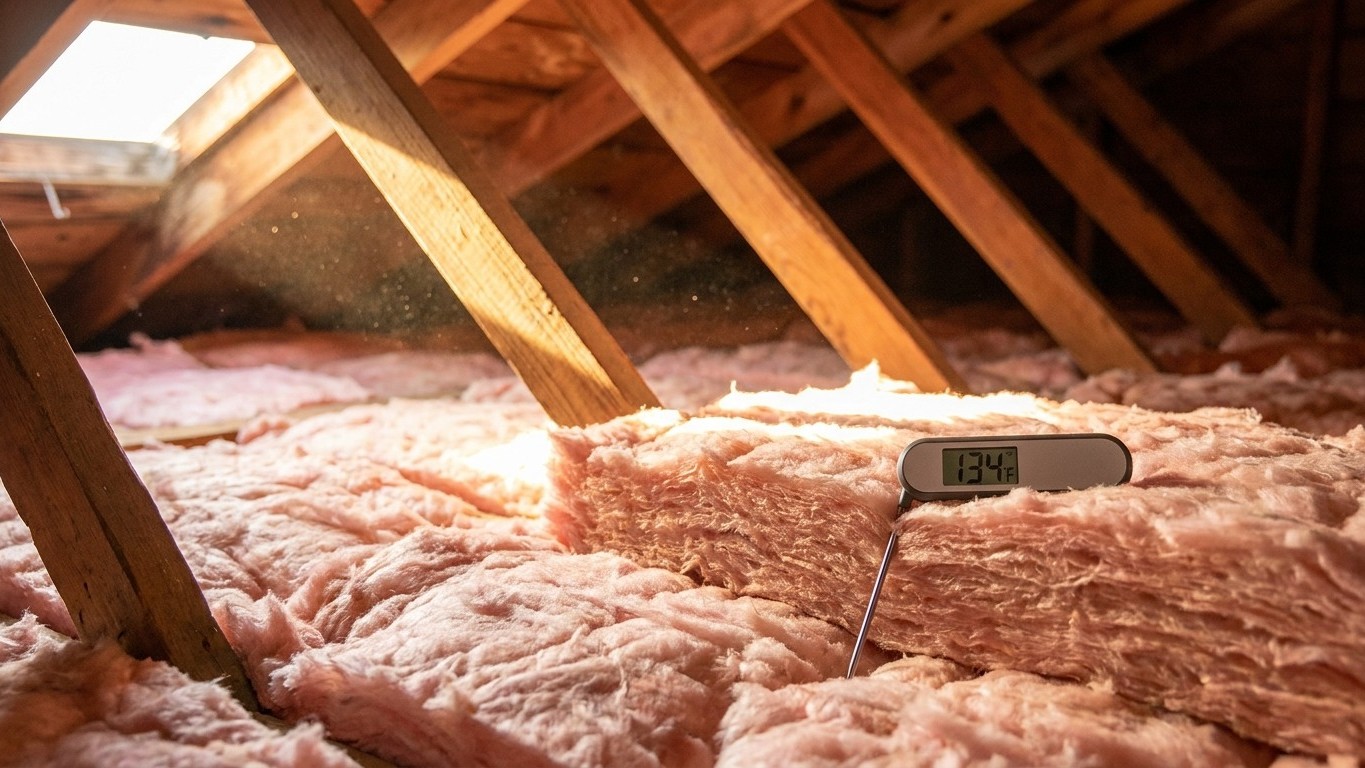
Even in a mild coastal climate, a roof deck under direct sun heats up well past the outdoor air temperature. Dark asphalt shingles can push attic air far hotter than the day outside, and that superheated space sits directly above the ceiling, above any ductwork routed through it, above whatever boxes and holiday decorations have been stored up there for years. Everything under an attic lives underneath that heat load, whether the summer outside is mild or savage.
The Insulation doing that job is not a seasonal product. It is a resistance to heat flow, full stop. In January, that resistance keeps furnace-warmed air from escaping upward. In July, on the coast’s occasional hot afternoon, the same material slows heat moving downward from a sun-baked attic into the living space below. It is the rare home improvement that works in both directions without any change in the material itself, which is exactly why it earns priority over more climate-specific fixes.
What Natural Resources Canada recommends for this zone
For climate zone 4, the zone that includes the Vancouver reference station, Natural Resources Canada’s Keeping the Heat In guide lists these recommended minimum insulation levels:
| Assembly | Recommended minimum (RSI) | Recommended minimum (R-value) |
|---|---|---|
| Roof or ceiling | RSI 7.9 | R 45 |
| Walls | RSI 3.9 | R 22 |
| Basement walls | RSI 3.3 | R 19 |
| Floor over unheated space | RSI 6.2 | R 35 |
These are nominal minimums recommended for this zone, not a code requirement in themselves. Provincial and municipal building codes set the actual legal minimums and can call for more. A reader living further north or inland, in a colder NRCan zone, would be looking at a different table entirely with higher recommended values, so the numbers above should not be assumed to apply beyond zone 4. Full detail lives on the Natural Resources Canada page.
What homes in British Columbia cool with
Air conditioning is far from universal here. According to Statistics Canada’s 2025 Canadian Social Survey on energy consumption behaviours, 45.2% of households in British Columbia reported having air conditioning, compared with 68.3% nationally. That gap likely reflects the mild coastal summers this territory’s own climate data describes, plus a housing stock built for a different set of priorities than heat rejection. It is a share of households surveyed, not a share of homes standing, and the survey’s own “not reported” and suppressed estimates mean the real figure for full saturation isn’t captured cleanly by this one number.
Where a household does run central air, the ductwork usually runs through the attic, the hottest space in the building on any warm day. Ceiling insulation does nothing to protect that ductwork; a duct running through a superheated attic loses cooled air to its surroundings regardless of how thick the insulation is on the ceiling below it. That is a separate, sealing-and-duct-insulation job, covered in more detail in this site’s duct sealing and insulation guide.
For the many households here relying instead on a window unit or a ductless mini-split, the calculation is simpler and more local: the insulation and air sealing of that one room’s walls and ceiling is what determines how hard the unit has to work. A leaky, under-insulated room defeats even an efficient mini-split fast. Readers weighing which cooling equipment fits a home like this can compare options in the room air conditioner guide on this site.
What the heat asks for that the cold does not
Two tools exist specifically for hot climates and have no real role outside them. A radiant barrier is the first. It reflects radiant heat rather than resisting conducted heat, carries no R-value of its own, and only earns its keep under a roof deck baking in direct, sustained sun. Given that the reference station for this territory records zero days a year above 90°F, a radiant barrier is not the tool for most homes here. It solves a problem this climate largely doesn’t have. Homeowners moving here from a hotter province, or those in the small pockets of British Columbia’s interior that do see real summer heat, are a different case, but for the coastal norm described by this data, that dollar is better spent on the ceiling insulation levels above.
The second is about vapor, and it runs backwards from what a cold-climate instinct expects. In a warm, humid climate, moisture-laden air sits outside the wall for most of the year, which is exactly why the model building code drops the requirement for an interior vapor retarder in the country’s warmest zones. British Columbia’s coast is mild rather than hot-humid, so this reversal doesn’t apply here the way it would in a genuinely humid subtropical climate. Getting vapor control wrong in either direction can trap moisture inside a wall assembly, so this is a decision worth making with the specifics of this territory’s own vapor barrier guide rather than settling here from general climate principles alone.
What the work is worth
The U.S. Environmental Protection Agency’s ENERGY STAR program estimates that homeowners can save an average of 15% on heating and cooling costs, or an average of 11% on total energy costs, by air sealing their homes and adding insulation in attics, floors over crawl spaces, and accessible basement rim joists. That figure bundles heating and cooling together deliberately, because for most homes the two are not separate budgets; the same envelope holds heat in through a long winter and, on the rare hot day, holds it out.
Two things about that number matter before applying it to any one house. It’s an average pulled from energy modeling of a typical existing home, not a guarantee for a specific address, and modeling assumptions built around a broader U.S. housing stock won’t map perfectly onto a coastal British Columbia home with its own age, orientation, and existing insulation. It also names exactly where that saving comes from: attics, floors over crawl spaces, and accessible basement rim joists. It says nothing about walls, windows, or doors, and stretching the figure to cover those upgrades overstates what the data actually shows.
For a territory where summer heat is nearly a non-event but winter heating runs for months, that combined heating-and-cooling framing is the honest way to read the number: most of the 15% here is winter savings, with cooling season making up a small fraction of it, which lines up with everything the climate data for this station has already said.