
Yes, Insulation helps New York homes stay cool, though summer heat isn’t the main event here the way it is in the Deep South. The state leans cold for more of the year than hot, so Insulation added for winter warmth does double duty when a July heat wave rolls through Buffalo, Albany, or the five boroughs. How much that duty matters depends on where in the state you live.
The short answer for New York

Insulation keeps a New York home cooler, and the honest measure of how much that matters is 12.2 days a year, the average number of days the temperature reaches 90 F or higher at the reference station in New York City, according to NOAA’s 1991-2020 Climate Normals. That’s not a long list. Compare it to a Gulf Coast city logging triple that count, and it’s clear New York’s summer heat load is real but limited.
That number describes the reference station in New York City, not every backyard in the state. Head north to the Adirondacks or west along Lake Erie and 90-degree days grow scarcer still; push into the Hudson Valley or Long Island in a hot August and you’ll feel closer to that 12-day average or above it.
The state’s three climate zones
The climate-zone map underneath that number tells the rest of the story. Under the 2021 International Energy Conservation Code, New York’s 62 counties split across three zones: 36 counties sit in zone 5A, 18 in zone 6A, and 8 in zone 4A. Zones 5 and 6 are cold-climate territory, the kind of zone where a furnace runs more months of the year than an air conditioner does. Zone 4A, the smallest slice, is milder but still nowhere near the long, sweltering cooling seasons of zone 2 or zone 1 territory farther south.
Put those two facts together and the answer sharpens: yes, Insulation reduces summer heat gain in a New York home, but here summer is the shorter half of the Insulation story. In a state built mostly of zone 5A and 6A counties, the bulk of the energy case for Insulation is made every winter, and the same material earns its keep again for a couple of hot weeks each summer. That’s a different answer than you’d give a homeowner in Texas or Arizona, where cooling season can run half the year. In New York, treat summer performance as a bonus that comes with a winter-driven upgrade, not the main reason to do the work.
What happens above the ceiling
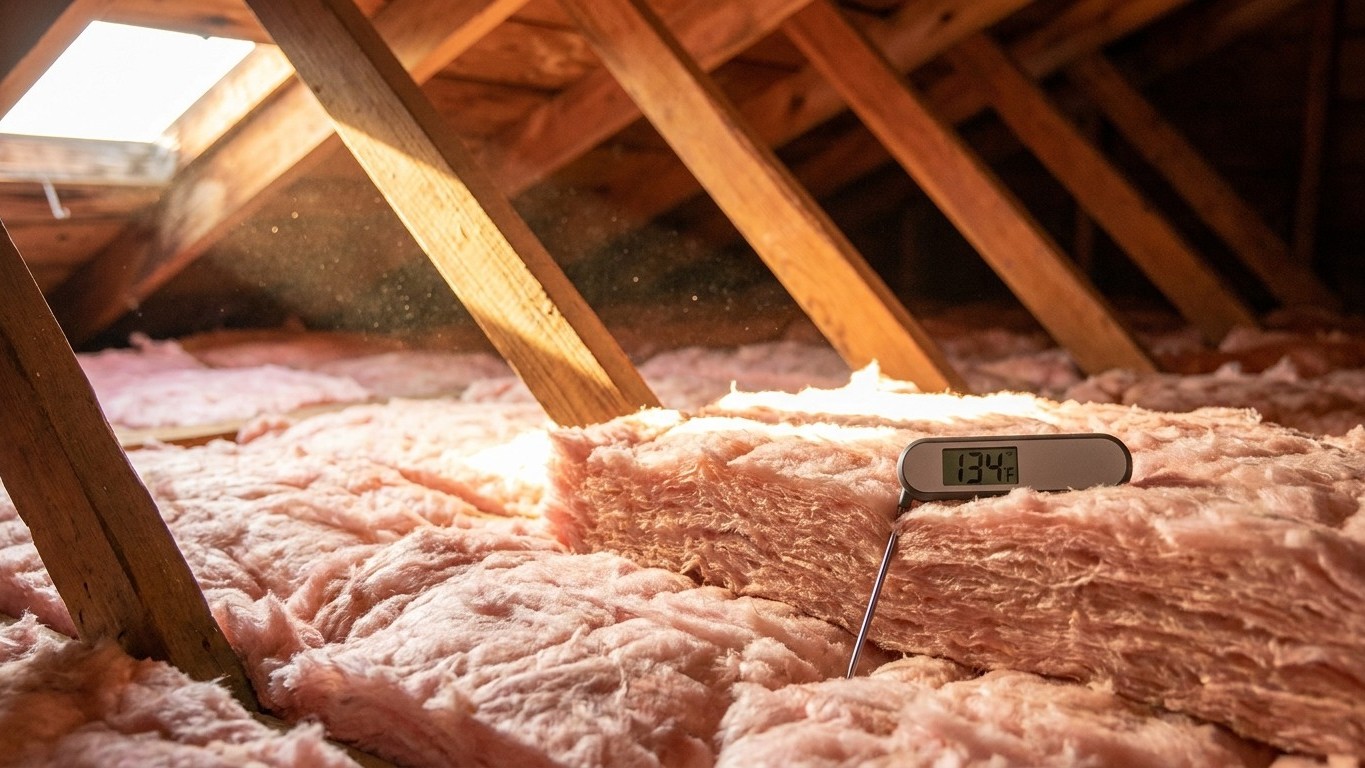
On a sunny July afternoon, a dark asphalt shingle roof can push the underside of the roof deck well past 140 F, and that heat radiates straight into the attic below. Attic air routinely runs 30 to 50 degrees hotter than the outdoor air on a clear summer day, simple physics of a large, dark, sun-facing surface absorbing solar energy all afternoon with nowhere to go. Everything under that roof deck sits inside that heat: the Insulation itself, any ductwork routed through the space, and the ceiling drywall that separates the attic from the living room below.
The insulation layer between the attic floor and the ceiling below is the barrier that slows that heat from marching downward into the house. It’s the same material, doing the same job it does in January: resisting the flow of heat through a temperature difference, just running in reverse in summer. In winter, heat wants to escape upward from a warm house into a cold attic. In summer, heat wants to push downward from a scorching attic into a cooler house. One layer of fiberglass, cellulose, or spray foam resists both, which is why attic insulation is the rare upgrade that pays twice, whichever season put it to the test.
ENERGY STAR insulation levels for New York’s zones
ENERGY STAR’s retrofit guidance for existing wood-framed homes sets a target level by climate zone, and New York’s counties fall into two of the rows below.
| Zone | Attic (uninsulated) | Attic (already 3-4 in.) | Floor |
|---|---|---|---|
| Zones 4A and 4B | R60 | R49 | R19 |
| Zones 6, 5 and 4C | R60 | R49 | R30 |
New York’s eight zone-4A counties fall in the first row above; the 36 zone-5A and 18 zone-6A counties fall in the second. Both rows call for R60 in an attic starting from scratch, or R49 topping up 3 to 4 inches of existing material. The floor figure differs: R19 for zone 4A, R30 for the colder 5 and 6 zones, since a cold floor over an unheated crawl space loses more heat where winters run longer. These are retrofit levels for existing wood-framed construction, not code minimums for new builds, and they follow ENERGY STAR’s guidance based on the 2021 IECC. Confirming which zone applies to a specific county means checking ENERGY STAR’s zone map or the county table directly, since the letter after the zone number changes which row of this table applies.
What homes in New York cool with
Eighty-eight percent of New York households run some form of air-conditioning equipment, according to the U.S. Energy Information Administration’s 2020 Residential Energy Consumption Survey. That’s a high number for a state that logs barely twelve 90-degree days a year, and it says something about summer’s shorter but still uncomfortable stretches, plus the humidity that often rides along with them in the Northeast.
Central air versus room units
The more telling split is between central air and everything else. Only 29% of New York homes run a central air-conditioning unit, while 61% rely on individual equipment: a window unit, a wall unit, a ductless mini-split, or a portable AC rolled out for the season. That’s a wide gap, and it means most New York homes are cooling room by room rather than whole-house. Fifty percent also report using ceiling fans, often paired with one of those individual units to move air around a room a single window unit can’t reach on its own. All four figures are shares of households surveyed, not shares of the state’s housing stock, and some homes run more than one type of equipment.
That equipment mix changes what insulation can and can’t do for a New York household’s summer comfort. In the 29% of homes with central air, the ductwork is often routed through the attic, the hottest space in the building on a July afternoon. Ceiling insulation slows heat from reaching the living space below, but it does nothing for supply air losing its cool as it travels through 130-degree attic air on the way to a bedroom register. That’s a separate problem, solved by sealing and insulating the ducts themselves, not the attic floor.
For the larger share of homes running a window unit, wall unit, or mini-split, the math is simpler: that single room’s own walls, windows, and ceiling are the envelope doing the work, and insulation levels in that specific space matter more than anything happening in an attic above a bedroom the unit isn’t cooling. Homeowners weighing either setup can find more detail in this site’s guides to duct insulation and to choosing and sizing a room air conditioner.
What the heat asks for that the cold does not
Two features of hot-climate construction don’t show up in a cold-climate insulation job, and neither is the priority for a New York attic, for different reasons.
Radiant barriers
A radiant barrier, a reflective layer usually stapled to the underside of roof rafters, works by reflecting radiant heat away rather than resisting conducted heat the way insulation does. It carries no R-value and isn’t a substitute for insulation; it earns its keep in climates where the roof deck bakes for months and every degree of attic heat matters for cooling load. With an average of 12.2 days a year above 90 F, New York doesn’t fit that description for most of its housing stock. The smarter use of a limited home-improvement budget here is hitting the R60 attic target from the table above before adding a reflective layer that pays off mainly where summer runs long and central air runs constantly.
Vapor movement in summer
Vapor movement is the other piece that flips with the season, and it matters more in warm, humid climates than in New York’s. In winter, water vapor pushes from the warm indoor air toward the cold outdoors, which is why cold-climate building practice puts a vapor retarder on the warm-in-winter side of a wall. In a hot, humid summer climate, that flow reverses: the moisture load comes from outside, humid air pushing inward toward the air-conditioned space, which is part of why the model energy code drops the requirement for an interior vapor retarder in its warmest, most humid zones. New York’s zones don’t carry that warm-humid designation, so the standard cold-climate vapor-retarder logic still applies across most of the state. Getting that detail right matters, since a retarder placed on the wrong side of a wall can trap moisture instead of blocking it, a call worth making on this site’s vapor barrier page for New York rather than settling here.
What the work is worth
EPA’s own estimate for this kind of work is specific, and it’s worth quoting exactly rather than rounding: “EPA estimates that homeowners can save an average of 15% on heating and cooling costs (or an average of 11% on total energy costs) by air sealing their homes and adding insulation in attics, floors over crawl spaces, and accessible basement rim joists.” Two numbers, two different denominators: 15% off the heating-and-cooling portion of a bill, 11% off the whole energy bill once electricity for lights and appliances is factored back in.
The detail that matters for a New York homeowner weighing this project is right there in the sentence: heating and cooling together, not one or the other. That’s exactly why insulation deserves a place in a summer-heat conversation even in a state where winter drives most of the energy bill. The same attic work that cuts a January heating bill is baked into that same 15% figure covering the July cooling bill too, not two separate savings but one upgrade counted once across both seasons.
What the estimate does and doesn’t cover
Two things keep this number honest. First, it’s an average pulled from energy modeling of a typical existing U.S. home, not a projection for any single house on any single street in Buffalo or Brooklyn. Actual results depend on how leaky and under-insulated the home was to start, and on the fuel it runs on. Second, the figure applies specifically to attics, floors over crawl spaces, and accessible basement rim joists, the spots EPA modeled directly. It doesn’t cover wall insulation, new windows, or a new door, projects that carry their own separate math.
There’s no price tag attached to that 15/11% figure and no payback period published alongside it, and as of the end of 2025 the federal 25C tax credit that used to offset some of this work has closed. What’s left is the physics: a properly insulated attic in a zone-5A or zone-6A New York county does its heaviest work every winter, and picks up a second job every time the thermometer clears 90 degrees.