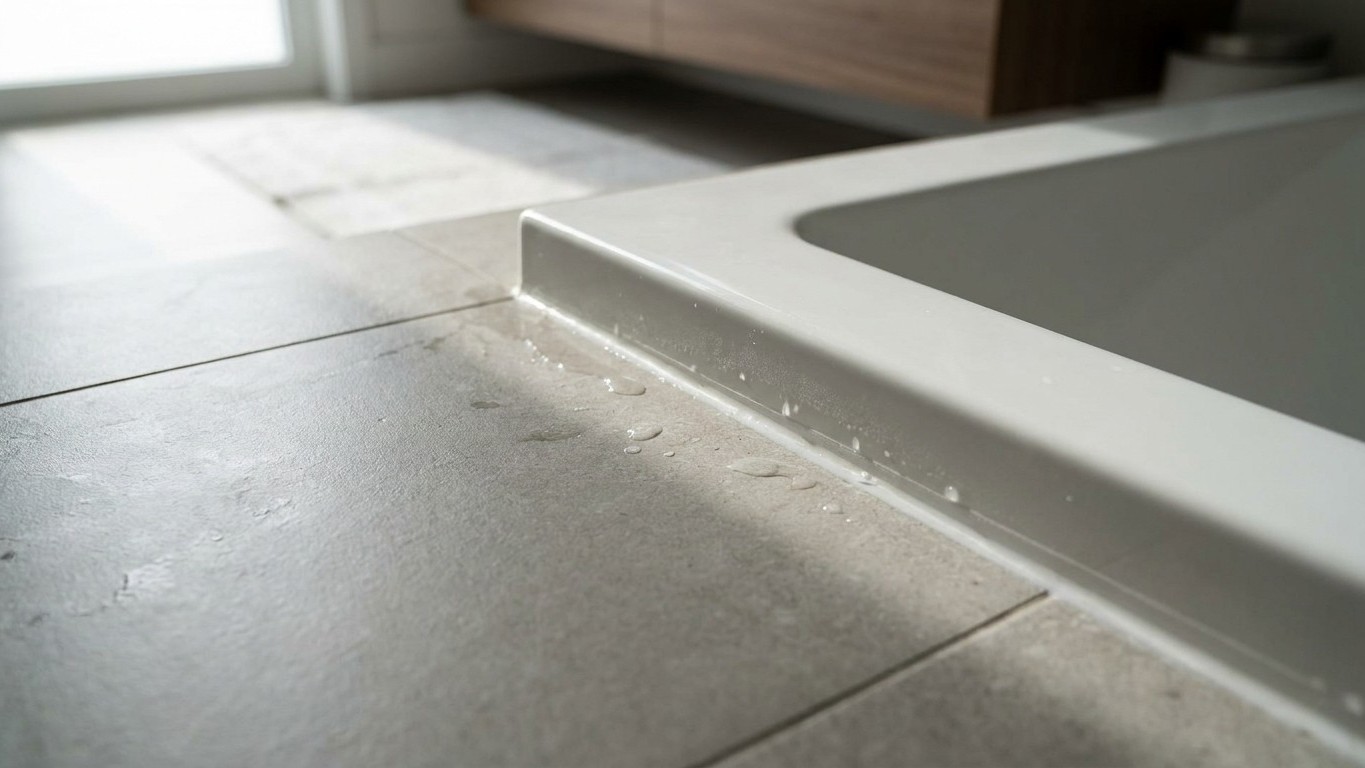

The right floor for a bathroom isn’t really about the material on top. It’s about what’s happening at the edges, where water lingers longest and where most coverings actually fail. Pick a covering that suits your comfort and style, then confirm the perimeter and subfloor can handle years of splashes, steam, and the occasional overflow before you commit.
What is actually happening

A bathroom floor takes on water in two completely different ways, and mixing them up is how people end up blaming the wrong thing. The first is surface water: what lands on the floor from a shower door, a dripping towel, a kid splashing in the tub. This kind of water sits on top, gets wiped or evaporates, and most flooring handles it without complaint. The second is edge water: moisture that creeps into the narrow gap where the floor meets the tub, the toilet base, or the wall, and stays there because nothing dries it out. That gap doesn’t get mopped. It doesn’t get sunlight or airflow. It just sits, day after day, and that’s the condition that actually damages a bathroom floor over time.
This is why two bathrooms with the same flooring material can age so differently. One has a tight, sealed perimeter and looks fine for decades. The other has a hairline gap in the caulk line by the tub, and within a few years the floor near that spot is cupping, staining, or smells faintly musty when you get close. The material wasn’t the problem. The edge was.
Standing water on the surface is, for almost every common bathroom floor, a survivable event. Wipe it up and move on. Constant humidity at a perimeter joint is not survivable in the same way, because it works on the material from underneath and from the side, where finishes and sealers are thinnest or don’t reach at all.
This is also where moisture testing comes in, and it’s worth being clear about what that testing actually does. A moisture meter or a subfloor probe, run by a flooring contractor or inspector, doesn’t diagnose your bathroom for you in one reading. It tells a trained person whether the material under the surface is behaving the way dry wood, dry concrete, or a dry underlayment should behave, compared to a baseline reading taken elsewhere in the house. That comparison is the whole point. A single number means very little without something dry to compare it against, which is why this is a job for someone who tests floors regularly, not a one-time DIY check with a hardware store gadget.
Understanding this mechanism, surface water versus edge water, is what lets you look at any bathroom floor, in any house, and know roughly where to look first.
The covering, or what is under it
Once you accept that the perimeter is where the real risk lives, the next question is where responsibility actually sits: on the visible flooring, or on what’s beneath it. These are not the same repair, and treating them as the same is how a lot of bathroom floor jobs go sideways.
| What you observe | What it usually means | Which layer it belongs to |
|---|---|---|
| Slight color change right along the tub or shower edge, surface still flat and solid | Moisture has reached the finish but hasn’t gotten past it yet | The covering (finish or sealant, not Structural) |
| Soft, spongy feel underfoot near the toilet base or tub | Water has passed through the covering and is affecting what’s underneath | Subfloor |
| Boards or planks lifting slightly at the edges, cupping in the middle | Wood-based flooring reacting to sustained moisture from below | Covering reacting to subfloor moisture, both need attention |
| Grout crumbling or hollow-sounding tile near a wall | Bond between tile and substrate has failed, often after long-term dampness | Covering and substrate together |
| Persistent musty smell with no visible surface damage | Moisture sitting in the subfloor or joists, not reaching the surface yet | Subfloor or framing, not the covering at all |
| Floor sags or bounces underfoot away from any wet area | Structural movement, unrelated to the surface finish | Framing, not flooring |
The pattern in that table matters more than any single row. Surface-level discoloration, the kind that hasn’t gone anywhere yet, is usually a covering-and-sealant conversation: recaulk, reseal, watch it. Softness, cupping, and smell without a visible cause point further down, to the subfloor or the framing, and no amount of new flooring fixes that until the layer underneath is dry and sound.
This is the rule that trips people up most often: sanding, Refinishing, or replacing a cupped board without ever finding where the moisture is coming from just buys a few years before the same board cups again. The covering is never the source of bathroom floor damage. It’s the layer that shows the damage first, because it’s thinnest and closest to the water. What’s under it, the subfloor, the joists, or an unaddressed leak, is where the actual decision needs to be made before any new flooring goes down.
What to check, in order
Before assuming a full floor replacement is needed, work through these checks from least invasive to most. Each one tells you something specific, and each one rules certain causes out.
- Look at the caulk and grout lines around every fixture. Cracked, missing, or peeling sealant at the tub, shower, and toilet base is the single most common entry point for edge water. If the sealant is intact everywhere, that rules out the most obvious source and points you toward something less visible, like a slow supply line or a roof leak reaching the bathroom from above.
- Press gently on the floor near every fixture, not just where it looks damaged. Softness that shows up before any visible staining tells you the subfloor is already affected even though the surface finish still looks fine. A floor that stays firm everywhere, even close to the tub, rules out significant subfloor damage for now, though it doesn’t rule out a slow problem just beginning.
- Check the ceiling or the room directly below, if there is one. A stain on a ceiling below a bathroom rules the problem in as active and worth addressing quickly. No stain below doesn’t rule out a leak, since some leaks travel sideways along framing before dropping, but it does mean you have a little more time to investigate calmly.
- Smell the room with the door closed for a few minutes, then reopen it. A musty smell that builds up in a closed bathroom suggests moisture sitting somewhere it shouldn’t, usually below the surface. No smell doesn’t guarantee a dry subfloor, but combined with a firm floor and intact caulk, it’s a reasonably good sign.
- Ask a flooring professional to run a moisture comparison reading if any of the above checks raised a flag. This is the point where a trained eye and a calibrated tool matter more than guesswork, comparing a suspect area against a known-dry reference point elsewhere in the house.
Every one of those checks can be done without lifting a single board or tile. The moment you need to pull up flooring to see the subfloor directly, you’ve crossed from checking into repair, and that’s a reasonable point to bring in someone who does this for a living rather than guessing at what’s underneath.
When this stops being a flooring job
Three situations move a bathroom floor problem out of flooring territory entirely, and recognizing them early saves time and money.
The first is anything structural: joists that flex, sag, or feel soft when pressed from below in a basement or crawl space, beams showing visible damage, or support posts that look compromised. That’s not a flooring question anymore. A structural engineer or a qualified contractor needs to assess load-bearing framing, because no floor covering, however well chosen, fixes a joist that’s failing underneath it.
The second is active water. If a fixture is actively leaking, a supply line is dripping, or water is visibly making its way into the bathroom right now, fixing or replacing the floor before that’s resolved is pointless. New flooring on top of an active leak just delays the moment you find out, usually with more damage than before. That call belongs to a licensed plumber, not a flooring installer.
The third is smell that’s been there long enough to notice consistently, especially paired with any softness underfoot. That combination usually means moisture has been sitting under the floor for long enough to start affecting the wood or the framing in ways a simple recaulk won’t reverse. At that point, someone needs to open up the area, confirm what’s actually happening structurally and biologically, and address it before any new covering goes down. Covering over a problem like that with fresh tile or vinyl doesn’t solve anything, it just hides it for a while.
A flooring fitter handles the covering and what sits just beneath it. A plumber handles where the water is coming from. A structural engineer handles what holds the house up. Confusing these three callouts is common, and expensive, because each one solves a different part of the same house. If the water’s origin looks like it’s coming from above rather than from a bathroom fixture itself, a roof leak reaching down through an upstairs bathroom is more common than people expect, and that’s a job for a roofing guide and a roofer, not a flooring one. Likewise, if the trail leads back to a supply line or a drain rather than the floor itself, that’s squarely a plumbing question, covered in more detail in the plumbing guides on this site.