
California asparagus growers deal mostly with soft-bodied, sap-sucking and leaf-chewing pests rather than the borers and beetles that specialize in asparagus elsewhere. UC Agriculture and Natural Resources documents nine species that actually feed on this crop in the state, from aphids clustering on new fern growth to snails chewing spear tips at night. Two commonly named garden pests elsewhere don’t belong on this list at all, because asparagus isn’t their host plant.
Which pests attack asparagus in California

UC Agriculture and Natural Resources documents eleven pest species associated with home garden crops in the state, but not all of them touch asparagus. The ones that do: aphids including melon aphid, brown garden snail and slugs (Cornu aspersum), cucumber beetles, earwigs, leaffooted bugs, root-knot nematodes, spider mites, stink bugs, and whiteflies. That’s nine species with a genuine claim on this crop.
Two names on the broader list get left off here on purpose. Corn earworm feeds on corn, tomatoes, and other fruiting vegetables, not on asparagus fern or spears, so a caterpillar tunneling through a spear almost certainly isn’t this insect. Tomato hornworm is a specialist on nightshade-family foliage, tomatoes, peppers, potatoes, and won’t touch an asparagus bed at all. If a reader spots either of these on asparagus, something else is going on, or the identification is off.
Among the nine that remain, the split is between foliage feeders and spear feeders. Aphids, spider mites, and whiteflies work the ferny top growth that develops after harvest ends each year. Brown garden snail, slugs, and earwigs go after the tender spears themselves, usually at night, which is why daytime inspection alone misses them. Cucumber beetles chew ragged holes in foliage and can carry disease between plants. Leaffooted bugs and stink bugs puncture the berries that form on female plants and can scar young stems. Root-knot nematodes work underground, attacking roots directly and showing no visible sign until the whole planting weakens.
This is a short list by design. UC Agriculture and Natural Resources documents these nine for California home gardens; the site won’t stretch that list to make the page feel more thorough. A short, sourced list beats a padded one every time a reader is trying to match a real problem to a real cause.
When each one shows up, and what it does first
California’s coastal and southern growing regions see no freeze in an average year, so pest activity here tracks warmth and moisture rather than a spring thaw date. Inland areas, the Central Valley, and the Sierra foothills do freeze, and that changes the calendar, so a gardener working from a coastal reference misreads their own inland season. Asparagus itself is planted as crowns in 8-inch furrows in early spring and isn’t harvested until year 3, which means the first two seasons of fern growth are the window when foliage feeders build populations largely unbothered by cutting.
Aphids, including melon aphid, tend to show up first on new fern growth once temperatures warm, clustering on stems and leaving a sticky honeydew that draws sooty mold. Spider mites follow in hot, dry stretches, producing fine stippling or bronzing on the ferny foliage rather than holes, because they feed by piercing individual cells rather than chewing tissue.
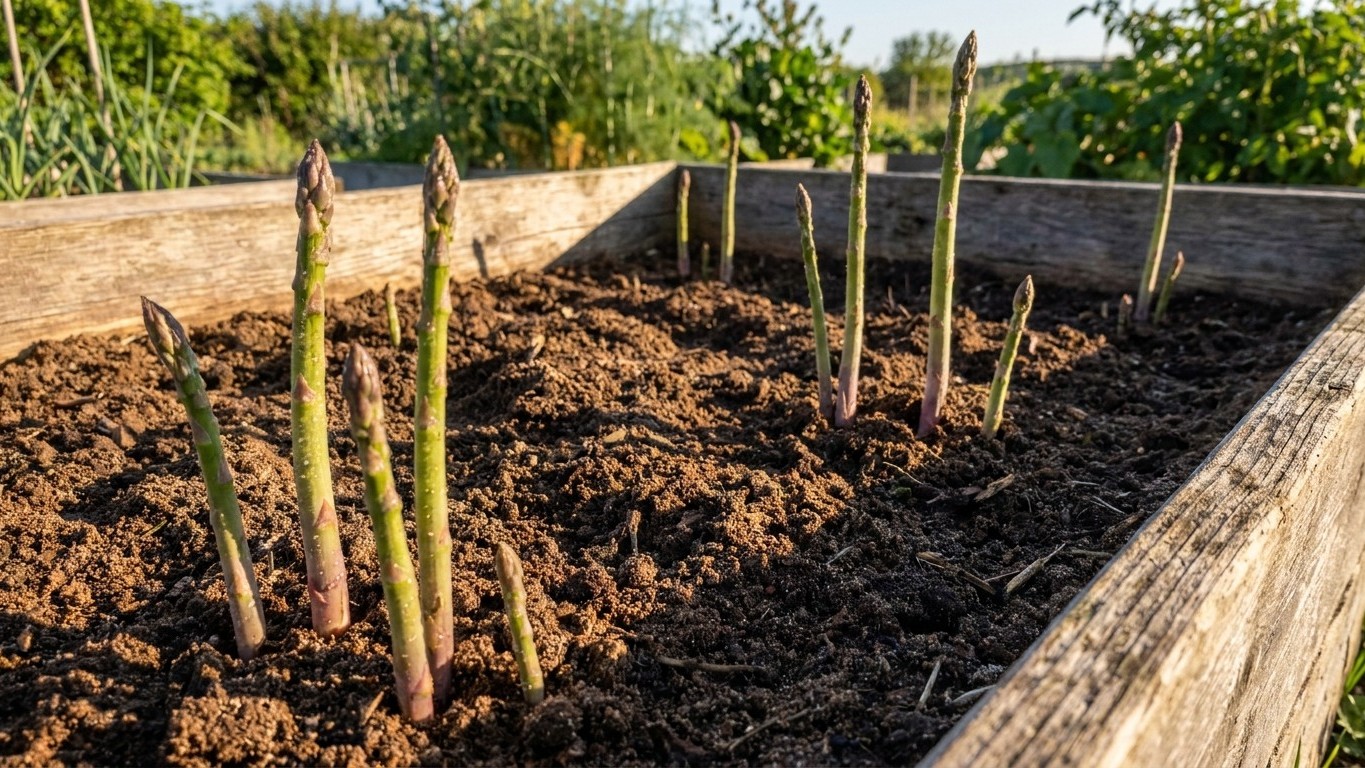
Brown garden snail and slugs are a spring problem on emerging spears, working overnight and leaving ragged tips or missing sections along with a slime trail that’s the giveaway even when the culprit itself isn’t around at daylight. Earwigs do similar damage to tender spear tips and hide in soil cracks or mulch during the day, which is why a nighttime check with a flashlight often confirms them faster than daytime searching.
Cucumber beetles arrive with warm weather and chew irregular holes through fern foliage, sometimes carrying bacterial wilt between plants as they move. Leaffooted bugs and stink bugs show up once female plants set berries, puncturing them and occasionally scarring nearby stems. Whiteflies cluster on the undersides of foliage and scatter in a small cloud when a plant is disturbed, a symptom that’s hard to mistake once seen. Root-knot nematodes give no early aboveground sign at all; the first clue is usually a planting that grows weaker year over year for no visible reason.
Telling the damage apart from everything else
Not every ragged spear or yellowing fern is a pest. California’s growing season runs close to 0.1 inches of rain across June, July, and August, with August itself averaging 0.0 inches, so drought stress is a constant background risk that mimics several pest symptoms. The state soil, the San Joaquin series, holds about 0.8 percent organic matter and is only moderately well drained, meaning a garden bed built on similar ground can show nutrient-deficiency yellowing that has nothing to do with insects.
| Symptom | Possible cause | What distinguishes it |
|---|---|---|
| Ragged, missing spear tips | Snails, slugs, or earwigs | Slime trails or nighttime feeding activity confirm mollusks and earwigs; a clean, angled cut suggests mechanical damage instead |
| Yellowing, stunted ferns | Root-knot nematodes, drought, or low soil fertility | Nematode damage worsens over successive seasons regardless of watering; drought stress improves once irrigation is adjusted |
| Stippled or bronzed foliage | Spider mites or heat stress | Mites leave fine webbing on close inspection; heat stress alone does not |
| Scarred or shriveled berries | Leaffooted bugs or stink bugs | Feeding punctures are visible on the berry surface; sunscald or irregular watering produces uniform shriveling instead |
A soil test settles the fertility question faster than guessing, and it’s the only way to know whether a bed resembles the state’s representative surface horizon or something entirely different, since organic matter and drainage vary enormously from one property to the next. When damage doesn’t match any row in that table cleanly, that’s the point to call in a second opinion rather than keep guessing.
What actually works here, and what is a waste of time
Timing beats almost everything else on this crop, because asparagus is not harvested until year 3, and the plant then produces for 10 to 15 years from the same crowns. That long horizon means a gardener can afford to prioritize cultural fixes over anything faster but riskier to the bed’s future. Handpicking snails and slugs at night, removing garden debris where earwigs shelter during the day, and keeping the planting free of weeds that host aphids and whiteflies all work without touching the plant’s long-term health.
Physical barriers placed early do more good than a treatment applied after damage is already visible. Copper tape or diatomaceous earth around a bed’s perimeter, put down before spears emerge, intercepts snails and slugs before they reach the crop. Row covers during the fern stage keep cucumber beetles and leafhoppers off young growth without needing anything sprayed at all. Because the furrow itself is backfilled gradually, about 2 inches every other month across the first year, that same schedule is a natural point to check for nematode damage on exposed roots before covering them again.
What doesn’t work: reaching for a treatment before confirming which of the nine documented species is actually present, since the wrong approach on the wrong pest wastes a season on a fifteen-year planting. Overwatering to compensate for California’s dry summers is also counterproductive, since it favors the moist conditions slugs and snails prefer while doing nothing for spider mites or nematodes. Any product decision belongs with the county extension office, which knows what’s currently registered for use in the state; this site doesn’t prescribe treatments.
Where to check this for your own county
Every pest named here comes from UC Agriculture and Natural Resources, and that’s the exact office to contact for county-level confirmation, since statewide documentation doesn’t mean a given pest is active in a particular garden. A county with a long dry summer and sandy soil sees a different mix of pressure than one with heavier ground and more humidity, even within the same state.
The four varieties Utah State University Extension names for home gardens, all-male Jersey Giant and Jersey Knight, and the male-female Purple Passion and UC 157 F1, come with no published guidance on which resists which pest better; that comparison simply isn’t in the record, so don’t expect a variety choice to substitute for monitoring.
The most useful next step for a specific property is a call or sample drop-off to the county’s UC Cooperative Extension office or Master Gardener program, which can confirm a pest ID and match it to what’s actually registered for use nearby. State-level lists are a starting point for what to look for, not a diagnosis of what’s in one particular bed.
Common questions
Do asparagus beetles occur in California?
They aren’t among the species UC Agriculture and Natural Resources documents for this crop in the state. The list here covers aphids, snails and slugs, cucumber beetles, earwigs, leaffooted bugs, root-knot nematodes, spider mites, stink bugs, and whiteflies, nine species total, and asparagus beetle isn’t one of them.
Can nematodes really kill an established asparagus bed?
Root-knot nematodes work slowly underground and produce no early aboveground symptom, so a planting can decline over several seasons before the cause is obvious. Given that the bed is meant to produce for 10 to 15 years, catching this early through a soil or root check matters more here than on a crop replanted annually.
Does California’s dry summer make pests worse?
Not directly, but the near-absence of summer rain, close to 0.1 inches across June through August, means irrigation scheduling has more influence on plant stress than it would in a wetter region, and stressed plants often show symptoms that get mistaken for pest damage.
Is treating for pests before year 3 harvest safe for the bed?
Physical controls like row covers, barriers, and handpicking carry no risk to the crowns. Any chemical decision should go through the county extension office first, since the planting is meant to last well over a decade and the wrong product choice early on isn’t something to guess at.