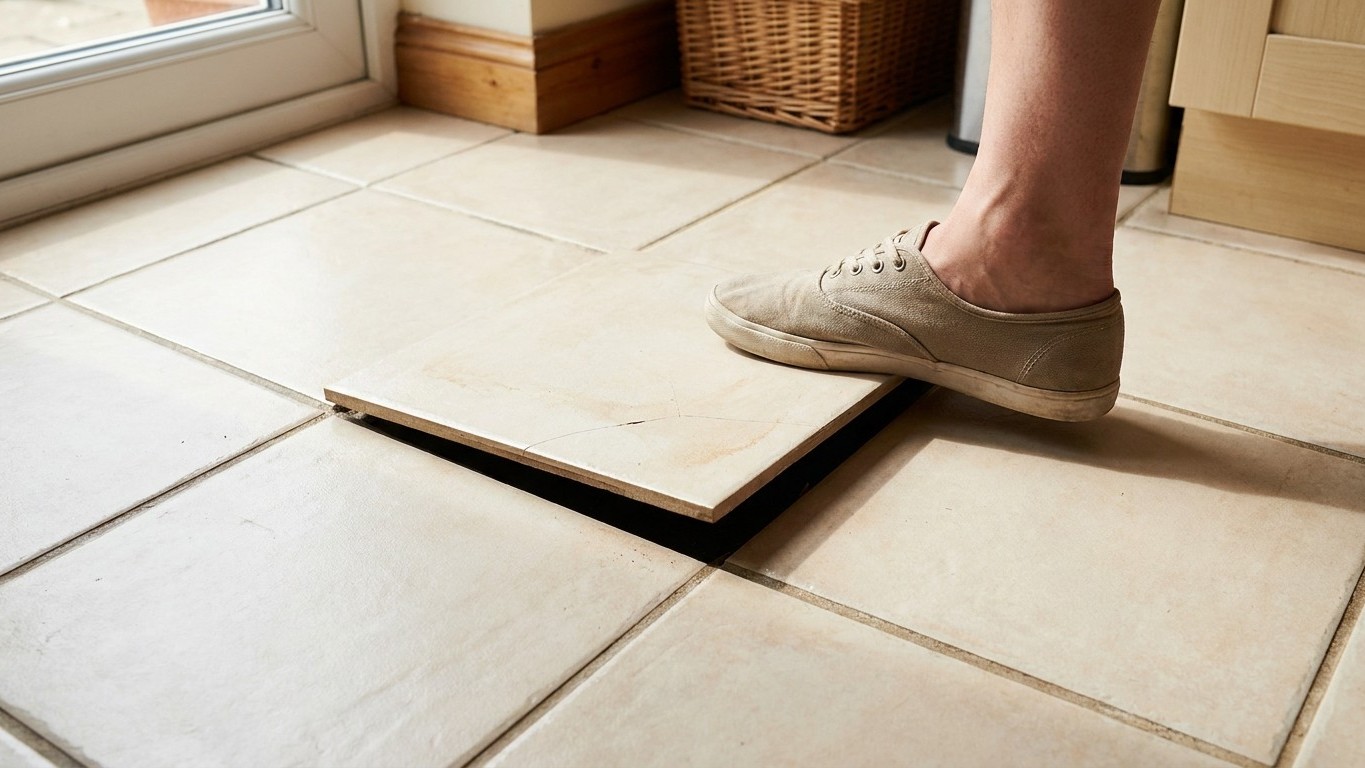

A hollow sound under your foot means the tile has come loose from whatever is supposed to be holding it down. It’s air where adhesive should be. That doesn’t always mean the tile needs replacing, and it doesn’t always mean the whole floor is failing. Sometimes it’s one tile. Sometimes it’s the entire bed talking. The sound alone won’t tell you which. What comes next will.
What is actually happening

Tile doesn’t stick to a subfloor the way glue sticks to paper. It sits on a bed of adhesive, and that bed is supposed to make full contact across the back of every tile. When it doesn’t, when a trowel skipped a spot or the adhesive shrank as it cured, a void forms underneath. That void is what you hear. A solidly bonded tile transmits the tap into the floor below and the sound dies fast, almost dull. A tile riding on a pocket of air rings back at you, sharper, more hollow, because the impact has nowhere to go but bounce.
Voids don’t stay still. Foot traffic flexes the tile over the gap, a little more each time, and the edges of that tile start working against their neighbors. That’s why a hollow spot today is often a cracked tile in six months, and why the crack usually runs along an edge rather than through the middle. The tile isn’t failing on its own. It’s failing because the support underneath it already failed first, and the tile is just the part you can see.
Size matters here more than most people assume. A single hollow tile in the middle of an otherwise solid floor is usually a local adhesive gap, the kind that happens during installation and stays contained. A hollow area that spans several tiles in a row, especially one that follows a straight line, points somewhere else: a seam in the subfloor, a control joint that wasn’t respected, or movement happening beneath the tile bed itself rather than within it.
This is also where moisture testing enters the picture, and it’s worth being clear about what that test actually does. A moisture test doesn’t diagnose a loose tile. It answers a narrower question: is the subfloor holding more moisture than the adhesive and tile system was designed to tolerate. A flooring contractor or a home inspector runs this with a moisture meter pressed to the surface, or in more thorough cases a calcium chloride test taped down for a set period. Neither test explains why a tile sounds hollow by itself, but both rule moisture in or out as the reason the bond failed in the first place. That distinction, adhesive failure versus moisture-driven failure, changes Everything about what happens next.
The covering, or what is under it
Every hollow-sounding tile belongs to one of two stories. Either the tile itself came unstuck from an otherwise sound base, which is a covering problem you can often fix in an afternoon, or the base underneath is moving, wet, or delaminating, which means the tile is only the messenger. Mixing these two up is the single most common reason a repair doesn’t hold. Resetting a tile onto a substrate that’s still failing just buys a few months before the same spot rings hollow again.
| What you observe | What it usually means | Which layer it belongs to |
|---|---|---|
| One isolated tile sounds hollow, edges flush with neighbors | Localized adhesive gap from installation | Covering (tile and adhesive only) |
| Several tiles in a row sound hollow along a straight line | Subfloor seam, expansion joint, or panel edge underneath | Substrate, transmitted through the covering |
| Hollow tile with a slightly raised or “lippy” edge next to its neighbor | Movement in the bed, not just an air gap | Substrate, showing through the tile |
| Grout cracking in a pattern that repeats across the room | Flex in the subfloor itself, not a tiling defect | Substrate |
| Widespread hollow sound concentrated near a wall, door, or plumbing fixture | Possible moisture history affecting the base beneath the tile | Substrate, and possibly what’s under that |
The covering is the tile, the grout, and the thin layer of adhesive holding them down. That’s the part a homeowner can reasonably lift, clean, and reset without special training. What’s under it, the subfloor itself, whatever framing supports that subfloor, and any moisture sitting in either, is a different problem entirely, and it’s the one that actually decides whether the repair sticks.
A single tile you can pop up, scrape clean, and re-bed is a covering fix. A run of tiles that all sound the same way, or grout lines that keep cracking in the same spots no matter how many times they’re patched, means the covering is just reporting on trouble underneath it. Sanding, resetting, or re-grouting the surface without addressing that trouble is treating the symptom while the cause keeps working.
What to check, in order
None of the following requires lifting a single tile. Each check either rules something out or narrows down what’s likely happening beneath the surface.
- Tap the whole floor, not just the spot that bothers you. Use a coin or the handle end of a screwdriver and work in a grid pattern across the room, listening for where the sound changes. A single hollow tile surrounded by solid ones rules out a widespread substrate issue. A hollow area that keeps spreading as you tap further out suggests the opposite.
- Look at the grout lines up close. Hairline cracks that follow a straight path across multiple tiles usually trace a seam or joint in the subfloor below. Random, isolated cracks near one tile point to a local adhesive failure instead. This step rules out (or confirms) that the tile problem has a Structural echo underneath it.
- Run your hand across tile edges where the floor sounds hollow. A smooth, flush surface with a hollow sound underneath usually means an air gap only. A slight height difference between adjacent tiles, even one you can barely feel, means the bed has shifted, not just separated. That rules out a simple air pocket and points toward movement in the substrate.
- Check the location against what’s on the other side of the wall or floor. Hollow tiles clustered near an exterior wall, a bathroom, a kitchen sink line, or a laundry hookup deserve more attention than the same sound in the middle of a hallway, because those locations are where plumbing and weather most often reach a subfloor first.
- If accessible, look at the underside from a basement or crawlspace. Staining, sagging, or a change in the wood’s color directly below a hollow area confirms the substrate is involved, not just the tile. This is the point where the next step, actually testing that area for moisture or opening it up, requires lifting tile or drilling a small access point, and that’s a reasonable place to stop and call in a flooring contractor rather than keep going solo.
Each of these checks costs nothing but time, and together they tell you.
When this stops being a flooring job
Three things move this out of flooring territory entirely, and none of them get fixed by resetting a tile.
The first is anything structural. If the hollow sound lines up with a sagging joist, a cracked beam, or a support post that’s shifted, no amount of adhesive addresses that. A structural engineer, not a flooring contractor, is the right call here, because the tile is only reflecting a problem in the framing underneath the whole house, not just the floor.
The second is active water. A hollow tile near a supply line, a drain, or an exterior wall that’s still wet, or that gets wet again after drying, isn’t a flooring problem waiting for a fix. It’s a plumbing or building envelope problem that happens to show up as a loose tile. Resetting that tile without stopping the water guarantees the same hollow sound returns, usually worse, within a season. A plumber traces and repairs the source; a flooring contractor only deals with what’s on top of it.
The third is anything that’s been wet long enough to smell. Musty, sour, or mildew odors coming from a hollow area mean the substrate has been damp for a while, long enough for organic material to start breaking down. At that point the concern isn’t the tile at all. It’s what that moisture has done to the wood, the adhesive, and potentially the air quality in the room. That calls for someone qualified to assess water damage and possible mold, not a tile reset.
Figuring out where that water is actually coming from is its own separate question, and this site’s guides on plumbing leaks and roof and exterior water intrusion go into that in more depth. A flooring fitter can tell you a tile is loose. Only tracing the water back to its source tells you why it stayed that way.