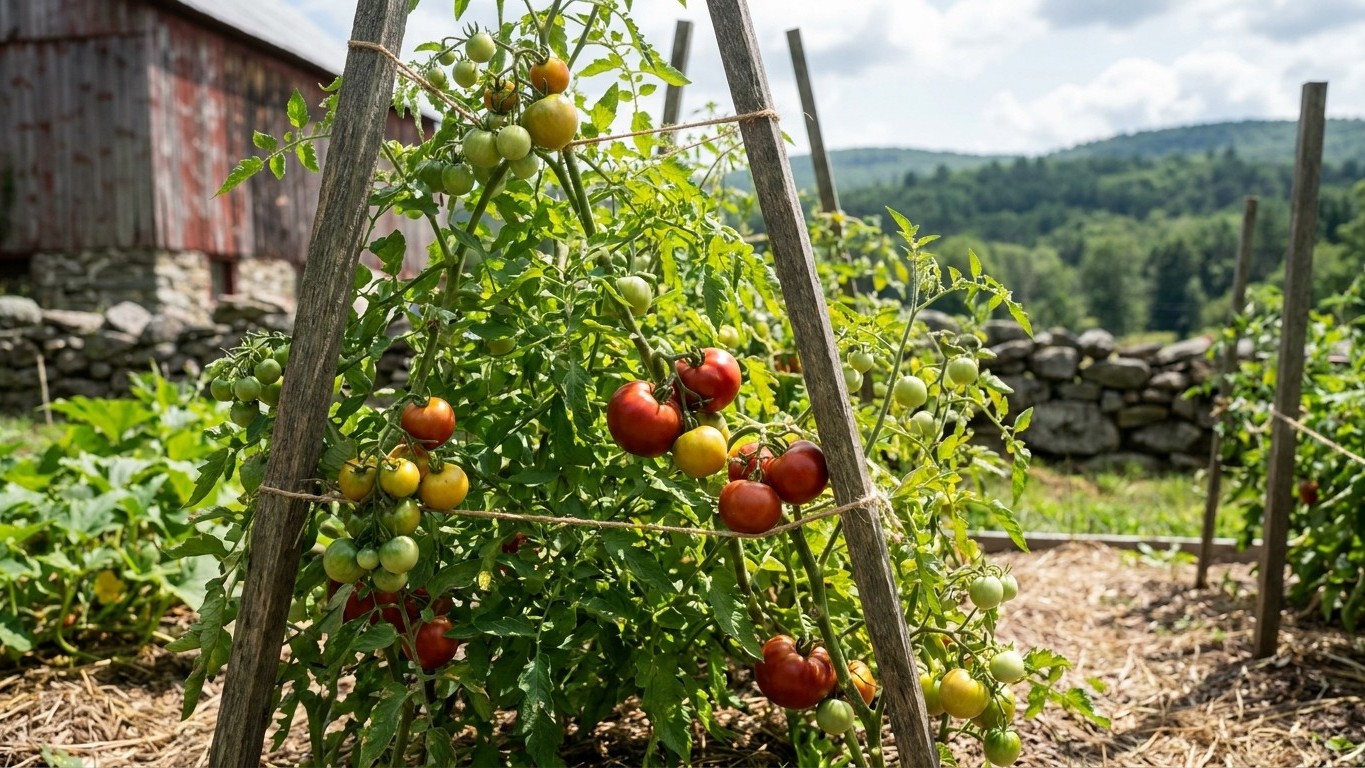

Pick when the fruit shows full color and gives slightly to a gentle squeeze, not by the calendar. In frost-free coastal and Southern California, that’s the only rule that matters, since heat and irrigation cutoffs end the season, not cold. In the Central Valley, the Sierra foothills and Northern California, an approaching freeze forces an earlier harvest, green fruit included, before the first hard frost of fall.
When to Pick Tomatoes in California
A tomato tells you it’s ready long before it looks perfect on a store shelf. The signal to watch is called color break: the blossom end shifts from solid green to a lighter, almost translucent shade, and a faint blush of pink or yellow starts spreading upward. Once that break shows on at least half the fruit, it’s ripening on its own internal clock, using stored sugars and the plant hormone ethylene, whether or not it stays attached to the vine. Firmness matters too. A ripe tomato yields slightly under thumb pressure without feeling mushy. Wait for deep color everywhere and you’re often waiting for cracking, sunscald, or a bird beating you to it.
What changes across California is why you’re picking on a given week, not the ripeness test itself. Coastal Los Angeles and most of Southern California run frost-free in an average year, according to NOAA climate records for the Los Angeles station, which show zero days at or below 32°F over three decades and list the frost-free season as running the full 365 days. That means growers there aren’t racing a freeze at all. The limiting factor is heat stress in mid-summer, when blossoms drop above roughly 95°F, and later in the season, whenever a household’s water allocation gets tight enough that vines are pulled early to save the remaining crop’s flavor rather than push for maximum size.
The Central Valley, the Sierra foothills, and Northern California operate under a completely different constraint. Those regions do freeze, sometimes hard, and a fall frost date there ends the picking season on a specific week rather than a soft, weather-dependent slide. Nothing in this article should be read as applying those Central Valley or Sierra frost dates to the coastal and Southern California zones described above, and the reverse is just as true.
Hardiness zone context, not a planting calendar
USDA’s Plant Hardiness Zone Map, built from the average annual extreme minimum winter temperature, places California across an unusually wide band, from 5a up near the high Sierra to 11a along the far southern coast. That’s the system to name when someone hands you a “zone 9” recommendation and asks if it applies statewide: it almost never does. Los Angeles anchors the warm end of that range; a Sierra foothill town anchors the cold end. Treat any single zone number as a description of one reference city, not the state.
| Region | Frost risk | What actually limits picking |
|---|---|---|
| Coastal & Southern CA | None in an average year (Los Angeles station data) | Heat stress, water restrictions |
| Central Valley | Yes, fall freeze occurs | Timing before first hard frost |
| Sierra foothills & Northern CA | Yes, earlier and harder freeze | Shorter frost-free window overall |
What to do with the green ones
Not every tomato on the vine gets to finish the job outdoors, and that’s fine. Fully mature green fruit, meaning it’s reached full size with a whitish-green, waxy skin rather than a dull, hard, immature green, will ripen off the plant almost as well as it would have on it. The trick is telling the two apart before you strip the vine.
Slice one open. Mature green fruit shows developed seeds surrounded by a gel-like coating; the interior wall has started to fill in with pale color rather than staying solid white. Immature fruit, by contrast, has flat, underdeveloped seeds and a hard cross-section with almost no gel. That second kind won’t ripen well no matter how it’s handled. It’ll eventually soften and lighten in color, but the flavor stays thin and the texture goes rubbery rather than tender, because the fruit never accumulated enough sugar before it was cut off from the plant.
Why growers pull green fruit here
In the Central Valley, the Sierra, and Northern California, the trigger is straightforward: a freeze is forecast, and every tomato left on the vine when that hits is lost outright, not just delayed. Stripping the plant of mature green fruit the day before a hard frost salvages a real harvest instead of a compost pile.
Along the frost-free coast and in Southern California, the calculation is different. Growers there sometimes pull green tomatoes early not because of cold but because a plant is collapsing from heat exhaustion, spider mite pressure, or the household is cutting back irrigation late in a dry season and the remaining fruit won’t get enough water to finish properly on the vine. The green-tomato rescue is the same technique either way; only the reason for doing it changes region to region.
One practical note that applies statewide: pick with a short stem attached if you can, and handle mature green fruit gently. Bruised green tomatoes rot in storage far faster than they ripen, since a broken skin lets in the same fungi and bacteria that would normally be kept out by an intact waxy coating.
Ripening indoors, and how long they keep
Once mature green or partially colored tomatoes come inside, room temperature does the ripening, not the refrigerator. Somewhere between 65°F and 75°F is the range most kitchens naturally sit in, and it’s close to ideal. Colder than that slows ripening to a crawl; much hotter and the fruit softens faster than it develops flavor, which is its own kind of disappointing.
Spread the fruit out in a single layer, stem side down, on a tray, a cardboard box lid, or newspaper spread on a counter. Crowding or stacking tomatoes traps moisture against the skin and speeds up rot in whichever fruit is on the bottom. Check the layer every couple of days and pull out anything that’s gone soft, wrinkled, or shows a spot of mold; one bad tomato in a batch can spread rot to its neighbors fast.
Speeding it up, or slowing it down
Ethylene gas is the ripening signal tomatoes produce on their own, and it builds up in an enclosed space. Sealing a few green tomatoes in a paper bag, especially with an already-ripe banana or apple tossed in, concentrates that gas and can shave real time off the process. A loosely closed bag still lets in enough air to prevent mold; a fully airtight container doesn’t, and often causes rot before ripening finishes.
Going the other direction, holding tomatoes back rather than rushing them, works by removing them from the ripening trigger. Mature green fruit wrapped individually in newspaper and kept in a cool, dark spot, ideally in the mid-50s to low 60s°F, will hold for an extended stretch and can be brought out a few at a time to finish ripening on the counter as needed. This is the closest thing to a home method for spreading a single harvest out over weeks instead of ripening everything at once and drowning in tomatoes for a few days followed by nothing.
Fully ripe tomatoes, by contrast, don’t keep long under any method. Left on the counter, expect a handful of days before texture starts breaking down. The refrigerator extends that slightly but comes at a real cost to flavor and texture, which the next section gets into.
What goes wrong here
The most common mistake is refrigerating a ripe or ripening tomato. Temperatures below about 55°F damage the membranes inside the fruit that hold flavor compounds and give a ripe tomato its texture. The tomato doesn’t rot faster in the fridge, but it comes out mealy, watery, and noticeably blander, which defeats the point of growing it at home in the first place. If a tomato needs to be held longer than a few days, a cool room, not the refrigerator, is the better call.
The second frequent problem is picking too early out of impatience, mistaking the color-break stage for the immature stage and pulling fruit that never developed enough sugar to ripen well. That fruit ripens in color but stays flat in flavor. Slicing a test fruit open before committing to a full harvest, checking for that gel-filled interior described above, avoids the guesswork.
Bruising during picking is underrated as a cause of loss. A tomato dropped into a bucket, or piled several layers deep in a basket, develops soft spots that turn into rot points within a day or two, well before the rest of the fruit shows any problem. Handle mature green and ripening fruit the way you’d handle eggs, not potatoes.
Finally, growers in frost-prone parts of the state sometimes wait for a frost warning that never quite arrives with enough lead time, then lose a full vine’s worth of fruit overnight. Because the Central Valley, Sierra, and Northern California freeze dates aren’t published in this guide as a single number, and shift year to year, the safer approach is watching a short-range forecast in early fall and stripping mature green fruit the moment a freeze is called, rather than betting on one more week of ripening on the vine.
Common questions
Does California have a set date to stop picking tomatoes before frost?
Not a single one. Coastal and Southern California run frost-free in an average year based on Los Angeles station records, so there’s no frost deadline there at all. The Central Valley, Sierra foothills, and Northern California do freeze, but the timing varies enough by year and by specific location that a single statewide date would be misleading rather than useful.
Can a tomato picked fully green ever ripen properly?
Only if it’s mature green, meaning full-sized with a light, waxy skin and developed seeds inside a gel coating. Immature green fruit, still hard and flat-seeded inside, will change color off the vine but won’t develop real tomato flavor.
Should I bring tomatoes inside before a heat wave, the way I would before a frost?
In frost-free parts of the state, extreme heat is a more realistic threat to a crop than cold. Fruit already past color break can be picked ahead of a heat spike and finished indoors, since prolonged temperatures above roughly 95°F cause sunscald and uneven ripening on the vine.
Where can I get planting and pest guidance specific to my part of California?
Growing conditions vary enormously between the coast, the Central Valley, and the Sierra, and a local county resource will reflect that better than a statewide rule of thumb. The University of California’s cooperative extension network, at ucanr.edu, publishes region-specific guidance through its local county offices.